The short answer
Charging on surplus solar saves money only if your export rate is meaningfully below your import rate. If your utility credits exports at or near the retail rate, exporting the surplus and importing overnight is nearly equivalent and a solar-tracking charger buys you little. If exports are credited well below retail — which is increasingly common — then self-consuming that surplus is where the saving is, and a charger that adjusts in 1 A increments is what captures it.
The arithmetic
value = import rate - export rate
If you import at $0.24 and export at $0.06, each self-consumed kWh is worth $0.18
That is the entire economics of solar EV charging. At a 2-cent spread it is not worth engineering around. At an 18-cent spread, on 300 kWh of monthly charging, it is roughly $54 a month — and that is what justifies a charger chosen for its solar capability.
| Your situation | Value of self-consumption | Worth a solar-tracking charger? |
|---|---|---|
| Full retail net metering | Near zero | No |
| Export credited at wholesale, import at retail | Large | Yes |
| Time-of-use with cheap overnight import | Moderate — depends on the spread | Run the numbers |
| No export compensation at all | The full import rate | Yes, strongly |
| You are never home during the day | Low unless the car is | Probably not |
The practical constraint: the car has to be there
Solar produces in the middle of the day. If your car leaves at 8am and returns at 6pm, it is not home for any of it, and no charger can change that.
Which means solar EV charging genuinely suits:
- Someone who works from home, or works shifts.
- A two-car household where one car stays home.
- Weekend charging, where a Saturday afternoon of surplus does real work.
- A household with home battery storage, which time-shifts the surplus so the car can use it at night. That is a larger project than a charger.
Why 1-amp granularity matters here specifically
Solar output is not stable. A cloud crossing an array changes production in seconds, and a charger that can only step in large increments either over-draws from the grid or leaves surplus unused.
| Array surplus | 1 A steps can draw | 8 A steps can draw |
|---|---|---|
| 3.8 kW | 16 A — about 3.8 kW | 16 A — about 3.8 kW |
| 4.3 kW | 18 A — about 4.3 kW | 16 A — 0.5 kW exported |
| 5.0 kW | 21 A — about 5.0 kW | 16 A — 1.2 kW exported |
| 5.8 kW | 24 A — about 5.8 kW | 24 A — about 5.8 kW |
A house with rooftop solar
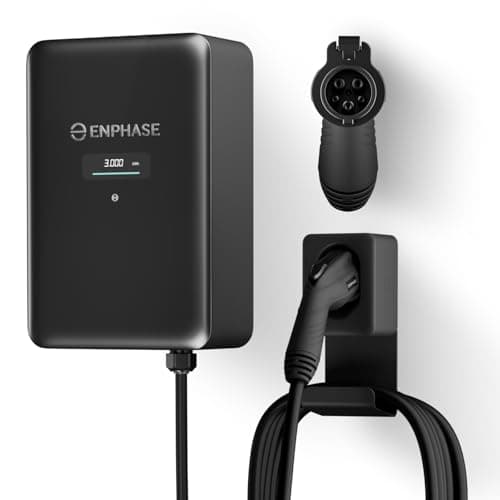
Enphase IQ EV Charger 2 (48 A)
Adjusts in 1 A increments to track array output, with a five-year warranty — the longest of any charger we recommend. The integration is strongest inside the Enphase ecosystem and thinner outside it, which is worth knowing before building around it. [Full review](/chargers/enphase-iq-ev-charger-review).
#ad Price as of October 5, 2026. How we make money
What to check before buying a solar charger
- Your export and import rates. The whole business case. If the spread is small, stop here.
- Whether the car is home during production hours. If not, no charger helps.
- Your array's typical surplus. A 4 kW array in a house using 1 kW has 3 kW to give; that is a 12 A charge, not a 48 A one.
- Whether your inverter ecosystem matters. An Enphase charger with an Enphase array is a tighter integration than a mixed set-up.
- Whether a home battery is a better investment. A battery time-shifts surplus to the evening for the whole house, not just the car. It is a much larger project with a much broader benefit.
What solar charging does not do
- It does not make charging free. The array cost money and the surplus had an alternative use — exporting it. Self-consumption captures the spread, not the full value.
- It does not charge faster. A 4 kW surplus is a 4 kW charge, which is slower than a 48 A grid charge.
- It does not work at night. Obvious, and worth stating because the marketing imagery often implies otherwise.
- It does not avoid the circuit. A solar-tracking charger still needs a properly sized 240 V circuit for the times it runs at full output. What amp do I need.
A cheaper way to get most of the benefit
If the spread justifies self-consumption but you do not want to buy a charger for it, manual scheduling captures a lot of the value. Set the charger or the car to charge during the middle of the day when the car is home — a fixed window rather than active tracking. You will over-draw sometimes and under-use sometimes, and you will still self-consume most of the surplus.
A monitor tells you whether it is working, which is more useful than guessing:
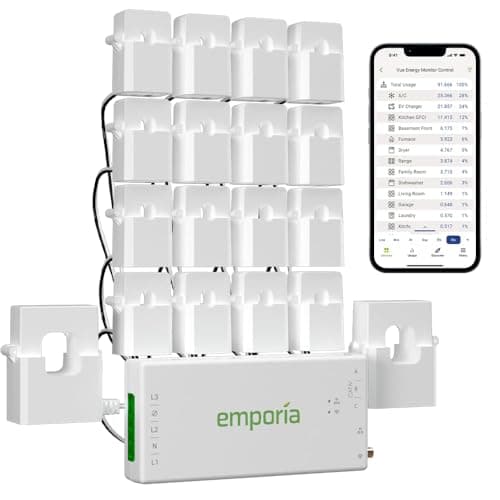
Knowing what your panel is actually doing
Emporia Vue 3 Home Energy Monitor
Shows production, consumption and the charging circuit separately, so you can see how much surplus is actually being self-consumed rather than exported. Worth having before you decide whether a solar-tracking charger is justified.
#ad Price as of October 5, 2026. How we make money