The short answer
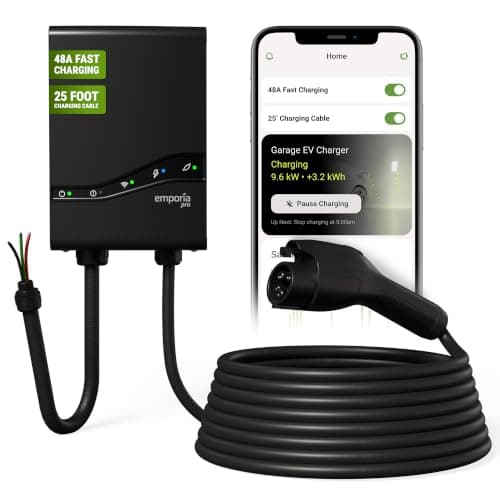
A 48 A charger needs 6 AWG copper on a 60 A breaker. A 40 A charger needs 8 AWG copper on a 50 A breaker in conduit, but 6/2 NM-B if you are running Romex, because NEC 334.80 limits NM cable to the 60 degC ampacity column. A 32 A charger needs 8 AWG copper on a 40 A breaker.
| Charger | Breaker | Copper in conduit (75 degC) | Aluminum (75 degC) | NM-B cable (60 degC) |
|---|---|---|---|---|
| 16 A | 20 A | 12 AWG (25 A) | 10 AWG | 12/2 (20 A) |
| 24 A | 30 A | 10 AWG (35 A) | 8 AWG | 10/2 (30 A) |
| 32 A | 40 A | 8 AWG (50 A) | 6 AWG | 8/2 (40 A) |
| 40 A | 50 A | 8 AWG (50 A) | 6 AWG | 6/2 (55 A) |
| 48 A | 60 A | 6 AWG (65 A) | 4 AWG | 6/2 (55 A) — see note |
| 80 A | 100 A | 3 AWG (100 A) | 1 AWG | Not practical |
Where these numbers come from
NEC Table 310.16 gives the allowable ampacity of insulated conductors, in three columns by the temperature rating of the insulation. The relevant copper values:
| Size | 60 degC | 75 degC | 90 degC |
|---|---|---|---|
| 12 AWG | 20 A | 25 A | 25 A |
| 10 AWG | 30 A | 35 A | 40 A |
| 8 AWG | 40 A | 50 A | 55 A |
| 6 AWG | 55 A | 65 A | 75 A |
| 4 AWG | 70 A | 85 A | 95 A |
| 3 AWG | 85 A | 100 A | 110 A |
| 2 AWG | 95 A | 115 A | 130 A |
| 1 AWG | 110 A | 130 A | 150 A |
Why your conductor is usually governed by the 75 degC column
THHN wire is 90 degC-rated insulation, and the 90 degC column is more generous. But the circuit is only as good as its weakest termination: the breaker lug, the charger's terminal block, the receptacle. Most modern residential equipment is rated 75 degC, so the 75 degC column governs. If anything in the path is rated 60 degC, the whole circuit drops to that column.
This is why "my wire is 90 degree rated so it carries 75 amps" is usually wrong in practice even though it is right about the wire. The wire is not the limit; the terminations are.
The NM-B catch, properly explained
The practical consequence: a 40 A charger on a 50 A breaker takes 8 AWG THHN in conduit but 6/2 NM-B in a wall. People read the first answer, buy 8/2 Romex, and fail inspection.
NM-B also cannot be used in wet locations or outdoors at all. An outdoor run is THWN-2 in conduit. If any part of your run leaves the dry interior of the building, that is the method.
Copper or aluminum
Aluminum is cheaper per foot and lighter, and modern AA-8000 series aluminum building wire with the correct terminations and anti-oxidant compound is a perfectly legitimate choice — utilities use it for service conductors universally. The trade is that you go up roughly two sizes for the same ampacity, and the terminations are less forgiving of a sloppy installer.
For a short branch circuit to a charger, copper is usually the right call: the material cost difference on 40 feet of wire is small, and you remove a whole class of termination risk. For a long run to a detached garage, aluminum starts to make real financial sense and an experienced electrician will say so.
The thing the table cannot tell you: voltage drop
Ampacity is a heat question. Voltage drop is a separate one, and on long runs it is the binding constraint. The usual design target is to keep branch-circuit voltage drop under 3%.
A 48 A load at 240 V over 100 ft of 6 AWG copper loses roughly 2.4 V (about 1%). Over 200 ft it loses roughly 4.8 V (about 2%).
Ampacity is satisfied at both distances; the design margin is not the same
Illustrative one-way-distance arithmetic using the standard voltage-drop formula. Your electrician calculates it for your actual route, conductor and load. Long runs are the case where going up a size beyond the ampacity minimum is a genuine engineering decision rather than over-specification.
What to buy
Conductors for the common circuit sizes
Buy the gauge your electrician specifies for your run, not the one a chart implies. These are the correct products for the three common cases.
A 60 A circuit for a 48 A charger
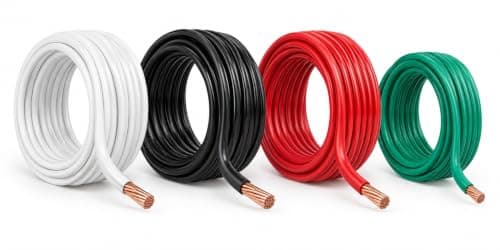
6 AWG THHN Copper Wire Set with 8 AWG Ground (50 ft)
6 AWG copper carries 65 A at 75 degC, which is what a 60 A breaker and a 48 A charger require. Buying the conductors as a matched set with the correctly sized equipment ground saves a trip.
#ad Price as of October 5, 2026. How we make money
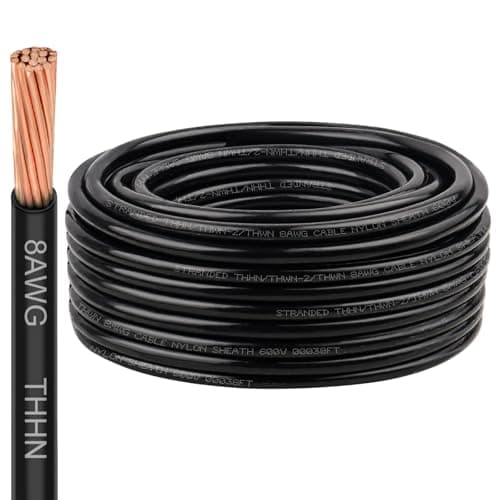
A 40 A circuit for a 32 A charger
8 AWG THHN Stranded Copper Wire (100 ft)
8 AWG copper is good for 50 A at 75 degC, which covers a 40 A breaker and a 32 A charger. This is the gauge that makes a 32 A install dramatically cheaper and easier than a 48 A one.
#ad Price as of October 5, 2026. How we make money
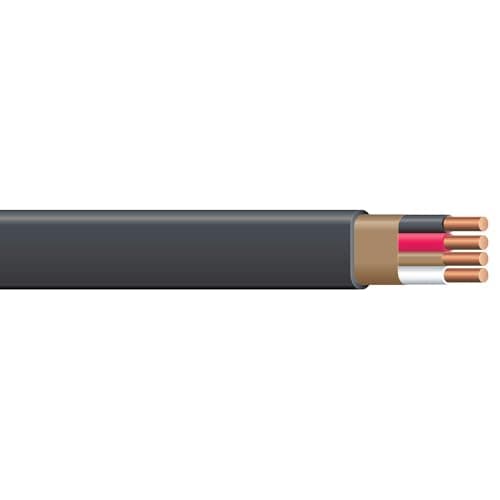
An indoor 48 A run inside a finished wall
Woods 6/3 NM-B Cable with Ground (50 ft)
6/3 NM-B carries 55 A under NEC 334.80, which limits the cable assembly to the 60 degC column regardless of the THHN conductors inside it. That is enough for a 48 A charger on a 60 A breaker; it is NOT enough to assume from the conductor gauge alone.
#ad Price as of October 5, 2026. How we make money
We earn commission on qualifying purchases at no cost to you. Affiliate disclosure.