The short answer
Use copper for an EV charger circuit. Aluminum is code-accepted and genuinely cheaper per amp — but, as the NEC 310.16 ampacity reference we size from puts it, aluminum's advantage lands on large feeders of 2 AWG and up, while "copper wins on smaller branch circuits and tight conduit fills". A 48 A charger circuit is exactly that: a small branch circuit. Aluminum also has to be sized larger for the same ampacity and demands listed lugs, antioxidant compound and torqued terminations — so the saving on a 40 ft run is small and the ways to get it wrong are not.
The two real differences
1. Aluminum carries less current per gauge
NEC Table 310.16 lists copper and aluminum in separate columns, and the aluminum numbers are lower for the same gauge. The reference's own worked example makes the pattern plain: a 100 A circuit is 3 AWG copper or 1 AWG aluminum at 75 degC — roughly two gauge sizes up to carry the same current.
So an aluminum charger circuit is physically bigger wire in a bigger conduit. That eats part of the material saving and all of the ease of pulling it, which is why the economics only turn in aluminum's favor on large feeders where the copper price is severe.
| Charger output | Breaker | Copper conductor (75 degC) |
|---|---|---|
| 48 A | 60 A 2-pole | 6 AWG |
| 40 A | 50 A 2-pole | 8 AWG |
| 32 A | 40 A 2-pole | 8 AWG |
| 24 A | 30 A 2-pole | 10 AWG |
2. Aluminum terminations are a procedure, not a connection
This is the part that causes problems. Aluminum requires terminals listed for aluminum (CO/ALR or AL9CU marked), antioxidant compound on the conductor, and torque to the manufacturer's specification — the ampacity reference says exactly this about aluminum feeders. Copper tolerates a slightly sloppy install; aluminum does not, and an EV charger is the appliance most likely to find out, because it draws its full current for hours at a time.
When aluminum does make sense
- Feeding a subpanel. If the charger circuit comes off a new subpanel, the feeder to that subpanel is exactly the kind of large run where aluminum (or aluminum SER cable) is normal and economic. See does an EV charger need its own circuit.
- A long run to a detached structure. Distance is where conductor cost scales, and a detached garage feeder is a feeder, not a branch circuit.
- A service upgrade. Service-entrance conductors are routinely aluminum — see electrical panel upgrade cost.
In all three cases the aluminum is the big wire upstream, and the last stretch to the charger is still usually copper. That is the normal division, and it is the right one.
What about the old aluminum branch wiring in my house?
Small-gauge aluminum branch wiring from the 1960s and 70s is a known problem at its terminations and is a separate subject from modern alloy conductors. Do not extend it, do not land a charger on it, and do not let anyone splice a charger circuit into it. A charger needs a new dedicated circuit regardless — our load calculation and breaker size chart start from that assumption.
The copper to buy
Conductor for the common charger circuits
Match the conductor to the breaker, not to the charger's label, and check the run length and ambient temperature with your electrician before buying. These are the three sizes that cover almost every home install.
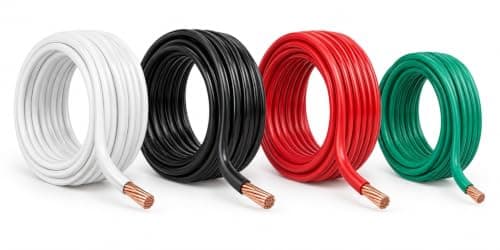
A 60 A circuit for a 48 A charger
6 AWG THHN Copper Wire Set with 8 AWG Ground (50 ft)
6 AWG copper carries 65 A at 75 degC, which is what a 60 A breaker and a 48 A charger require. Buying the conductors as a matched set with the correctly sized equipment ground saves a trip.
#ad Price as of October 28, 2026. How we make money
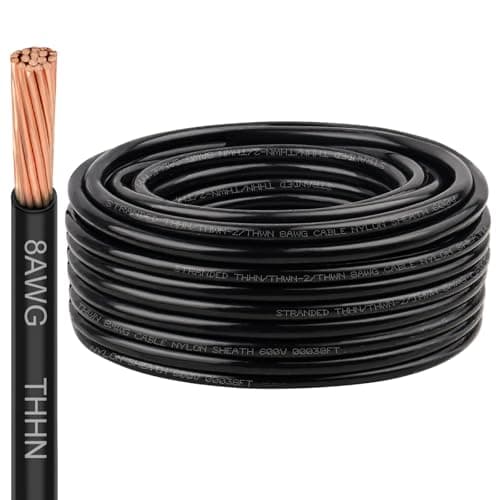
A 40 A circuit for a 32 A charger
8 AWG THHN Stranded Copper Wire (100 ft)
8 AWG copper is good for 50 A at 75 degC, which covers a 40 A breaker and a 32 A charger. This is the gauge that makes a 32 A install dramatically cheaper and easier than a 48 A one.
#ad Price as of October 28, 2026. How we make money
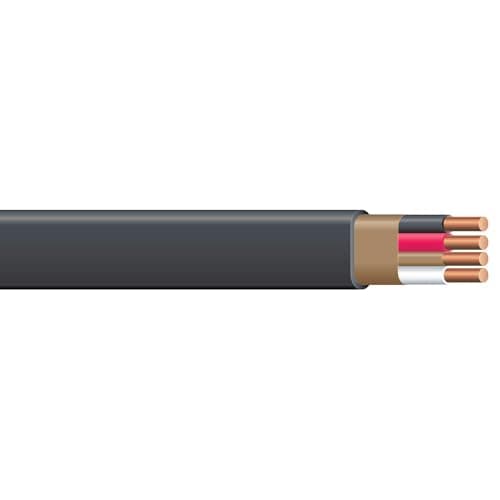
An indoor 48 A run inside a finished wall
Woods 6/3 NM-B Cable with Ground (50 ft)
6/3 NM-B carries 55 A under NEC 334.80, which limits the cable assembly to the 60 degC column regardless of the THHN conductors inside it. That is enough for a 48 A charger on a 60 A breaker; it is NOT enough to assume from the conductor gauge alone.
#ad Price as of October 28, 2026. How we make money
We earn commission on qualifying purchases at no cost to you. Affiliate disclosure.
The 6 AWG THHN set is a 60 A circuit for a 48 A charger, listed at 65 A in the 75 degC column. The 8 AWG THHN spool covers a 40 or 50 A circuit. The 6/3 NM-B cable is the indoor-in-a-wall option, and note the catch: NEC 334.80 limits NM-B to the 60 degC column, which is why that cable is 55 A rather than 65 A. Our wire size guide and cable gauge explained work through the derating.
The short version
- Branch circuit to the charger: copper. The saving from aluminum at this size is small and the termination risk is not.
- Feeder to a subpanel or outbuilding: aluminum is reasonable, sized from the aluminum column with listed lugs.
- Whatever you use, the terminations decide it — listed terminals, antioxidant compound on aluminum, torqued to specification.
- Never mix metals in a connector that is not listed for both.