The short answer
Plug-in hybrids accept around 7.2-7.7 kW / 32 A at most, and their batteries are small enough to fill in two to four hours at that rate. So: buy a 32 A charger on a 40 A breaker with 8 AWG copper — or consider whether the Level 1 cordset that came with the car is genuinely enough, which for a car parked overnight every night it often is.
PHEV owners are the group most reliably oversold on home charging, for an understandable reason: the advice ecosystem is built around battery EVs, where a big charger genuinely helps. A plug-in hybrid is a different vehicle with a different arithmetic.
The two facts that change everything
- The onboard charger is small. A Jeep Wrangler 4xe tops out at 32 A / 7.7 kW. A 48 A charger plugged into one delivers exactly 7.7 kW, because the limit is hardware inside the car.
- The battery is small. EPA publishes a 2.4-hour 240 V charge time for the 2026 Wrangler 4xe and 3.4 hours for the Grand Cherokee 4xe. There is nothing to speed up.
Put those together and the case for a large charger disappears entirely. What remains is a choice between Level 1 and a 32 A Level 2 unit, which is a genuine decision with a real answer.
Level 1 against 32 amps, honestly
| Option | Power | Full charge, Wrangler 4xe | Install needed |
|---|---|---|---|
| Level 1 cordset (in the car) | about 1.4 kW | about 12 hours | None — a household outlet |
| 16 A portable on 240 V | about 3.8 kW | about 4.5 hours | None — an existing 240 V outlet |
| 24 A on a dryer circuit | about 5.8 kW | about 3 hours | A listed switching device |
| 32 A Level 2 | 7.7 kW | about 2.4 hours | A 40 A circuit, 8 AWG copper |
Twelve hours on Level 1 sounds slow until you count the hours your car is actually parked. A car home at 6pm and leaving at 7am has thirteen hours. Level 1 fills it.
The question that decides it
The secondary consideration is what happens when the battery is empty. A PHEV is not stranded — it runs on gasoline. That is the fundamental difference from a BEV and it is why the stakes of a slower charger are so much lower. The cost of not charging fully is some gasoline, not a canceled trip.
Why a big charger costs you real money here
| 32 A (correct) | 48 A (no benefit) | |
|---|---|---|
| Breaker | 40 A two-pole | 60 A two-pole |
| Copper in conduit | 8 AWG | 6 AWG |
| Load added to your panel | 40 A of calculated demand | 60 A of calculated demand |
| Power delivered to a PHEV | 7.7 kW | 7.7 kW — identical |
| Charge time | about 2.4 hours | about 2.4 hours — identical |
The 20 extra amps of calculated demand is the underrated cost. On a marginal service, the difference between a 40 A and a 60 A circuit can be the difference between a straightforward install and a service upgrade conversation — for a charger that will never deliver more than 7.7 kW to this car.
Where the money is better spent
- Hardwiring rather than plugging in. On a 32 A charger the 40 A receptacle ceiling is not a constraint, so plug-in costs you nothing in speed — but hardwiring still removes the GFCI breaker and the receptacle as failure points.
- An industrial-grade receptacle, if you do plug in. The best-documented failure in home charging.
- A holster and a cable hook. Twenty dollars, and it is what keeps the handle out of the mud on a Wrangler.
- A time-of-use tariff. For a PHEV, the tariff saves more money per year than any equipment choice.
What we would actually buy for a plug-in hybrid
A hardwired 32 A unit is the clean answer. The portable 40 A is there because it is cheap, it travels, and the car cannot use more than 32 A of it anyway.
A 40 A circuit, a PHEV, or a 100 A panel
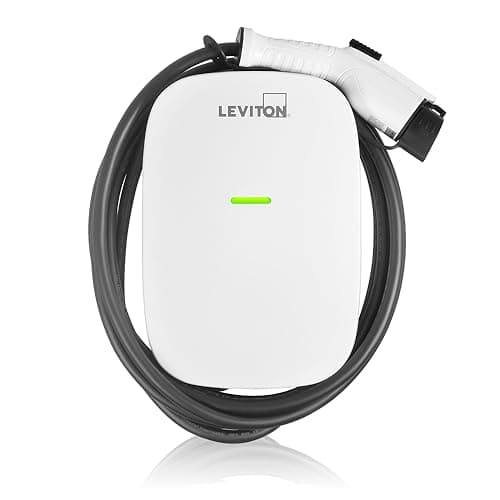
Leviton Level 2 EV Charger (32 A, hardwired)
A 32 A hardwired unit — the right size for a Wrangler 4xe, a Model 3 RWD, or any house whose load calculation will not support more.
#ad Price as of October 5, 2026. How we make money
The cheapest charger worth owning
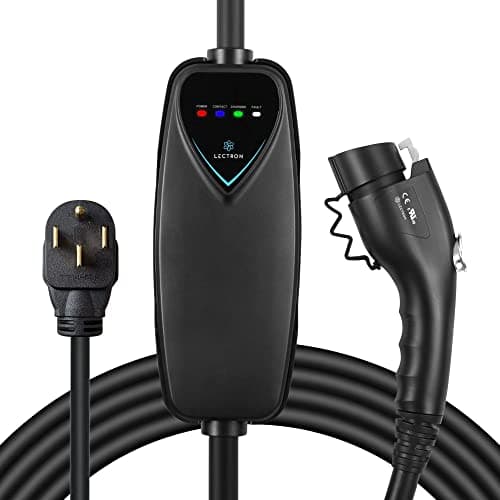
Lectron Level 2 EV Charger (40 A, NEMA 14-50)
A 40 A ETL-certified portable charger for roughly half what the smart units cost. It does one thing, it does it at 9.6 kW, and for a household charging overnight on a flat rate that is the whole job.
#ad Price as of October 5, 2026. How we make money
A renter with access to a 240 V outlet
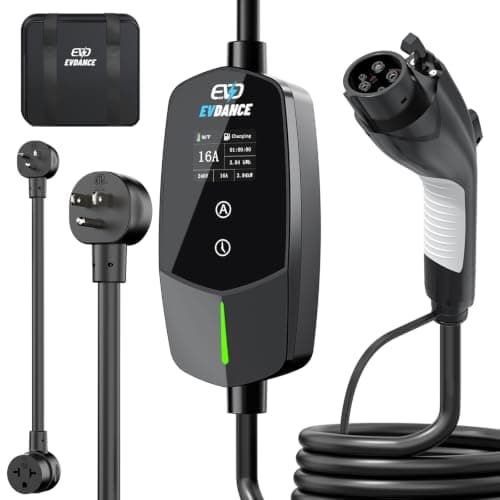
EVDANCE Level 1 & 2 Portable EV Charger (16 A)
A dual-voltage 16 A cordset. On 240 V that is about 3.8 kW — roughly twice the Level 1 cordset that came with the car, from an outlet you may already be allowed to use.
#ad Price as of October 5, 2026. How we make money
Getting the handle and the cable off the floor
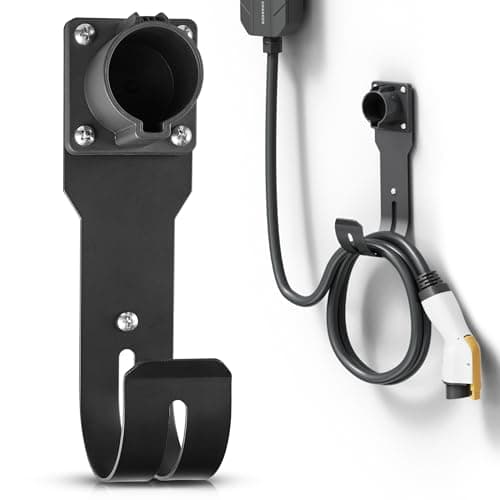
MECMO J1772 Holster Dock and J-Hook
A holster for the handle plus a hook for the loop. The cheapest meaningful upgrade to any charging setup, because a handle that lives on the floor gets stepped on, driven over and eventually fails.
#ad Price as of October 5, 2026. How we make money
We earn commission on qualifying purchases at no cost to you. Affiliate disclosure.
A PHEV's efficiency figures look alarming, and are not
EPA rates the 2026 Wrangler 4xe at 68.0 kWh per 100 miles in electric operation and the Grand Cherokee 4xe at 58.0. Those are much worse than any battery EV on this site — the Hummer EV, the least efficient BEV we cover, is 65.1.
That is not a fault in the measurement. A plug-in hybrid carries both a battery and an engine, which is a lot of mass, and the Wrangler in particular is not aerodynamic. It also matters much less than it would on a BEV, because the electric range is short and the engine covers the rest. EPA's total range figures — 370 miles for the Wrangler, 470 for the Grand Cherokee — are the ones that describe the car you drive.
What it does mean is that electric miles in a PHEV cost more electricity than electric miles in an efficient BEV. Our cost to charge page has the formula if you want to work out whether electric or gasoline is cheaper for you at your rates — the honest answer varies by state.