The short answer
In order of how little permission each requires: (1) the Level 1 cordset that came with the car, into an existing outlet; (2) an adjustable portable charger on an existing 240 V outlet; (3) a plug-in Level 2 charger on a 240 V outlet the landlord agrees to have verified; (4) asking the landlord to install a dedicated outlet; (5) a shared or workplace charger plus occasional public charging. Options 1 and 2 require nothing permanent and nothing to argue about.
Renting is the single most under-served situation in home charging advice, which almost always assumes you own the garage and can pull a circuit. You may not be able to do either — and you probably still have more options than you think.
Start with the arithmetic: is Level 1 enough?
Most renters skip this question and go straight to "I need Level 2". Run the numbers first, because for a meaningful share of drivers the cordset in the trunk is genuinely sufficient.
The US Department of Energy puts Level 1 at 120 V, 1.9 kW, approximately 5 miles of range per hour of charging. Over 12 hours plugged in overnight, that is roughly 60 miles replaced.
| Vehicle (EPA trim) | kWh / 100 mi | Miles in 12 hours | Enough for a 40-mile day? |
|---|---|---|---|
| Hyundai Ioniq 6 RWD 18in (2025) | 26.0 | about 66 | Yes, comfortably |
| Tesla Model Y Long Range AWD (2026) | 27.5 | about 62 | Yes |
| Chevrolet Bolt EUV (2023) | 29.4 | about 58 | Yes |
| Ford Mustang Mach-E RWD Ext (2026) | 30.7 | about 56 | Yes |
| Rivian R1T Dual Large (2026) | 44.4 | about 38 | Marginal |
| GMC Hummer EV Pickup 3X (2025) | 65.1 | about 26 | No |
If you drive an efficient car under 50 miles a day and can plug in every night, Level 1 works and the whole landlord conversation becomes unnecessary. If you drive a truck or a long commute, it does not, and you need one of the options below.
Option 2: an adjustable portable charger on an existing 240 V outlet
A great many rental garages, laundry rooms and basements have a 240 V outlet already — a dryer outlet, an old range outlet, a welder outlet. An adjustable portable charger lets you use one at a current the circuit can genuinely handle.
The adjustability is the point. On a circuit you do not own and cannot characterize, being able to dial down to 8 or 16 A means you can charge without loading it anywhere near its limit.
Portable chargers that need no installation
All three plug into an existing outlet. The first two are dual-voltage and adjustable, which is what you want on a circuit you do not control; the third is faster if a genuine dedicated 14-50 exists.
A shared or uncertain circuit
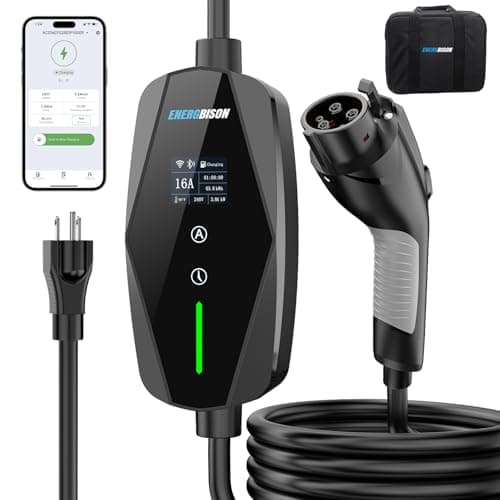
Portable Level 1 & 2 EV Charger with Timer (8-16 A)
Adjustable from 8 to 16 A with a built-in timer, which is the right feature set for a circuit you do not own and cannot characterize: dial it down until nothing else on the circuit complains.
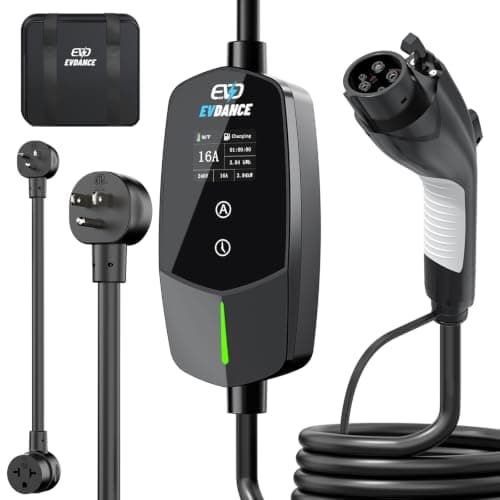
A renter with access to a 240 V outlet
EVDANCE Level 1 & 2 Portable EV Charger (16 A)
A dual-voltage 16 A cordset. On 240 V that is about 3.8 kW — roughly twice the Level 1 cordset that came with the car, from an outlet you may already be allowed to use.
#ad Price as of October 5, 2026. How we make money
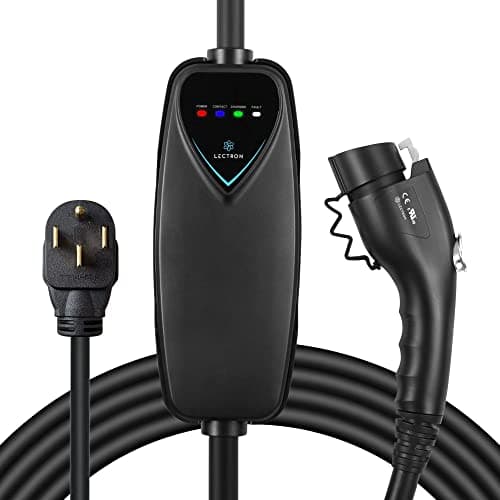
The cheapest charger worth owning
Lectron Level 2 EV Charger (40 A, NEMA 14-50)
A 40 A ETL-certified portable charger for roughly half what the smart units cost. It does one thing, it does it at 9.6 kW, and for a household charging overnight on a flat rate that is the whole job.
#ad Price as of October 5, 2026. How we make money
We earn commission on qualifying purchases at no cost to you. Affiliate disclosure.
Option 3: a plug-in Level 2 charger
If a verified, dedicated NEMA 14-50 exists on an adequate circuit, a plug-in Level 2 charger gets you 40 A — 9.6 kW — with no installation at all. It unplugs and comes with you at the end of the lease, which makes it the best-value purchase available to a renter.
This is also the case where the full hardwired vs plug-in comparison resolves straightforwardly: as a renter, plug-in wins on portability alone.
Option 4: asking the landlord
Worth doing properly rather than casually, because the ask is more persuasive than most renters realize. A dedicated 240 V outlet in a parking space is an improvement to the property that:
- Stays with the building and is increasingly expected by tenants.
- Costs a one-off amount that you may be willing to contribute to or fund entirely.
- Is a permitted, inspected improvement, not a modification — which is the framing that matters to a property owner.
- May attract a utility rebate, which several utilities offer to multi-unit and rental property owners specifically.
Make it concrete: a named electrician, a written quote, a specified outlet type, and an offer in writing. "Can I install a charger?" gets a reflexive no. "Here is a quote from a licensed electrician for a permitted NEMA 14-50 outlet in my parking space, I will pay for it, and it stays with the property" is a different conversation.
Several states have "right to charge" legislation that constrains what a landlord or HOA may refuse, generally for tenants willing to bear the cost. Those laws vary substantially and we are not going to summarize yours — but it is worth checking whether your state has one before you accept a no.
Option 5: charge elsewhere, deliberately
The honest option. If workplace charging exists, or there is reliable Level 2 within walking distance of home, a hybrid pattern works: top up at work, use public Level 2 on weekends, keep the Level 1 cordset for overnight trickle. It is less convenient and it is a real plan.
The economics matter here: public charging is usually more expensive than residential rates and DC fast charging is substantially more. Our home against public charging page covers the comparison.
What not to do
- Do not run an extension cord from a window to a car in a shared lot. Trip hazard, weather exposure, and in many leases a clear violation.
- Do not use an unverified 240 V outlet at full current. The circuit behind it is unknown, and it is not yours.
- Do not install anything permanent without written permission. Even a wall bracket. It is the kind of thing that costs a deposit.
- Do not use a NEMA 10-30 outlet. No equipment grounding conductor. See using a dryer outlet.