The short answer
It depends entirely on your parking. An assigned space with a wall or post nearby is a solvable problem — propose a permitted, metered outlet you pay for. A shared garage with no assigned space needs a building-level solution, which means the HOA or property manager. Street parking means public and workplace charging plus a Level 1 cordset wherever you can reach an outlet. In all three cases, start by running the Level 1 arithmetic — it is enough more often than people assume.
Situation 1: an assigned space
The best case, and genuinely achievable. What you are proposing is a dedicated 240 V outlet serving your space, on its own circuit, ideally with its own meter or a submeter so the electricity is billed to you rather than to the building.
The metering point is what unlocks this. A property manager's first objection is almost never the electrical work — it is "who pays for the power". Answer that before it is asked and the conversation changes completely.
- Get a written quote from a licensed electrician who has done multi-unit work, for a permitted outlet with submetering.
- Offer to fund it, and say so in writing.
- Specify that it stays with the property at the end of your tenancy.
- Name the outlet type — NEMA 14-50 — rather than asking for "a charger". An outlet is an electrical improvement; a charger sounds like a tenant modification.
- Mention utility rebates. Several utilities have programs specifically for multi-unit dwellings, and a property owner may not know.
Situation 2: a shared garage, no assigned space
Harder, because no individual solution exists — a charger in a space you do not control is not yours. This needs a building-level decision, which means the HOA board or the property management company.
What tends to work when a single tenant's request does not:
- Find the other EV owners in the building. Three tenants asking is a different proposition from one, and shared cost changes the economics.
- Propose shared chargers in common spaces rather than individual ones, which is usually what the building wants anyway.
- Bring the utility program to them. Many utilities have multi-unit charging incentives, and a program that covers a substantial share of the cost is a far easier board vote.
- Suggest a phased plan — conduit and capacity now, two chargers initially, more as demand grows. Boards approve phases more readily than projects.
- Check your state's right-to-charge law. Several states constrain what an HOA may refuse, particularly for an owner-funded installation in an assigned space.
Situation 3: street parking
The honest answer is that home charging is not available to you, and the plan is a deliberate combination:
- Workplace charging, if it exists. This is the single biggest lever and worth pushing for at work.
- Public Level 2 near home, used on a predictable weekly rhythm rather than reactively.
- DC fast charging as a backstop, not a routine — it is the most expensive electricity you will buy.
- A Level 1 cordset for any evening you can legitimately reach an outlet.
This is less convenient than a garage and it is a workable plan. Many city EV owners live this way. The cost comparison is on our home against public charging page, and it is worth reading before you buy the car rather than after.
What to buy in all three situations
A portable, adjustable charger, because it works in every scenario and comes with you to the next building.
The chargers that suit apartment living
Nothing mounted, nothing permanent, nothing that needs a landlord's signature. The adjustable ones matter most: on a circuit you do not control, being able to dial down is the safety margin.
A shared or uncertain circuit
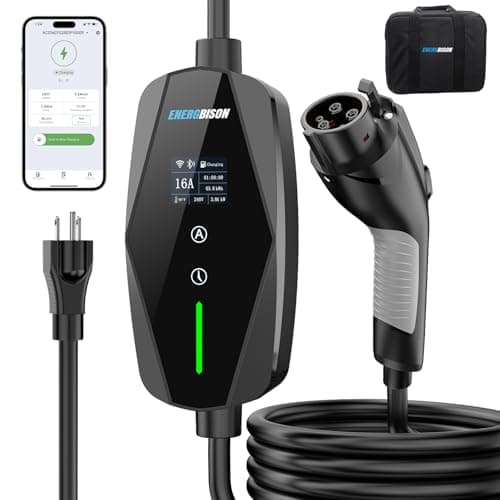
Portable Level 1 & 2 EV Charger with Timer (8-16 A)
Adjustable from 8 to 16 A with a built-in timer, which is the right feature set for a circuit you do not own and cannot characterize: dial it down until nothing else on the circuit complains.
A renter with access to a 240 V outlet
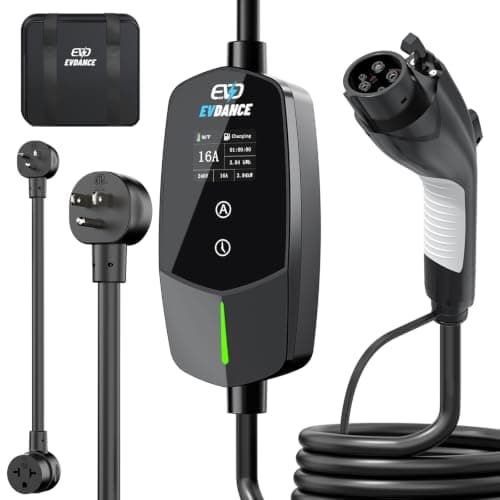
EVDANCE Level 1 & 2 Portable EV Charger (16 A)
A dual-voltage 16 A cordset. On 240 V that is about 3.8 kW — roughly twice the Level 1 cordset that came with the car, from an outlet you may already be allowed to use.
#ad Price as of October 5, 2026. How we make money
The cheapest charger worth owning
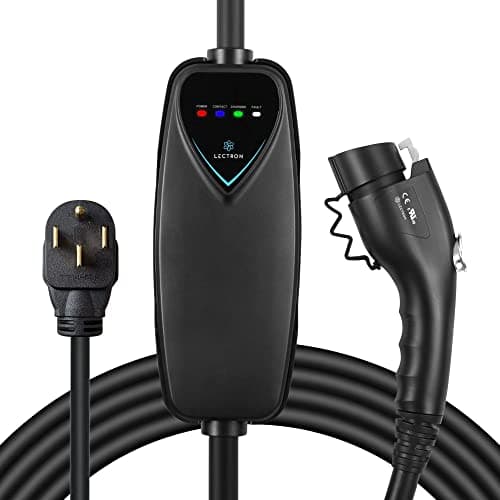
Lectron Level 2 EV Charger (40 A, NEMA 14-50)
A 40 A ETL-certified portable charger for roughly half what the smart units cost. It does one thing, it does it at 9.6 kW, and for a household charging overnight on a flat rate that is the whole job.
#ad Price as of October 5, 2026. How we make money

The extension to pick if you must use one
SEGUMA J1772 Extension Cable (21 ft, 50 A, UL listed)
50 A rated and UL listed, which is the combination to insist on: the rating has headroom over a 48 A charger and the listing means something tested it.
#ad Price as of October 5, 2026. How we make money
We earn commission on qualifying purchases at no cost to you. Affiliate disclosure.
While you wait
Building decisions take months. Meanwhile, run the Level 1 numbers honestly: the US Department of Energy puts Level 1 at approximately 5 miles of range per hour, which over 12 hours is roughly 60 miles replaced. On an efficient car with a normal commute, that is sufficient — see the full table on our renters page.
If you are still shopping for the car, this is also a genuine argument for choosing an efficient one. A 26 kWh-per-100-mile sedan is a far easier car to live with on constrained charging than a 65 kWh-per-100-mile truck, and that difference is larger than any charger decision.