The short answer
A 30 A dryer circuit supports 24 A of continuous EV charging — 80% of 30 A, because EV charging is a continuous load under NEC 625.42. That is about 5.8 kW, which adds roughly 18-20 miles of range per hour on an average EV. It is a legitimate charge rate, but only on a circuit an electrician has verified, and only through a listed switching device rather than a splitter that allows both loads at once.
Why the usual advice is wrong in both directions
"Just use the dryer outlet, it's 240 volts" ignores the duty-cycle difference entirely. "Never use a dryer outlet" ignores that 24 A is a perfectly usable charge rate for a lot of drivers and that a correctly verified circuit with a listed switching device is a reasonable engineering solution.
The honest position is the middle one: this works, within a limit, on a verified circuit, with the right device. Each of those four qualifiers is doing work.
The 24-amp ceiling and what it actually delivers
| Vehicle (EPA trim) | kWh / 100 mi | Miles added per hour | Miles in 8 hours |
|---|---|---|---|
| Hyundai Ioniq 6 RWD 18in (2025) | 26.0 | 20.1 | 161 |
| Tesla Model Y Long Range AWD (2026) | 27.5 | 19.0 | 152 |
| Ford Mustang Mach-E RWD Ext (2026) | 30.7 | 17.0 | 136 |
| Rivian R1T Dual Large (2026) | 44.4 | 11.8 | 94 |
| Jeep Wrangler 4xe (2026) | 68.0 | 7.7 | 61 — the whole battery, twice over |
Read the right-hand column. For most drivers, 8 hours at 24 A replaces considerably more than a normal day's driving. If you commute 40 miles, this is not a compromise — it is enough.
What dryer outlet do you have?
| Receptacle | Configuration | Ground? | Suitable? |
|---|---|---|---|
| NEMA 14-30 | Two hots, neutral, ground | Yes | Yes, if the circuit is verified. The modern standard |
| NEMA 10-30 | Two hots and a neutral, no separate ground | No | Not without rewiring. The frame-grounding arrangement these relied on is long obsolete |
This matters more than anything else on the page. A 10-30 outlet has no equipment grounding conductor. Adapters exist that bond the EV charger's ground to the neutral, and that arrangement is not something we will recommend for a nightly continuous load on a 240 V circuit. If you have a 10-30, the answer is to have the circuit brought up to a grounded configuration.
Splitter against switch — the distinction that matters
There are two kinds of product sold for this, and they are not equivalent.
- A passive splitter gives you two outlets from one circuit and relies on you never using both. On a 30 A circuit with a dryer and a car, that is an overload waiting for an inattentive evening.
- An automatic switch energizes one outlet or the other, never both. The dryer takes priority; the car waits. The circuit physically cannot carry both loads.
Buy the switch. The price difference is real and so is the difference in what can go wrong.
Listed automatic switches for a dryer circuit
Both of these are cETLus safety certified and switch automatically with dryer priority. Note the price: compare it honestly against the cost of a dedicated 40 A circuit, because for some houses the real circuit is the better buy.
Charging off a dryer outlet without rewiring
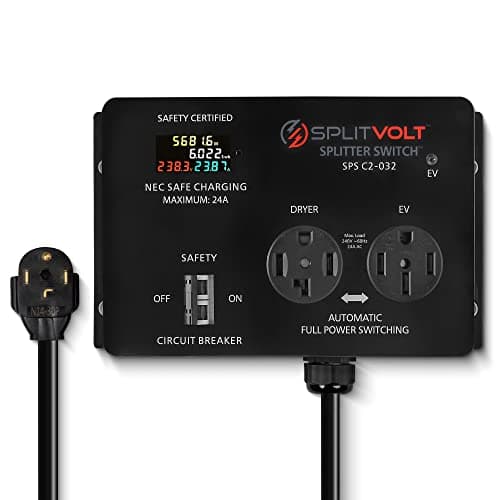
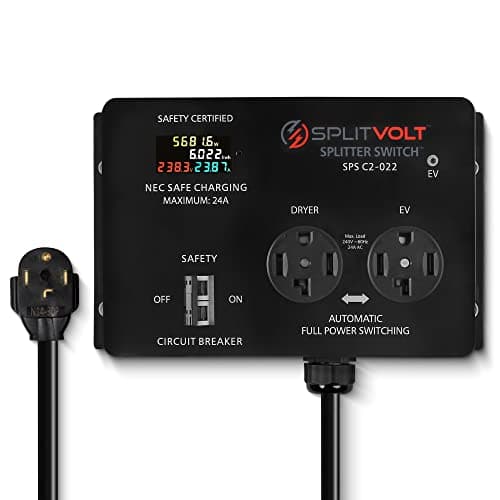
Splitvolt NEMA 14-30/14-50 Splitter Switch
A cETLus-certified automatic switch that lets a dryer circuit feed either the dryer or a 24 A charger, never both. This is the one product in this category we would actually put on a dryer circuit — because it is a listed switch, not a splitter that lets you overload the circuit.
#ad Price as of October 5, 2026. How we make money
A 14-30 dryer outlet specifically
Splitvolt NEMA 14-30 Splitter Switch
The 14-30-only version, for a laundry room with a four-prong dryer outlet and nothing else to give.
#ad Price as of October 5, 2026. How we make money
We earn commission on qualifying purchases at no cost to you. Affiliate disclosure.
A simpler option worth considering
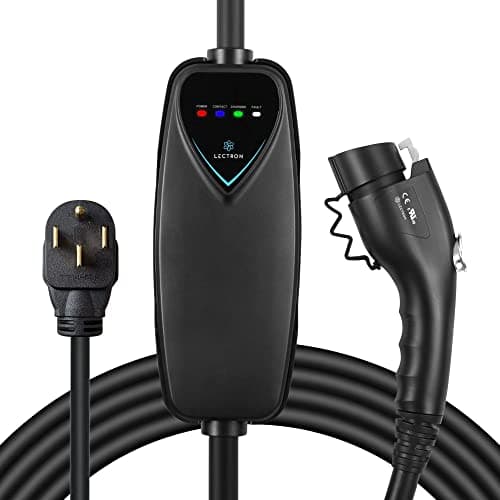
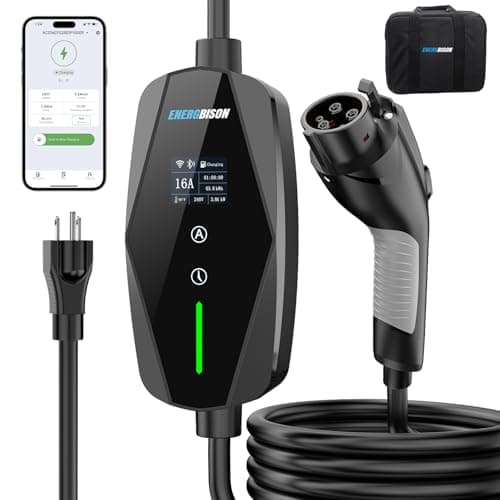
If your dryer outlet is a 14-30 and you only need modest charging, a portable charger set to a low current is less equipment in the path than a switch plus a charger. Adjustable portables dial down to 16 A or less, which no 30 A circuit will object to, and nothing stays plugged in permanently.
A shared or uncertain circuit
Portable Level 1 & 2 EV Charger with Timer (8-16 A)
Adjustable from 8 to 16 A with a built-in timer. Slower than 24 A, but it is one device rather than two, and the timer means it can be set to run only at night when the dryer is definitely idle.