The short answer
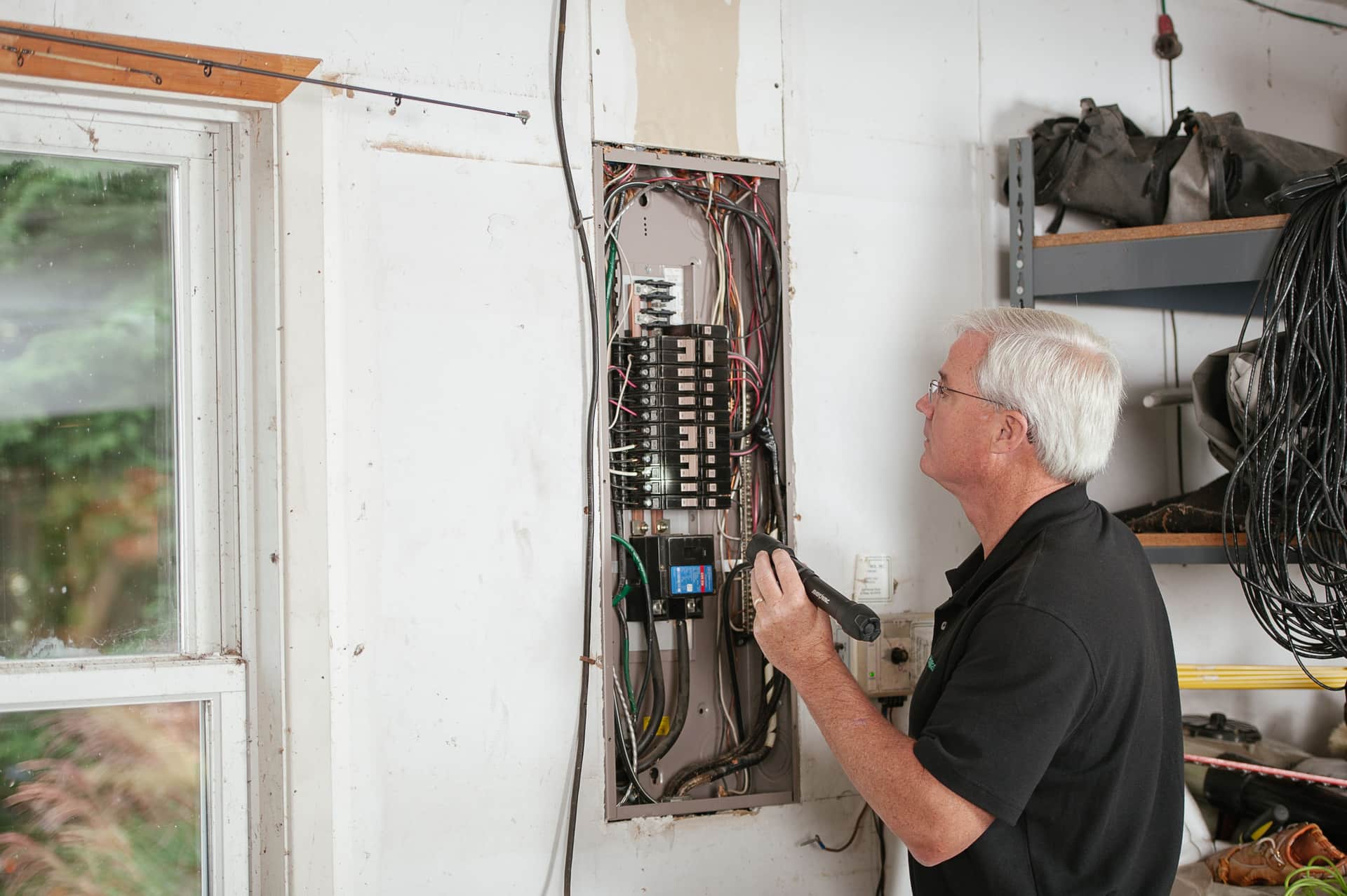
A NEMA 14-50 receptacle on a 50 A circuit supports a 40 A continuous charger, not 50 A, because EV charging is a continuous load and a circuit may carry only 80% of its rating continuously. The circuit needs 8 AWG copper in conduit (or 6/2 NM-B), a 50 A two-pole GFCI breaker per NEC 625.54, and — the part that matters most in practice — an industrial-grade receptacle, not a builder-grade one.
What the circuit needs
| Component | Requirement | Code basis |
|---|---|---|
| Breaker | 50 A two-pole, GFCI | NEC 625.41 (125% of 40 A) and NEC 625.54 (GFCI for receptacles) |
| Conductors, conduit | 8 AWG copper (50 A at 75 degC) | NEC Table 310.16 |
| Conductors, NM-B cable | 6/2 — 8 AWG Romex is limited to 40 A | NEC 334.80 limits NM to the 60 degC column |
| Equipment ground | Sized from the breaker, commonly 10 AWG copper | NEC Table 250.122 |
| Receptacle | NEMA 14-50R, industrial grade | Not a code requirement — a duty-cycle one |
| Box | Deep enough for 8 AWG conductors and the receptacle | Box fill, NEC 314.16 |
| Outdoor only | Extra-duty in-use cover | NEC 406.9(B) for wet locations, cord connected |
The 40-amp ceiling, and why it exists
NEC 625.42 classifies EV charging as a continuous load. A continuous load may occupy no more than 80% of a circuit's rating. 80% of 50 A is 40 A. That is the entire derivation, and it is why a charger plugged into a 14-50 outlet is a 40 A charger no matter what the charger is capable of.
A real consequence worth planning for: if you buy a 48 A charger and a 14-50 outlet, the charger will either refuse to run above 40 A or — on an adjustable unit — need to be set to 40 A. You will have paid for 48 A hardware that your installation cannot use. Either hardwire it, or buy the 40 A version and spend the difference on the receptacle.
The receptacle is the whole story
If you take one thing from this page: a NEMA 14-50 receptacle designed for an electric range is not designed for an EV. A range draws heavily in bursts. An EV draws 40 A continuously for six to eight hours, every night, for years. That duty cycle is a different engineering problem, and it finds every marginal contact.
The failure mode is progressive and visible: the receptacle face discolours around the blade slots, then browns, then chars. By the time it is obvious, the contacts have been running hot for months. This is the most widely documented failure in home EV charging and it is entirely avoidable for the price of a better part.
Industrial-grade NEMA 14-50 receptacles
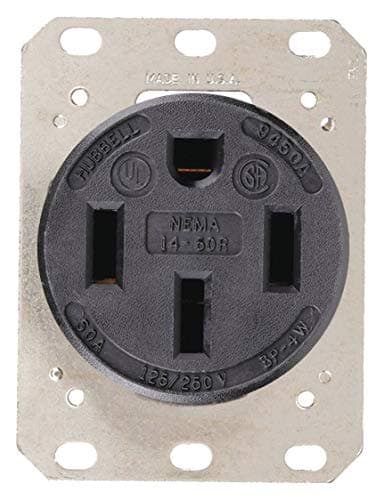
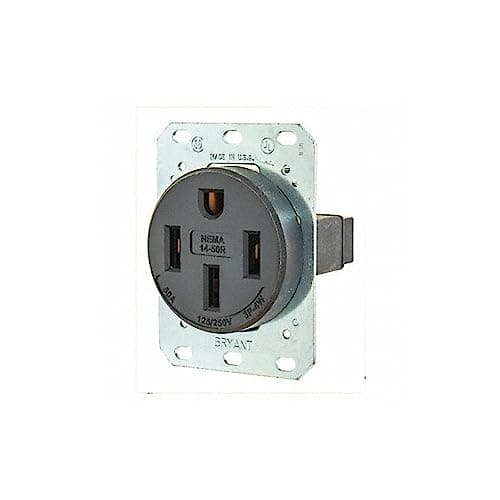
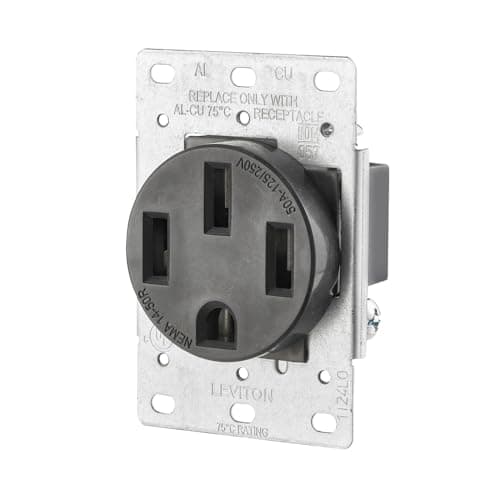
Three tiers. The Hubbell is the part electricians specify by name for this application; the Bryant is its sister brand at a lower price; the Leviton is the floor below which we would not go for a 40 A continuous load.
The one part not to save money on
Hubbell HBL9450A NEMA 14-50 Receptacle (industrial)
An industrial-grade 14-50 receptacle. An EV draws 40 A continuously for hours, which is a duty cycle the cheap builder-grade receptacles were never designed for — this is the part that stops a plug-in install from browning its own contacts.
#ad Price as of October 5, 2026. How we make money
The same quality, slightly cheaper
Bryant 9450FR NEMA 14-50 Receptacle
Bryant is Hubbell's sister brand and the 9450FR is the same class of part for a little less — the sensible alternative when the Hubbell is out of stock.
#ad Price as of October 5, 2026. How we make money
A budget that cannot stretch to the Hubbell
Leviton 279-S00 NEMA 14-50 Receptacle
An industrial-grade Leviton 14-50 at a fraction of the Hubbell's price. Better than any builder-grade part, and the right compromise if your charger is set to 32 A rather than 40 A.
#ad Price as of October 5, 2026. How we make money
We earn commission on qualifying purchases at no cost to you. Affiliate disclosure.
Checking an outlet that is already there
Finding a 14-50 in the garage feels like winning. Before you trust it, have an electrician confirm four things:
- The breaker size. A 14-50 receptacle on a 30 A or 40 A breaker exists in the wild. The receptacle tells you nothing about the circuit behind it.
- The conductor gauge. Older RV outlets were sometimes wired light on the assumption of intermittent use.
- That it is on a dedicated circuit. A 14-50 sharing a circuit with anything else is not suitable for a continuous 40 A load.
- GFCI protection. Under NEC 625.54 the receptacle needs it for EV charging use. An older range or RV outlet will not have it.
That last point catches a lot of people: an existing 14-50 is not automatically compliant for EV charging just because it exists and is the right shape.
14-50 against the alternatives
| Receptacle | Circuit | Continuous EV current | Has a neutral? |
|---|---|---|---|
| NEMA 14-50 | 50 A | 40 A | Yes (unused by the charger) |
| NEMA 6-50 | 50 A | 40 A | No — two hots and a ground |
| NEMA 14-30 | 30 A | 24 A | Yes |
| NEMA 10-30 | 30 A | 24 A | No ground — obsolete, avoid |
| NEMA 6-20 | 20 A | 16 A | No |
If you are pulling a brand new circuit purely for a car and will never plug an RV into it, ask your electrician about 6-50. If you want the outlet to be useful for anything else, 14-50 is the pragmatic choice.
Outdoors
A 14-50 outdoors with a plug in it needs an extra-duty in-use cover — the kind that closes over the plug — not a flip-lid cover that only seals when empty. Metal covers survive UV far better than the clear plastic ones.
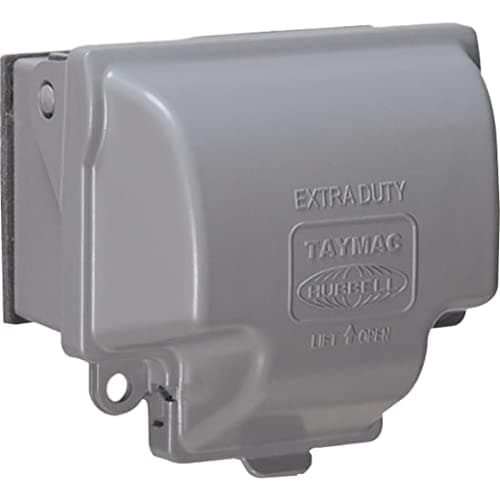
An outdoor 240 V receptacle with a charger plugged in
TayMac MX3300 RaynGuard Metal Weatherproof In-Use Cover
Extra-duty, metal, and deep enough to close over a 14-50 plug. Check the depth against your specific plug before ordering, because some charger plugs are bulkier than the RV plugs these are commonly sized around.
#ad Price as of October 5, 2026. How we make money