The short answer
The Hubbell HBL9450A is the best NEMA 14-50 receptacle for EV charging — an industrial-grade part whose contacts are built for the continuous duty an EV actually imposes. The Bryant 9450FR is the same class of device from Hubbell's sister brand for slightly less, and the Leviton 279-S00 is the industrial-grade budget choice. What all three have in common is the thing that matters: they are not builder-grade. A $10 big-box 14-50 was designed for a welder or an RV used occasionally, not 40 amps continuously for hours every night.
Quick picks
Ranked by fit for the stated use case first, then price, then warranty and support. Tap any row to jump to the full assessment. Commission rate plays no part in the order.
| # | Product | Best for | Score | Price |
|---|---|---|---|---|
| 1 | 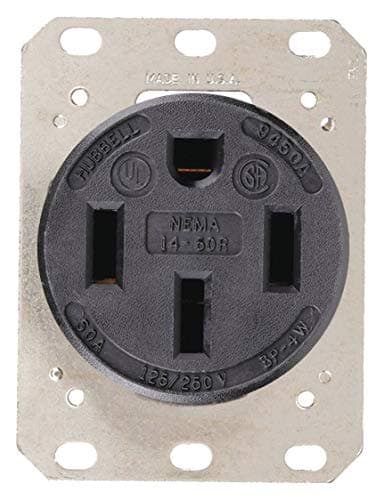 Hubbell HBL9450A NEMA 14-50 Receptacle (industrial)An industrial-grade 14-50 receptacle. | The one part not to save money on | 9.4 | |
| 2 | 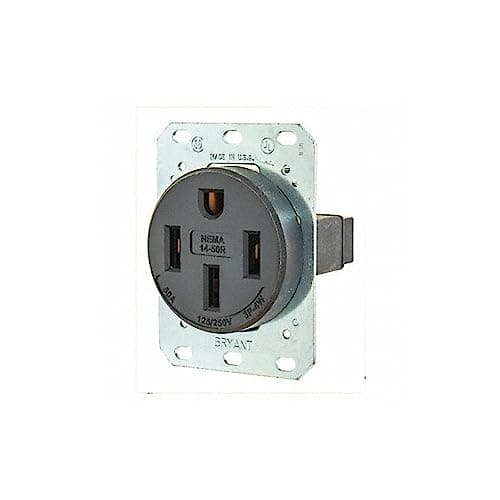 Bryant 9450FR NEMA 14-50 ReceptacleBryant is Hubbell's sister brand and the 9450FR is the same class of part for a little less — the sensible alternative when the Hubbell is out of stock. | The same quality, slightly cheaper | 9.0 | |
| 3 | 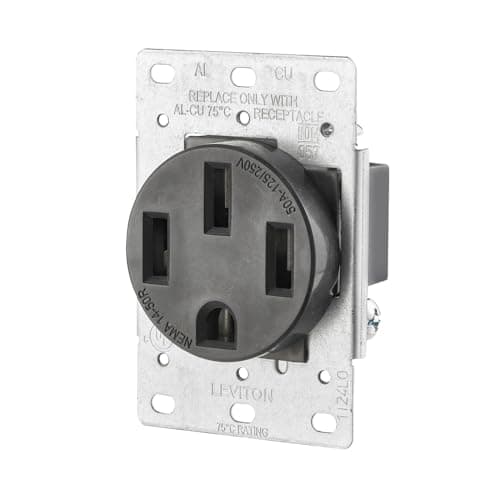 Leviton 279-S00 NEMA 14-50 ReceptacleAn industrial-grade Leviton 14-50 at a fraction of the Hubbell's price. | A budget that cannot stretch to the Hubbell | 8.0 |
Why the receptacle is the part that fails
Of everything in a plug-in EV charging install — the breaker, the conductors, the box, the charger — the receptacle is the component most likely to fail, and the failure is not subtle. It looks like a browned or melted receptacle face, a discolored plug blade, and in the worst cases scorching inside the box.
The mechanism is straightforward. NEC 625.42 classifies EV charging as a continuous load, meaning three hours or more at full current. Every other 240 V thing that has historically plugged into a 14-50 — a range, a welder, an RV hookup — is intermittent. A receptacle whose contacts have slightly too little spring tension does not care about intermittent use, because it gets a chance to cool. Under a nightly 40 A continuous draw it heats, the heat relaxes the contact metal, the contact resistance rises, and it heats more. That is a feedback loop, and it runs for months before anyone notices.
The 40 amp ceiling, which is not the receptacle's fault
Before the picks, the thing every plug-in buyer should know: a 50 A receptacle circuit supports a 40 A charger, not a 50 A one. Apply NEC 625.41's 125% rule in reverse and a 50 A circuit's continuous ceiling is 40 A. That is why every plug-in Level 2 charger sold in the US is capped at 40 A, and why a 48 A charger has to be hardwired.
| Item | Figure | Basis |
|---|---|---|
| Receptacle rating | 50 A, 125/250 V | NEMA 14-50R, 3-pole 4-wire grounding |
| Breaker | 50 A two-pole, GFCI protected | NEC 625.41 and 625.54 |
| Copper in conduit (75 degC) | 8 AWG | NEC Table 310.16 |
| Maximum charger output | 40 A / 9.6 kW | Continuous-load limit: 50 A x 0.8 |
What we ranked on
- Grade. Industrial or specification grade only. We will not list a builder-grade 14-50 for an EV circuit at any price.
- Contact design for continuous duty, which is the whole difference between these parts and a cheap one.
- Availability, because a receptacle you cannot get on the day of the install gets substituted for whatever the van has.
- Mounting, specifically whether the device suits a deep box and a flush plate rather than a surface-mount lash-up.
The picks
1. Hubbell HBL9450A — the one installers specify by name
The one part not to save money on
Hubbell HBL9450A NEMA 14-50 Receptacle (industrial)
Industrial-grade contacts rated for the continuous duty an EV imposes. If you only remember one part number from this site, make it this one.
#ad Price as of October 10, 2026. How we make money
This is the part that appears by name in reputable installers' quotes, and it is the reason it appears there: it is the fix for the failure mode described above. It costs several times a big-box receptacle, which is nothing against the cost of the circuit it terminates. It needs a deep box — check that before the drywall closes.
2. Bryant 9450FR — the same quality, slightly cheaper
The same quality, slightly cheaper
Bryant 9450FR NEMA 14-50 Receptacle
Bryant is Hubbell's sister brand and this is the same class of device for less. The sensible substitution when the Hubbell is out of stock.
#ad Price as of October 10, 2026. How we make money
Mechanically and commercially the same answer. It is less widely stocked, which is the only real reason it is second rather than first — and if your supply house has it when the Hubbell is on backorder, there is no reason to wait.
3. Leviton 279-S00 — the budget that is still industrial
A budget that cannot stretch to the Hubbell
Leviton 279-S00 NEMA 14-50 Receptacle
An industrial-grade Leviton for a fraction of the Hubbell's price. The right compromise if the charger is set to 32 A rather than 40 A.
#ad Price as of October 10, 2026. How we make money
This is the one to buy if the Hubbell's price is genuinely out of reach. It is a real step up from builder-grade and it is universally stocked. The honest caveat is that it is not in the Hubbell's class for sustained 40 A duty — so if you buy it, have the terminal torque checked at six months, because that is when a loose connection shows itself.
The receptacle you should not buy
We are deliberately not listing one. The category to avoid is any unbranded or builder-grade 14-50 selling for under about fifteen dollars, including the ones bundled into cheap "EV charging outlet kits". The money saved is roughly one hour of the electrician's time, and the failure mode is a melted receptacle behind a car.
Installing it properly
- A deep box. 8 AWG conductors do not fold into a shallow box, and forcing them stresses the terminations.
- Torque the terminals to the manufacturer's specification, with a torque screwdriver. This is the step that gets skipped and it is the one that matters most.
- A 50 A two-pole GFCI breaker, per NEC 625.54 for a receptacle circuit.
- 8 AWG copper at 75 degC terminations per NEC Table 310.16, or larger for a long run. Our wire size guide covers voltage drop on long runs.
- Check it after the first few weeks. Warm is a warning; hot is a fault. Our post-install testing guide covers what to look for.
The full circuit walkthrough is on the NEMA 14-50 outlet for EV charging, and if you are choosing between receptacle configurations, NEMA 6-50 vs NEMA 14-50 covers why one has a neutral and the other does not.
How we picked
Every unit here is currently purchasable, carries a real UL or ETL certification to the relevant standard, and comes from a brand with an identifiable North American support path. We verified each one's published specifications against the manufacturer's own documentation on the date shown at the top of this page. We verify specifications; we do not bench-test hardware, and our methodology says so in plain terms. Ranking order is fit for the stated use case first, then price, then warranty and support — commission rate plays no part in it. Receptacles are one of the few categories where the correct recommendation is also the expensive one, and we have ranked accordingly rather than leading with the cheapest part.