The short answer
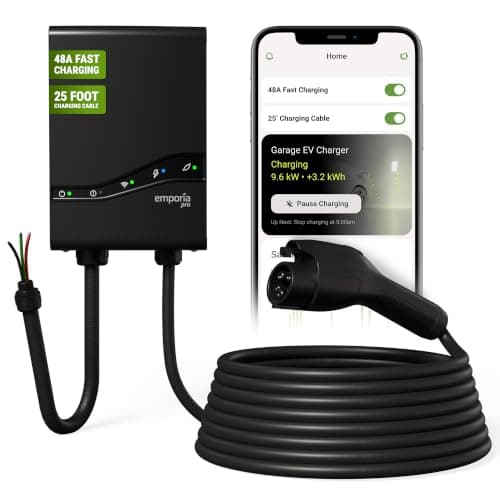
A charger that plugs into a receptacle needs GFCI protection. NEC 625.54 in both the 2020 and 2023 editions states that, in addition to 210.8, all receptacles installed for the connection of electric vehicle charging shall have ground-fault circuit-interrupter protection for personnel. A hardwired charger generally does not — the outlet supplying direct-connected EVSE is not required to be GFCI protected unless the manufacturer's instructions specify it.
The code language, and how it changed
| Edition | What it required |
|---|---|
| 2017 NEC | GFCI protection for all single-phase receptacles installed for EV charging rated 150 volts to ground or less, and 50 amperes or less |
| 2020 NEC | In addition to 210.8, all receptacles installed for the connection of EV charging shall have GFCI protection. The voltage and amperage limits were removed |
| 2023 NEC | Unchanged from 2020 — all receptacles, no voltage or amperage exception |
The scope note matters as much as the rule. Portable and fastened-in-place EVSE that is permitted to be cord-and-plug connected must be supplied through a GFCI-protected receptacle. The outlet supplying direct-connected EVSE is outside the requirement unless the manufacturer's instructions say otherwise.
That single distinction is one of the strongest practical arguments for hardwiring, which is why it appears again on our hardwired vs plug-in page.
Why the pairing nuisance-trips
Your charger already contains ground-fault protection. EVSE units include a CCID (charging circuit interrupting device) — the Autel MaxiCharger, for instance, publishes a 20 mA CCID ground-fault detection threshold. A Class A GFCI breaker trips at 5 mA.
So on a plug-in install you have two ground-fault devices in series at different thresholds, and the less sensitive one is downstream. Normal capacitive leakage from 25 feet of charging cable, especially damp, can be enough to approach 5 mA. The breaker sees a fault; nothing is wrong.
What to do if yours is tripping
- Rule out a real fault first. A GFCI that trips the moment you plug in, every time, is more likely to be reporting something true. Have an electrician check the circuit, the receptacle and the equipment ground before assuming nuisance.
- Note the pattern. Does it trip on plug-in, mid-charge, only in rain, only when cold? That pattern is the most useful thing you can hand an electrician.
- Check the charger's manual. Some manufacturers publish known incompatibilities or recommend specific breaker types.
- Try a different GFCI breaker. Within the same panel brand, different models behave differently. Self-test models and newer designs are often better.
- Hardwire it. The complete fix. It removes the receptacle, removes the GFCI requirement, and gets you the charger's full output as a bonus.
What not to do: install a non-GFCI breaker on a receptacle circuit. It will fail inspection, it violates 625.54 where that edition is adopted, and it removes personnel protection on an outdoor-capable 240 V receptacle. If GFCI tripping is making the install unusable, hardwire — do not delete the protection.
GFCI breakers for the common circuit sizes
Two-pole GFCI breakers for EV charging circuits
Breakers are panel-specific: fitting another brand into a load center voids its listing and an inspector will see it. Confirm what your panel takes before ordering.
A plug-in charger on a 14-50 receptacle circuit
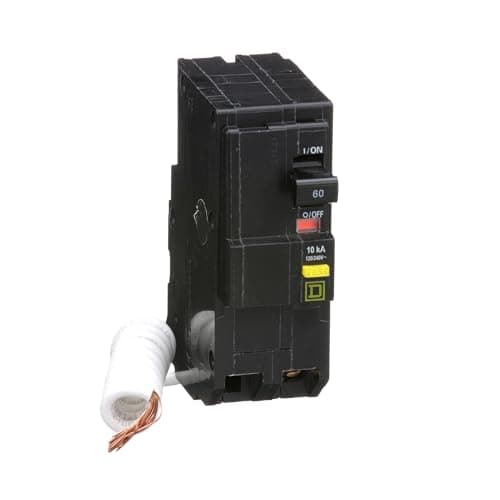
Square D QO260GFI 60 A 2-Pole GFCI Breaker
If your charger plugs into a receptacle, NEC 625.54 requires GFCI protection on that circuit, and this is the part that provides it. It is also the single most common cause of nuisance tripping in a home charging install.
The same job in an Eaton BR panel
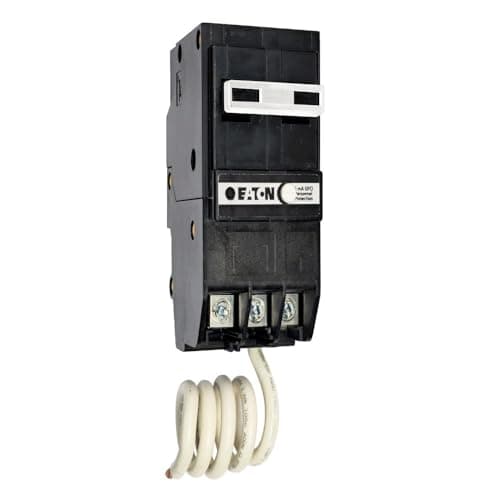
Eaton BRN260GF 60 A 2-Pole GFCI Breaker
Eaton's 60 A two-pole GFCI for a BR-series panel. Same role, same caveat about nuisance tripping.
#ad Price as of October 5, 2026. How we make money
We earn commission on qualifying purchases at no cost to you. Affiliate disclosure.
Note the price difference against a standard breaker. On a 50 A or 60 A two-pole, a GFCI device costs several times a thermal-magnetic one — which is another quiet line item in favor of hardwiring, alongside the receptacle you also would not need to buy.
GFCI, AFCI and the two-pole requirement
Three things that get confused:
- GFCI detects current leaking to ground — a shock hazard. This is what 625.54 requires for receptacles.
- AFCI detects arcing — a fire hazard. AFCI requirements are driven by NEC 210.12 and the room types it lists; a dedicated garage EV circuit is generally not in scope, but your local amendments govern.
- Two-pole simply means the breaker occupies two slots and switches both hot legs, which every 240 V circuit requires. It says nothing about GFCI or AFCI.