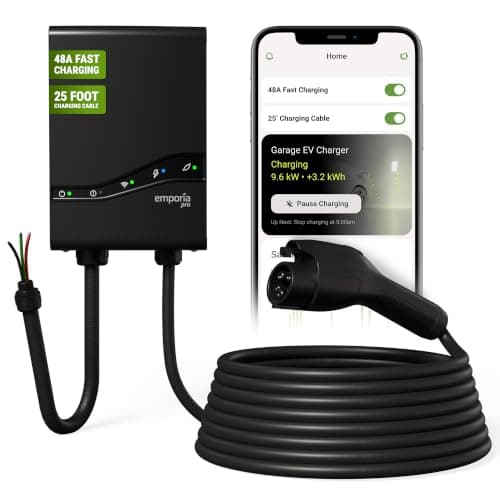
The short answer
The Emporia Pro is the best-balanced home charger for a typical US house: 48 A / 11.5 kW hardwired, a 25 ft cable, NEMA 4 build, UL certified and ENERGY STAR. What sets it apart is not the output — several units match it — but that PowerSmart load management ships with the Vue home energy monitor, so it throttles against your panel's measured draw rather than a number in a setting.
That distinction is the whole review. Load management is the single feature most likely to turn a “you need a service upgrade” quote into a normal install, and load management that is guessing is worth much less than load management that is measuring.
NEC 625.42 explicitly permits an EVSE installation's overall rating to be limited through controls, which is the code basis for treating a managed charger as a smaller load. The Emporia is the cheapest unit we know of that does this properly.
Who this is for
- A typical US household with a 48 A car — Model Y, Ioniq 5, Mach-E, Rivian, EV6, ID.4, i4. The 25 ft cable reaches across a two-car garage and the output matches the car.
- Anyone whose load calculation came back marginal. This is the unit most likely to make the install work without utility involvement.
- Anyone who wants to know what their house is actually drawing, because the monitor is useful well beyond charging.
- Households choosing between hardwired and plug-in, since it is sold in both and the decision stays reversible.
Who should buy something else instead
Four genuine cases, and they are not hedges:
- Your car tops out at 32 A. Every plug-in hybrid, the entry Model 3 RWD, the Audi Q4 35. Buy a 32 A charger on a 40 A breaker and keep the difference.
- The charger is going on an outdoor post in a cold climate. The Grizzl-E Classic's cast-aluminum NEMA 4 body and physical amperage switches are more robust, and the Autel MaxiCharger is rated to -40 degF.
- You have rooftop solar. The Enphase IQ EV Charger 2 adjusts in 1 A increments to absorb surplus, which the Emporia does not.
- You want the absolute cheapest route to 11.5 kW. The EVIQO 48 A gets there for meaningfully less, giving up the monitor and some support depth.
The energy monitor, and why it is the point
Most “load management” on home chargers is a setting: you tell the charger your service rating and it limits itself to an assumed headroom. That works, and it is conservative in the wrong direction — it throttles when it does not need to and cannot react to what is actually happening.
The Vue monitor clamps current transformers onto the service conductors in your panel. The charger is then reading real whole-home draw, so it can run at full 48 A at 2am and back off at 6pm when the oven and the dryer are competing. Over a night, very little total energy is lost, because the throttling only happens during the couple of hours the house is genuinely busy.
The cable, which is the other reason we rank it first
25 feet. That sounds like a trivial spec until you measure your own garage: the Leviton 48 A unit is 18 ft, the ChargePoint Home Flex is 23 ft, the Tesla Wall Connector is 24 ft. Seven feet is the difference between a cable that loops comfortably and one that stretches taut across a bay.
Measure from your intended mounting point to the car's charge port and add three to five feet of slack before you choose any charger. Our mounting guide covers the method, and it prevents the most common post-install regret.
What this charger needs from your electrical system
| Item | Requirement | Code basis |
|---|---|---|
| Charger output | 48 A / 11.5 kW | Manufacturer published |
| Breaker | 60 A, two-pole | NEC 625.41 — 125% of a continuous load; NEC 625.42 makes EV charging continuous |
| Copper conductor (conduit, 75 degC) | 6 AWG | NEC Table 310.16 |
| GFCI breaker | Required if plug-in; not required if hardwired | NEC 625.54 |
| Install type | hardwired or plug-in | Manufacturer published |
Known issues, from owner reports
Labeled as owner reports rather than tested findings, because we verify specifications and do not bench-test. These are the patterns that recur.
- GFCI nuisance tripping on plug-in installs. The most frequently reported problem, and it is not specific to this charger — it is the general EVSE-plus-GFCI interaction. Your charger has its own ground-fault protection and a Class A GFCI breaker trips at 5 mA, so normal leakage from a long cable can reach the threshold. The reliable fixes are a different GFCI breaker model or hardwiring, which removes the requirement entirely under NEC 625.54. Full explanation.
- The monitor has to be installed to be useful. The Vue's current transformers go into the panel, which means the electrician is in there longer and there is a second thing to get right. Factor it into the quote rather than discovering it on the day.
- App-dependent scheduling. There is no physical timer. If you want a schedule that survives a cloud outage, check whether your car can enforce it instead.
- Ships with a default output below maximum on some configurations. Confirm the current your car is actually drawing after installation — 48 A, not 40. How to check.
Hardwired or plug-in?
The Emporia Pro is sold both ways, and the difference is material: 48 A / 11.5 kW hardwired, 40 A / 9.6 kW on a NEMA 14-50 plug. That is not a limitation of the charger — a receptacle circuit carries only 80% of its rating continuously, so every plug-in charger is capped the same way.
If you own the house, hardwire: you get the full 48 A, no GFCI breaker, and no receptacle to loosen over a decade. If you might move, plug in and the charger comes with you. The full comparison.