The short answer
Buy the Enphase IQ EV Charger 2 if you have rooftop solar, especially Enphase solar: it steps output in 1 A increments to absorb surplus production and carries a 5 year warranty, the longest here. Buy the Emporia Pro for everything else — it hardwires at the same 48 A / 11.5 kW and includes a whole-home energy monitor that no other charger in its price class ships with.
Quick picks
Ranked by fit for the stated use case first, then price, then warranty and support. Tap any row to jump to the full assessment. Commission rate plays no part in the order.
| # | Product | Best for | Score | Price |
|---|---|---|---|---|
| 1 | 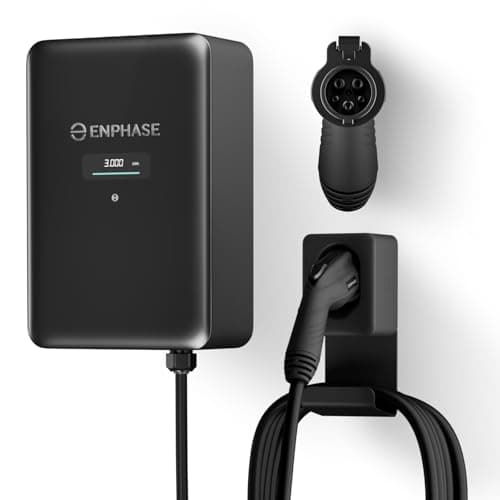 Enphase IQ EV Charger 2 (48 A)The charger to buy if you have solar: it adjusts in 1 A increments to absorb whatever the array is exporting, and it carries a 5-year warranty, the longest here. | A house with rooftop solar | 8.7 | $1,011.60View on Amazon $1,124.00 list · 10% off |
| 2 | 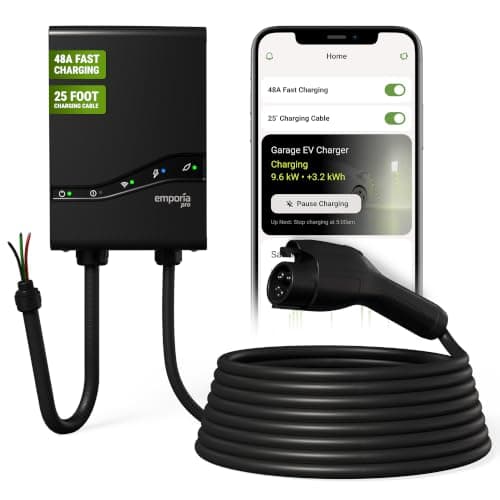 Emporia Pro Level 2 EV ChargerThe best-balanced 48 A charger for a typical US house: full 11.5 kW hardwired, and the only unit at this price that ships with a whole-home energy monitor so its load management is reading your actual panel rather than guessing. | Most households, and anyone with a tight panel | 9.0 |
The specifications, side by side
| Enphase IQ EV Charger 2 | Emporia Pro | |
|---|---|---|
| Max output | 48 A / up to 11.5 kW | 48 A / 11.5 kW hardwired; 40 A on a plug |
| Breaker | 60 A two-pole | 60 A two-pole at 48 A; 50 A at 40 A |
| Connector | J1772 | J1772 or NACS, chosen at purchase |
| Install | Hardwired | Hardwired or plug-in |
| Cable | Manufacturer published | 25 ft |
| Enclosure | NEMA 4 | NEMA 4 |
| Certification | UL certified | UL certified, ENERGY STAR |
| Output granularity | 1 A increments, to track surplus solar | PowerSmart load management |
| Energy monitoring | Through the Enphase system | Vue whole-home monitor included |
| Warranty | 5 years | 3 years |
Two different definitions of a smart charger
Both of these are sold as intelligent, and the word means something different in each case. Getting this right is the entire purchase decision, because the feature you are paying for is worthless if it is pointed at a problem you do not have.
The Enphase is clever about production. Its output steps in 1 A increments, which is fine enough to follow an array's output as clouds move across it. The point is to charge the car on electricity you generated rather than exporting it at whatever your utility pays and reimporting it at retail that evening. Without an array, that capability does nothing at all.
The Emporia is clever about consumption. It ships with the Vue whole-home energy monitor, which goes in the panel and measures what the house is actually drawing. PowerSmart then throttles the charger when the dryer and the oven and the heat pump are all running, instead of letting the main breaker decide. That is a load-management feature, and it is aimed at a house with a tight service rather than a roof with panels on it.
Where the Enphase wins
- Solar tracking that is actually fine-grained. A 1 A step at 240 V is about 240 W of resolution. A charger that can only move in 6 A jumps spends most of a partly cloudy afternoon either importing from the grid or leaving surplus on the table.
- A 5 year warranty. The longest term published by any home charger we recommend, against a category norm of three. Our warranty comparison puts that in context, including why the company behind the term matters as much as the number.
- It joins a system instead of fighting one. If the roof is already Enphase, the charger appears in the same app as the microinverters and the battery, and the surplus logic has first-party data to work from rather than inference.
Where the Emporia wins
- It solves the problem more households actually have. Far more US houses have a marginal electrical panel than have rooftop solar. If a load calculation says your service is tight, the included monitor plus PowerSmart is the feature that keeps you out of a panel upgrade.
- A 25 ft cable, published. Long enough to cross a two-car garage without an extension, which is one of the most common sources of regret on any charger purchase. See our cable length guide.
- NACS or J1772, and hardwired or plug-in. Four configurations against the Enphase's one. If the car has a NACS port, or the house has a usable 14-50 outlet, that flexibility is worth more than any app feature.
- ENERGY STAR certification, which some utility rebate programs require. Check your own utility's list before you buy — our rebates page explains what to look for now that the federal credit has lapsed.
What they share
Both hardwire at 48 A onto a 60 A two-pole breaker with 6 AWG copper, per NEC 625.41's 125% continuous-load rule. Both carry a NEMA 4 enclosure and a real UL certification rather than a generic electrical mark. Both deliver 11.5 kW, which is the onboard AC limit of most current BEVs, so neither charges a given car faster than the other.
Both are also app-first: neither has a physical amperage selector or a mechanical timer. If that is a dealbreaker, the honest answer is a different charger entirely — best EV chargers without an app exists for exactly this reader.
The plug-in Enphase, if you only want the solar part
Enphase also sells the IQ EV Charger 2 as a 40 A unit on a NEMA 14-50 cord. It keeps the 1 A solar tracking and the 5 year warranty, drops to 9.6 kW, and plugs into an existing outlet instead of needing a new circuit. For a solar household with a correctly installed 14-50 already on the wall, that is the cheapest route into surplus charging — with the usual caveat that a receptacle circuit needs a GFCI breaker under NEC 625.54.
Solar plus an existing 14-50 outlet
Enphase IQ EV Charger 2 (40 A, NEMA 14-50)
The same solar tracking on a plug, for a house that already has the outlet.
If neither is quite right
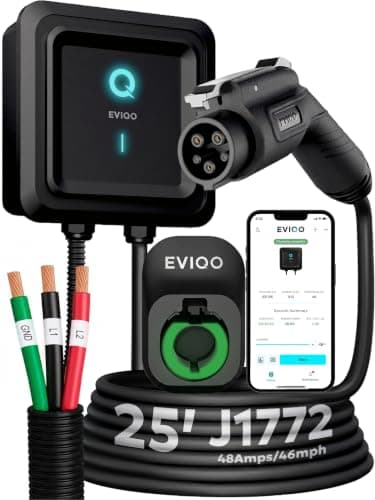
- You want the cheapest real 48 A unit. The EVIQO 48 A hardwires at 11.5 kW for considerably less, with a newer brand behind it. Our EVIQO against the Emporia head-to-head is the direct comparison.
- You drive a Tesla. Best NACS home chargers covers the units that skip the adapter.
- You want more solar options. Best EV chargers for solar ranks four units on output granularity rather than amperage, and explains why that is the specification that matters with an array.
- You are not sure 48 A is the right target at all. Start at what amp EV charger do I need and work from your car's onboard limit and your panel's headroom, not from the biggest number available.
What your electrician needs to know
The charger circuit is the same for both — a 60 A two-pole breaker and 6 AWG copper at 75 degC terminations for 48 A, hardwired, no GFCI breaker required. The difference is what else happens inside the panel.
- The Emporia needs panel time. The Vue monitor's current transformers clamp around the service conductors, and the monitor itself needs a spot and a power feed. That is extra labor on the same visit, and it is much cheaper done then than on a second call.
- The Enphase needs commissioning against the array. If the roof is Enphase, the charger is added to the existing system rather than configured standalone, which usually means the solar installer rather than a general electrician.
- Panel space is finite. On a crowded load center, a 60 A two-pole breaker plus monitor hardware can be the point at which a panel upgrade enters the conversation. Run the load calculation first.
- Both are permitted work. Hardwired EVSE needs a permit and an inspection in nearly every US jurisdiction — see our permits guide.
The verdict, naming a loser
How we compared them
Both units were checked for stock and for a matching manufacturer listing on the date at the top of this page. Every specification here comes from the manufacturer's own published documentation, cited at the foot of the page; where a figure is not published we say so instead of repeating one from a retailer listing. We do not bench-test chargers, and our methodology says so. Prices in the buy rows are live from the retailer and play no part in the ranking.