The short answer
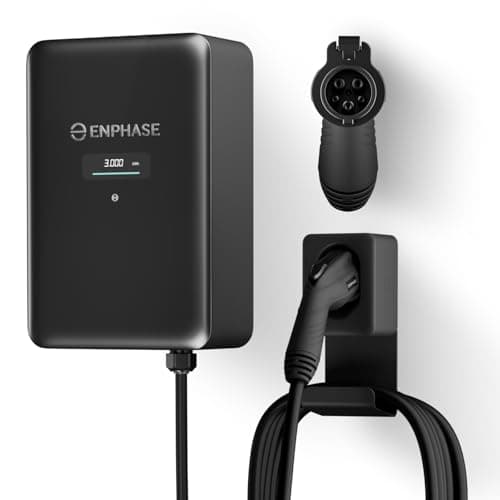
The Enphase IQ EV Charger 2 is the charger to buy if you have rooftop solar: it adjusts in 1 A increments to absorb whatever your array is exporting, delivers 48 A / up to 11.5 kW hardwired, is NEMA 4 and UL certified, and carries a five-year warranty — the longest of any unit on this site. Without an array, it is an expensive 48 A charger whose headline feature does nothing.
That is an unusually conditional recommendation, and it should be. Solar tracking is a real, substantial feature that changes the economics of charging — and it is entirely inert on a house with no panels.
Who this is for
- A house with rooftop solar, particularly one on unfavourable export terms where surplus is being sold cheaply and charging happens at night at a higher rate.
- An existing Enphase system, where the charger integrates rather than competes.
- Anyone who wants the longest warranty available. Five years against the three that is standard here.
- A large, inefficient vehicle, where the full 48 A is genuinely needed and the longer warranty on a hard-worked charger is worth something.
Who should buy something else instead
A longer list than usual, because this charger is specifically for one situation:
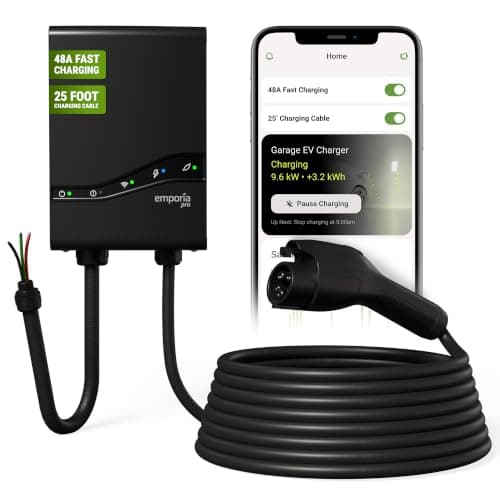
- You have no solar. The feature you are paying a premium for does nothing. Buy the Emporia Pro, which costs less and includes an energy monitor.
- You have favorable net metering. If your utility credits exports at or near retail, charging on surplus rather than exporting it saves much less. Solar EV charging at home covers what to check.
- Your panel is tight. This charger adjusts its output; it does not watch whole-home draw and throttle. The Emporia Pro does, and that is what avoids service upgrades.
- You are not in the Enphase ecosystem. The integration story is strongest inside it and thinner outside, which is worth knowing before you build around it.
- Budget matters. This is the most expensive non-Tesla unit here.
What solar tracking actually does
A conventional charger draws its set current whenever it is charging. If your array is producing 4 kW and the house is using 1 kW, 3 kW is going to the grid — and a 48 A charger that starts up pulls 11.5 kW, most of it bought from the utility.
A solar-tracking charger varies its draw to match the surplus. 1 A increments matter here specifically because solar output is not stable: a cloud passing over an array changes production in seconds, and a charger that can only step in 8 A jumps either over-draws from the grid or under-uses the surplus.
| Your situation | Does solar tracking help? |
|---|---|
| Solar, poor export rate, you charge during the day | Yes, substantially |
| Solar, poor export rate, you charge overnight on a cheap tariff | Some — it can shift daytime top-ups |
| Solar, favorable net metering at retail rate | Much less — exporting and importing are near-equivalent |
| Solar, you are never home during the day | Little, unless the car is |
| No solar | No. Buy something else |
The honest summary: this charger's feature is worth real money to a specific household and nothing to most. We would rather say that than describe it as a universally better charger.
The five-year warranty
Worth separating from the solar argument, because it stands on its own. Three years is the norm in this category; Tesla's Universal is four; this is five. On a device bolted to a house and working hard every night, the longest warranty from an established manufacturer has value independent of any other feature.
What this charger needs from your electrical system
| Item | Requirement | Code basis |
|---|---|---|
| Charger output | 48 A / 11.5 kW | Manufacturer published |
| Breaker | 60 A, two-pole | NEC 625.41 — 125% of a continuous load; NEC 625.42 makes EV charging continuous |
| Copper conductor (conduit, 75 degC) | 6 AWG | NEC Table 310.16 |
| GFCI breaker | Not required — NEC 625.54 covers receptacles | NEC 625.54 |
| Install type | hardwired | Manufacturer published |
Known issues, from owner reports
- Price. The most expensive non-Tesla unit we recommend, and the premium is only justified by the solar feature or the warranty.
- Hardwired only, so it does not move with you.
- The integration story is Enphase-centric. Owners outside that ecosystem report the experience is less seamless, which is unsurprising and worth knowing.
- No whole-home load management in the sense the Emporia Pro offers. Solar tracking and load management are different problems.
- Enphase publishes multiple amperage SKUs (40, 48, 64 and 80 A versions exist). Confirm which one you are ordering, because the circuit it needs follows from that.
What the install needs
A 60 A two-pole breaker and 6 AWG copper for the 48 A version, per NEC 625.41 and Table 310.16. Hardwired, so no GFCI breaker is required under NEC 625.54.
If you are having solar work done at the same time, this is the moment to coordinate: the charger, the array's monitoring and any panel work are one conversation rather than three. It is also the moment to fit panel-level surge protection, which is cheap while the panel is open.
Protecting a charger that is wired into the panel
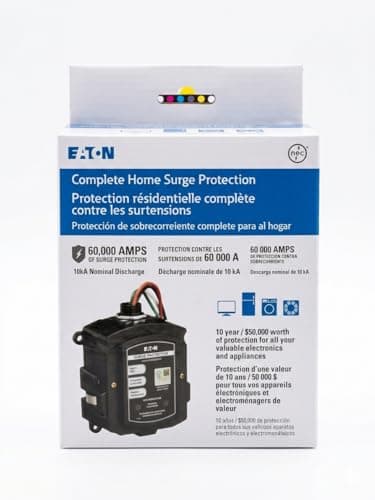
Eaton CHSPT2ULTRA Whole-Home Surge Protector
A Type 2 device at the panel. On a house with an array and a hardwired charger, there is a lot of power electronics worth protecting and nothing to plug a surge strip into.