Skip to content
EV & Charger

Our picks

Best Hardwired EV Chargers

Full 48 amps, no GFCI breaker, and nothing in the current path that can loosen over ten years of nightly use.

By Mike M.Published Last verified

A wall-mounted Level 2 EV charger installed on the exterior wall of a house

The short answer

Hardwiring gets you the charger's full 48 A / 11.5 kW, needs no GFCI breaker (NEC 625.54 applies to receptacles, not to directly connected equipment), and removes the plug and receptacle from the current path entirely. The Emporia Pro is our pick; the Tesla Wall Connector is the choice for a Tesla-only household. The only reason not to hardwire is that you might move.

Quick picks

Ranked by fit for the stated use case first, then price, then warranty and support. Tap any row to jump to the full assessment. Commission rate plays no part in the order.

#ProductBest forScorePrice
1
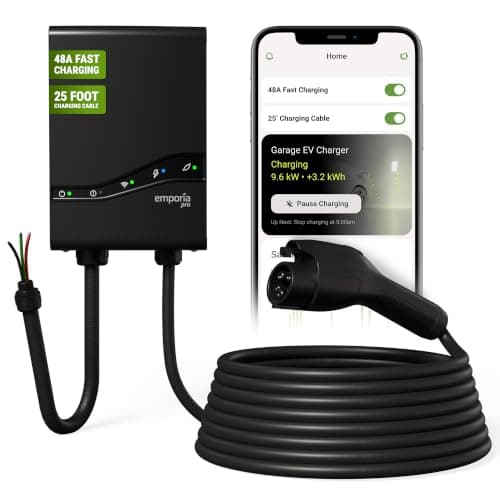
Emporia Pro Level 2 EV Charger
Emporia Pro Level 2 EV ChargerThe best-balanced 48 A charger for a typical US house: full 11.5 kW hardwired, and the only unit at this price that ships with a whole-home energy monitor so its load management is reading your actual panel rather than guessing.
Most households, and anyone with a tight panel9.0
2
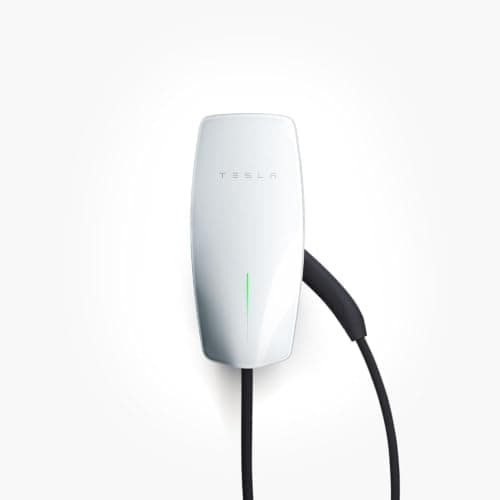
Tesla Wall Connector (Gen 3)
Tesla Wall Connector (Gen 3)If every car in the driveway is a Tesla, this is the cleanest answer: 48 A, a 24 ft cable, and a handle that opens the charge port for you — but it is NACS-only, so a J1772 car needs an adapter every single time.
A Tesla-only household8.8
3
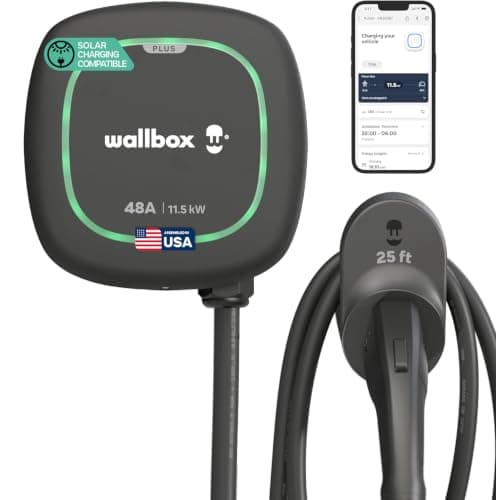
Wallbox Pulsar Plus 48 A
Wallbox Pulsar Plus 48 AA genuinely small 48 A charger — under 8 inches square — which is the deciding factor when the only spot left is a narrow strip of wall beside the panel.
The smallest 48 A unit on a wall8.5
4
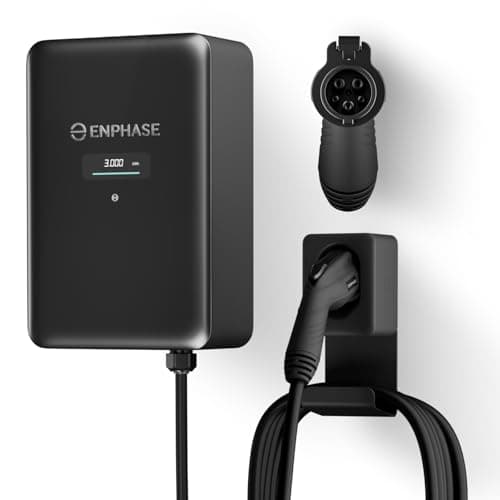
Enphase IQ EV Charger 2 (48 A)
Enphase IQ EV Charger 2 (48 A)The charger to buy if you have solar: it adjusts in 1 A increments to absorb whatever the array is exporting, and it carries a 5-year warranty, the longest here.
A house with rooftop solar8.7
5
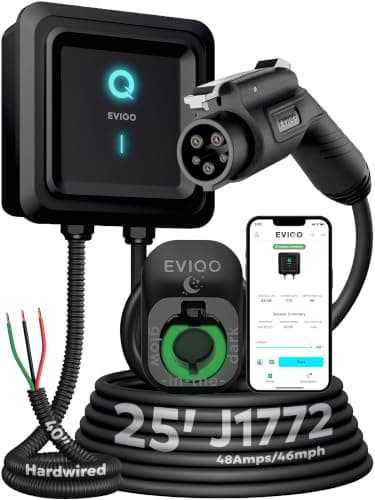
EVIQO Level 2 EV Charger (48 A, hardwired)
EVIQO Level 2 EV Charger (48 A, hardwired)The cheapest way to get a genuine 11.5 kW hardwired install, with IP66/NEMA 4 weatherproofing and an internal switch for 16/32/40/48 A.
48 A on a budget8.4
$449.99View on Amazon

$510.00 list · 12% off

6
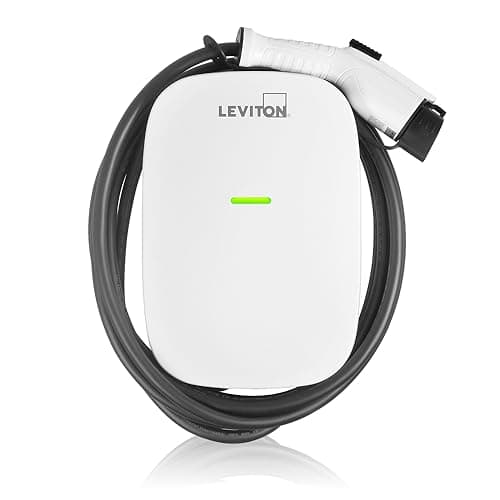
Leviton Level 2 EV Charger (48 A, hardwired)
Leviton Level 2 EV Charger (48 A, hardwired)48 A and 11.6 kW from a company your electrician already stocks, which matters more than it sounds: a warranty claim on a Leviton goes through a supply house, not a startup's support queue.
An electrician's default brand8.2

Why hardwiring is the better install

Hardwired against plug-in, the differences that matter
HardwiredPlug-in
Maximum continuous outputThe charger's full rating — 48 A40 A, being 80% of a 50 A circuit
Power at 240 V11.5 kW9.6 kW
GFCI breaker requiredNoYes — NEC 625.54
Nuisance tripping riskLowReal — GFCI plus EVSE is the classic pairing
Connections in the current pathOne terminal blockTerminal block, plug and receptacle
Typical 10-year failureRareReceptacle contacts heating and browning
Parts you do not have to buyGFCI breaker and receptaclen/a
Moves house with youNoYes
The 40 A ceiling on a plug-in install comes from EV charging being a continuous load under NEC 625.42, and a circuit carrying only 80% of its rating continuously. Full comparison on hardwired vs plug-in.
Hardwired against plug-in, the parts that differSide by side comparison showing a hardwired charger spliced directly to the branch circuit versus a plug-in charger on a NEMA 14-50 receptacle with a GFCI breaker.Hardwired60A48 Adirect spliceFull 48 A · no GFCI breaker required · nothing to loosenNEC 625.54 applies to receptacles, not to directly connected equipment.Plug-inGFCI14-5040 A40 A ceiling · GFCI breaker required · moves house with youThe receptacle and the GFCI breaker are the two parts that cause trouble.
The receptacle and the GFCI breaker are the whole difference — and both are failure points a hardwired install does not have.

Note the row about parts you do not have to buy. A GFCI breaker costs several times a standard one, and an industrial-grade NEMA 14-50 receptacle is not cheap either. Hardwiring removes both from the bill of materials, which partly offsets the slightly higher labor.

The GFCI point, properly

NEC 625.54 in both the 2020 and 2023 editions requires GFCI protection for all receptacles installed for the connection of EV charging. The outlet supplying direct-connected EVSE is not required to be GFCI protected unless the manufacturer's instructions specify it.

That matters beyond the cost of the breaker, because GFCI plus EVSE is the most common source of nuisance tripping in home charging. Your charger already contains its own ground-fault protection — commonly at a 20 mA threshold — and a Class A GFCI breaker trips at 5 mA. Normal leakage from a long charging cable can reach that. Hardwiring removes the whole interaction. Our GFCI page covers it in full.

What we ranked on

  • Full 48 A hardwired output, which is the point of this page.
  • Cable length, where the 18 ft Leviton is a genuine limitation against 24-25 ft elsewhere.
  • Load management, because a hardwired 48 A unit is the largest sustained load most houses carry.
  • Enclosure and temperature range, since a hardwired unit is not moving once it is fitted.
  • Warranty length, where Enphase's five years stands out on a device you are committing to.

The one real downside

It does not come with you. If you may move within a few years, a plug-in charger is a possession and a hardwired one is a fixture. That is the whole argument on the other side, and for a renter it is decisive — see portable chargers for renters.

Worth knowing: several units here are sold in both configurations — the Emporia Pro, EVIQO 48 A, ChargePoint Home Flex and Grizzl-E among them. So starting plug-in and hardwiring the same unit later is possible, with the caveat that going to 48 A also means a 60 A breaker and heavier conductors rather than just a different connection.

What a hardwired install needs

The circuit side of a hardwired 48 A install

A 60 A two-pole breaker and 6 AWG copper, per NEC 625.41 and Table 310.16. Breakers are panel-specific — check what your load center takes.
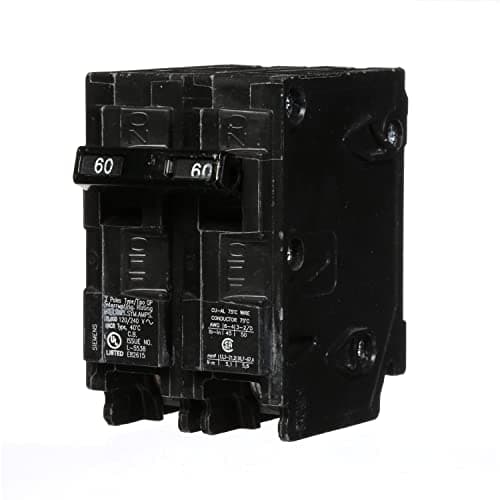
Siemens Q260 60 A Double-Pole Breaker

A 48 A charger in a Siemens or Murray panel

Siemens Q260 60 A Double-Pole Breaker

The standard 60 A two-pole breaker for a 48 A hardwired charger — 48 A x 125% = 60 A, exactly as NEC 625.41 requires.

$19.39View on Amazon

#ad Price as of October 5, 2026. How we make money
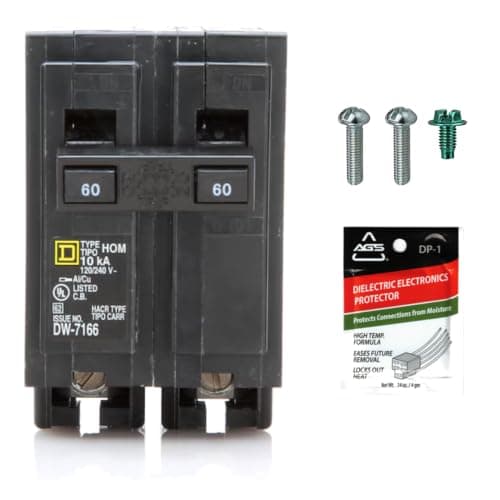
Square D HOM260 60 A Double-Pole Breaker

A 48 A charger in a Square D Homeline panel

Square D HOM260 60 A Double-Pole Breaker

The Homeline 60 A two-pole, for the single most common residential panel in the US. Match the breaker to the panel's listing, not to price.

$26.99View on Amazon

#ad Price as of October 5, 2026. How we make money
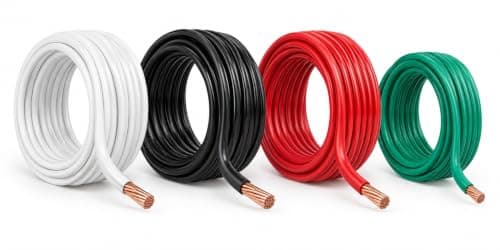
6 AWG THHN Copper Wire Set with 8 AWG Ground (50 ft)

A 60 A circuit for a 48 A charger

6 AWG THHN Copper Wire Set with 8 AWG Ground (50 ft)

6 AWG copper carries 65 A at 75 degC, which is what a 60 A breaker and a 48 A charger require. Buying the conductors as a matched set with the correctly sized equipment ground saves a trip.

$277.82View on Amazon

#ad Price as of October 5, 2026. How we make money
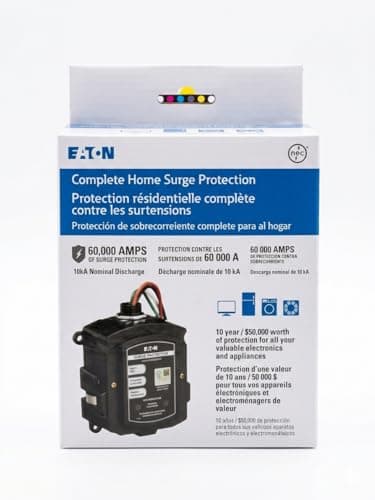
Eaton CHSPT2ULTRA Whole-Home Surge Protector

Protecting a charger that is wired into the panel

Eaton CHSPT2ULTRA Whole-Home Surge Protector

A panel-mounted Type 2 device rated at 60 kA. A hardwired charger has no plug to put a surge strip on, so the protection has to live at the panel — and it is cheap next to the charger it protects.

$70.99View on Amazon

$79.99 list · 11% off

#ad Price as of October 5, 2026. How we make money

We earn commission on qualifying purchases at no cost to you. Affiliate disclosure.

How we picked

Every unit here is currently purchasable, carries a real UL or ETL certification to an EVSE standard, and comes from a brand with an identifiable North American support path. We verified each one's published specifications against the manufacturer's own documentation on the date shown at the top of this page. We verify specifications; we do not bench-test chargers, and our methodology says so in plain terms. Ranking order is fit for the stated use case first, then price, then warranty and support — commission rate plays no part in it.
In detail

Every pick, assessed

Top pick · Most households, and anyone with a tight panel

Emporia Pro Level 2 EV Charger

Emporia Pro Level 2 EV Charger charger

9.0/ 10

$599.00View on Amazon

#ad Price as of October 5, 2026. How we make money

Our verdict

The best-balanced 48 A charger for a typical US house: full 11.5 kW hardwired, and the only unit at this price that ships with a whole-home energy monitor so its load management is reading your actual panel rather than guessing.

What works

  • Hardwires at the full 48 A for 11.5 kW — matches the onboard limit of most current BEVs exactly
  • PowerSmart load management reads whole-home draw through the included Vue monitor, so it can throttle instead of tripping a breaker
  • 25 ft cable reaches across a two-car garage without an extension
  • NEMA 4 enclosure and a real UL listing, not just an ETL mark

What doesn't

  • The energy monitor has to be installed in the panel to be useful, which means the electrician is in there longer
  • App-dependent for scheduling — there is no physical timer
  • At 40 A on the plug-in version you are paying for 48 A of hardware you cannot use
Emporia Pro Level 2 EV Charger specifications
Max output48 A / 11.5 kW hardwired; 40 A / 9.6 kW on a NEMA 14-50 plug
Breaker60 A dedicated 2-pole for 48 A; 50 A for 40 A
Cable25 ft
ConnectorJ1772 or NACS, chosen at purchase
EnclosureNEMA 4, indoor or outdoor
CertificationUL certified, ENERGY STAR
Warranty3 years
Load managementPowerSmart, with the Vue home energy monitor included

Specifications checked against Emporia Pro sell sheet. We verify published specifications; we do not bench-test hardware — how we assess products.

How it scored

Fit to a typical panel
9.4
Charge rate
9.0
Cable and reach
9.0
Smart features
9.2
Weather and build
8.6
Warranty and support
8.4
Pick 2 · A Tesla-only household

Tesla Wall Connector (Gen 3)

Tesla Wall Connector (Gen 3) charger

8.8/ 10

$885.00View on Amazon

#ad Price as of October 5, 2026. How we make money

Our verdict

If every car in the driveway is a Tesla, this is the cleanest answer: 48 A, a 24 ft cable, and a handle that opens the charge port for you — but it is NACS-only, so a J1772 car needs an adapter every single time.

What works

  • 24 ft cable, the longest of the mainstream premium units
  • Auto-sensing handle opens a Tesla charge port without touching the car
  • Power sharing lets two units share one circuit, which is rare at this price
  • Wi-Fi with over-the-air firmware updates

What doesn't

  • NACS only — every J1772 car in the household needs an adapter on the handle
  • Hardwired only, so it is not coming with you if you move out of a rental
  • Setup runs through Tesla's app flow even if you do not own a Tesla
Tesla Wall Connector (Gen 3) specifications
Max output48 A / 11.5 kW
Output range12-48 A
Input200-240 V AC single phase
Breaker60 A dedicated 2-pole for 48 A output
Cable24 ft
ConnectorNACS
InstallHardwired

Specifications checked against Tesla Gen 3 Wall Connector installation manual. We verify published specifications; we do not bench-test hardware — how we assess products.

How it scored

Fit to a typical panel
8.8
Charge rate
9.0
Cable and reach
9.6
Smart features
8.6
Weather and build
9.2
Universality
5.5
Pick 3 · The smallest 48 A unit on a wall

Wallbox Pulsar Plus 48 A

Wallbox Pulsar Plus 48 A charger

8.5/ 10

$799.99View on Amazon

#ad Price as of October 5, 2026. How we make money

Our verdict

A genuinely small 48 A charger — under 8 inches square — which is the deciding factor when the only spot left is a narrow strip of wall beside the panel.

What works

  • The smallest 48 A box here — matters more than people expect in a crowded garage
  • Bluetooth control works without an internet connection, so scheduling survives a Wi-Fi outage
  • Full 11.5 kW at 48 A
  • NEMA Type 4 to UL 50E

What doesn't

  • -22 degF lower limit is the narrowest cold rating of the units we recommend
  • Hardwired only
  • Costs more than the Emporia Pro for the same charge rate and no energy monitor
Wallbox Pulsar Plus 48 A specifications
Max output48 A / 11.5 kW
Input voltage240 / 208 V
Breaker60 A dedicated 2-pole
Cable25 ft
Dimensions7.8 in W x 3.9 in D x 7.9 in H
EnclosureNEMA Type 4 per UL 50E, indoor or outdoor
Temperature-22 degF to 104 degF
Warranty3 years limited
InstallHardwired

Specifications checked against Wallbox Pulsar Plus North America datasheet. We verify published specifications; we do not bench-test hardware — how we assess products.

How it scored

Footprint
9.8
Charge rate
9.0
Cable and reach
9.2
Smart features
8.8
Cold-weather fitness
7.0
Value
7.2
Pick 4 · A house with rooftop solar

Enphase IQ EV Charger 2 (48 A)

Enphase IQ EV Charger 2 (48 A) charger

8.7/ 10

$1,124.00View on Amazon

#ad Price as of October 5, 2026. How we make money

Our verdict

The charger to buy if you have solar: it adjusts in 1 A increments to absorb whatever the array is exporting, and it carries a 5-year warranty, the longest here.

What works

  • 1 A solar tracking is a real feature, not a marketing line — it is the difference between exporting at the retail rate and charging for free
  • 5-year warranty, the longest of any unit here
  • Integrates with an existing Enphase system rather than fighting it

What doesn't

  • Most expensive non-Tesla unit here, and the solar feature is worth nothing without an array
  • Hardwired only
  • The integration story is strongest inside the Enphase ecosystem and thinner outside it
Enphase IQ EV Charger 2 (48 A) specifications
Max output48 A / up to 11.5 kW at 240 V
Breaker60 A dedicated 2-pole
ConnectorJ1772
InstallHardwired
EnclosureNEMA 4
CertificationUL certified
Warranty5 years
SolarAdjusts in 1 A increments to track surplus solar

Specifications checked against Enphase IQ EV Charger 2 product documentation. We verify published specifications; we do not bench-test hardware — how we assess products.

How it scored

Solar integration
9.8
Charge rate
9.0
Warranty and support
9.6
Smart features
9.2
Weather and build
8.8
Value
6.2
Pick 5 · 48 A on a budget

EVIQO Level 2 EV Charger (48 A, hardwired)

EVIQO Level 2 EV Charger (48 A, hardwired) charger

8.4/ 10

$449.99View on Amazon

$510.00 list · 12% off

#ad Price as of October 5, 2026. How we make money

Our verdict

The cheapest way to get a genuine 11.5 kW hardwired install, with IP66/NEMA 4 weatherproofing and an internal switch for 16/32/40/48 A. The trade is a younger brand with a shorter support record.

What works

  • Full 48 A for well under the price of the premium 48 A units
  • IP66 plus NEMA 4 is a stronger weather rating than the price suggests
  • Amperage switch is internal and physical, so it survives app changes
  • 25 ft cable

What doesn't

  • EVIQO is a newer brand than ChargePoint, Tesla or Emporia; the warranty is only worth the company behind it
  • Ships set to 40 A, so a surprising number of owners never get the 48 A they paid for
  • EVIQO also publishes its own 'best charger' buying guides, which is a conflict worth knowing about when you read them
EVIQO Level 2 EV Charger (48 A, hardwired) specifications
Max output48 A / 11.5 kW hardwired; 40 A / 9.6 kW on a 14-50 plug
Adjustable output16, 32, 40 (default) or 48 A via an internal switch
Breaker60 A dedicated 2-pole for 48 A
Cable25 ft
ConnectorJ1772
EnclosureIP66 / NEMA 4
CertificationETL certified, ENERGY STAR, FCC; built to UL and CSA standards
Warranty3 years standard

Specifications checked against EVIQO hardwired charger specifications. We verify published specifications; we do not bench-test hardware — how we assess products.

How it scored

Value
9.6
Charge rate
9.0
Cable and reach
9.2
Weather and build
8.8
Smart features
7.4
Warranty and support
6.8
Pick 6 · An electrician's default brand

Leviton Level 2 EV Charger (48 A, hardwired)

Leviton Level 2 EV Charger (48 A, hardwired) charger

8.2/ 10

$704.85View on Amazon

#ad Price as of October 5, 2026. How we make money

Our verdict

48 A and 11.6 kW from a company your electrician already stocks, which matters more than it sounds: a warranty claim on a Leviton goes through a supply house, not a startup's support queue.

What works

  • Leviton's distribution means parts and warranty support go through normal electrical channels
  • Full 48 A
  • A Wi-Fi version exists if you want scheduling

What doesn't

  • 18 ft cable is the shortest here — this is the spec that most often forces a second mounting decision
  • Priced like a premium unit without a premium app
  • Hardwired only
Leviton Level 2 EV Charger (48 A, hardwired) specifications
Max output48 A / 11.6 kW at 208/240 VAC
Breaker60 A dedicated 2-pole
Cable18 ft
ConnectorJ1772
InstallHardwired, indoor or outdoor

Specifications checked against Leviton EV charging product specifications. We verify published specifications; we do not bench-test hardware — how we assess products.

FAQ

Questions people actually ask

What is the best hardwired EV charger?

The Emporia Pro for most households — full 48 A, a 25 ft cable, and load management with an included energy monitor. The Tesla Wall Connector for a Tesla-only driveway, and the Enphase IQ EV Charger 2 if you have solar or want a five-year warranty.

Is a hardwired EV charger better than a plug-in one?

For a homeowner, generally yes: it reaches the full 48 A, needs no GFCI breaker, and has no receptacle to degrade over a decade of nightly use. The only real advantage of plug-in is portability.

Does a hardwired EV charger need a GFCI breaker?

Generally no. NEC 625.54 requires GFCI protection for receptacles installed for EV charging; directly connected equipment is outside that requirement unless the manufacturer's instructions call for it. Always check the manual, which is enforceable under NEC 110.3(B).

Can I hardwire a charger that came with a plug?

On units sold in both configurations, often yes — check the specific model's manual. Note that going from a plug-in 40 A install to a hardwired 48 A one also means a 60 A breaker and 6 AWG copper, not just a different connection.

Does hardwiring cost more to install?

The labor is similar, and hardwiring removes a GFCI breaker and an industrial receptacle from the bill of materials — which partly offsets it. The larger cost difference is the amperage: 48 A needs 6 AWG copper and a 60 A breaker where 40 A needs 8 AWG and 50 A.

Sources

What we checked this against

Read next

Disclosure. Some links on this page are affiliate links. If you buy through one, we earn a commission at no extra cost to you. We are a participant in the Amazon Services LLC Associates Program. Prices come from Amazon's live data and are shown with the date they were checked; where no live price is available we say "check price" rather than show an old number. Commission rate plays no part in which products we recommend or in what order — see our methodology and our full affiliate disclosure.