The short answer
Leviton's home chargers are worth paying for when your electrician's supply house stocks them — a warranty claim goes through normal electrical distribution instead of a startup's inbox. Of the three, the EV40P (40 A, 25 ft cord, Wi-Fi) is the one we would buy. The hardwired EV480 and EV320 are solid, but their cable is 18 ft and the warranty is 2 years.
We verified this unit's published specifications against the manufacturer's own documentation on the date shown at the top of this page, and confirmed it is currently purchasable before writing a word of it. We verify specifications; we do not bench-test hardware — our methodology says so in plain terms, and anything in the "known issues" section below is labeled as owner reports rather than a finding of ours. Commission rate plays no part in the verdict or in which alternative we point you at.
The three units, and which one is yours
Leviton sells a wider EV range than most people realize, including 80 A commercial units and Wi-Fi variants of each wall box. For a house, three models matter. All three are certified to the EVSE standards (UL 2594, UL 2231), are cETLus listed, carry an ENERGY STAR certification and are OCPP 1.6 compliant — a detail that matters almost nowhere residentially and matters enormously if the charger ever has to report to a network.
| Model | Output | Cable | Install | Smart | Enclosure |
|---|---|---|---|---|---|
| EV480 | 48 A / 11.6 kW | 18 ft | Hardwired only | No (EV48W adds Wi-Fi) | NEMA Type 3R |
| EV320 | 32 A / 7.6 kW | 18 ft | Hardwired only | No (EV32W adds Wi-Fi) | NEMA Type 3R |
| EV40P | 40 A / 9.6 kW | 25 ft | NEMA 14-50 plug | Wi-Fi, My Leviton app | NEMA Type 3R |
Match that against the lower of two numbers — what your car accepts, and what your panel will give up. A Wrangler 4xe or an entry Model 3 RWD cannot use more than 32 A, so the EV320 on a 40 A circuit is the correct and cheaper purchase. A Model Y, Ioniq 5, Mach-E or EV6 will take 48 A, which is the EV480's argument. Our onboard charger limits table lists every model we cover with its source.
Why anyone pays Leviton prices
This is the part that does not show up on a spec sheet, and it is the honest reason to choose Leviton over a cheaper 48 A unit with better numbers.
- Your electrician can get one tomorrow. Leviton moves through the same distribution as the breakers, receptacles and load centers already in your house. No drop-ship wait, no "we don't install customer-supplied equipment" conversation.
- A warranty claim has a real channel. Two years is short (see below), but within it you are dealing with a 100-year-old wiring-device manufacturer through a supply house rather than chasing a support queue.
- One app for the house, not just the car. The My Leviton app that runs the EV40P also runs Leviton's smart load center and switches. If you already have that, the charger joins something rather than adding another account.
- NEC 625 compliance is table stakes for them. Leviton lists conformance to UL 2594, UL 2231-1/-2, UL 2251, UL 991, UL 1998, UL 840 and NFPA 70 Article 625 on each product page — the full EVSE file, not a generic electrical mark.
The 18 foot cable is the real decision
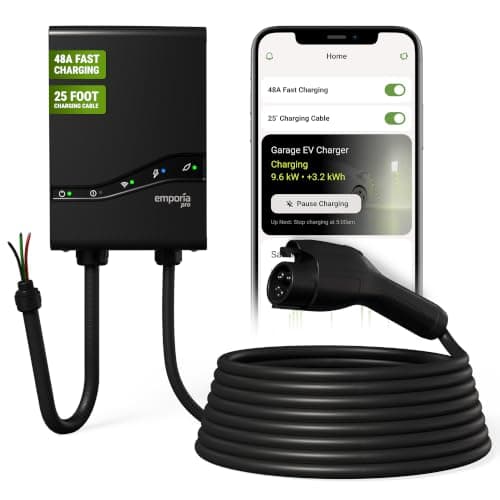
This is the specification that causes post-install regret, and on the EV480 and EV320 it is the shortest in this price class. For context: the Emporia Pro is 25 ft, the EVIQO 48 A is 25 ft, the Tesla Wall Connector is 24 ft, the ChargePoint Home Flex is 23 ft, and the Lectron Nexus is 23 ft. Eighteen feet is a different mounting problem.
Eighteen feet is fine if the charger lands within about ten feet of the car's charge port and the car always parks the same way round. It is not fine for a two-bay garage where either car might need it, a long driveway, or a charge port on the far side of the vehicle. Measure from the intended mounting point to the port, following the path the cable will actually take, then add three to five feet of slack. Our mounting height and position guide covers the method, and our cable length guide covers what to do when the number comes out short.
NEMA Type 3R, and what it does not promise
All three units are rated NEMA Type 3R in a water-resistant PC+PBT thermoplastic enclosure. Type 3R means protection against rain, sleet and snow. It is a genuine outdoor rating and it is not the same as the NEMA 4 / IP66 rating on a Grizzl-E, an EVIQO or an Autel, which adds protection against directed water — a hose, wind-driven spray, a pressure washer on the driveway.
In practice: Type 3R is right for a sheltered wall, a carport or a garage. For an exposed post, a coastal wall or a driveway you wash down, we would take the NEMA 4 unit. Our guide to IP and NEMA ratings explains the difference properly, and best outdoor EV chargers lists the units we would put in the weather.
The warranty is the weak spot
Leviton publishes a 2 year limited warranty on all three. That is below the class: three years is the norm here — Grizzl-E and EVIQO both give three — the Tesla Universal Wall Connector is four, and the Enphase IQ EV Charger 2 is five. For a device bolted to a wall, living outdoors and carrying 48 A continuously for eight hours a night, the warranty term is not a footnote.
It is also the clearest argument against the premium. You are paying a distribution and brand premium and receiving a shorter warranty than the cheaper competition — offset only by the fact that the claim channel is better. Whether that is worth it depends entirely on whether your electrician is the one sourcing the unit.
What these chargers need from your electrical system
| Model | Breaker | Copper conductor (conduit, 75 degC) | GFCI breaker |
|---|---|---|---|
| EV480 (48 A) | 60 A, two-pole | 6 AWG | Not required — hardwired |
| EV320 (32 A) | 40 A, two-pole | 8 AWG | Not required — hardwired |
| EV40P (40 A) | 50 A, two-pole | 8 AWG | Required — receptacle circuit, NEC 625.54 |
Both hardwired models ship with a mounting bracket and a pre-attached input cable, which shortens the install. Neither can be converted to plug-in — the choice between hardwired and plug-in is made at purchase, not at install, and our hardwired vs plug-in comparison is worth ten minutes before you order.
Who should buy something else instead
- Your load calculation came back marginal. No Leviton home unit ships with a whole-home energy monitor. The Emporia Pro does, and measured load management is the feature most likely to avoid a service upgrade.
- You want the cheapest route to 11.5 kW. The EVIQO 48 A gets there for meaningfully less, with NEMA 4 weatherproofing and a 3 year warranty — giving up the distribution channel and some support depth. If the budget is tighter than that and 40 A is enough, the Lectron Nexus is the cheapest wall box we would recommend.
- The charger is going on an exposed outdoor post. Take the NEMA 4 cast-aluminum Grizzl-E Classic or the -40 degF Autel MaxiCharger instead.
- You need a long cable and you need it hardwired. 18 ft is 18 ft. Start from best 48 amp EV chargers and sort on cable length.
Known issues, from owner reports
Labeled as owner reports rather than tested findings — we verify specifications and do not bench-test hardware.
- The cable is stiff in the cold. A recurring note on the hardwired units, and 18 ft of stiff cable is less forgiving than 25 ft of stiff cable. Relevant mostly in climates that spend weeks below freezing.
- The non-Wi-Fi models really have no app. The EV480 and EV320 as sold are unnetworked. If you want scheduling, either buy the EV48W/EV32W variants, use the EV40P, or let the car enforce the schedule — which is the more robust option anyway.
- RFID is present and off. Leviton's optional RFID access control ships disabled. Useful on a shared driveway, irrelevant in a private garage, and occasionally a source of confusion when someone finds the card reader and assumes the charger is locked.
- GFCI nuisance tripping on the EV40P. The general EVSE-and-GFCI interaction rather than a Leviton fault: the charger has its own ground-fault protection, and a Class A GFCI breaker trips at 5 mA. Full explanation.
The verdict
The three units, with live prices
Ranked the way we would buy them for a typical US house: cable length and install flexibility first, then output.
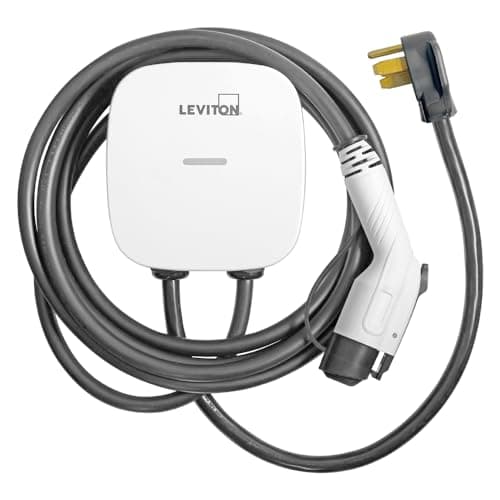
Plug-in with Wi-Fi from a known brand
Leviton Smart EV Charger (40 A, NEMA 14-50)
Leviton's 40 A plug-in with Wi-Fi and a 25 ft cable — the balanced pick in their range.
#ad Price as of October 28, 2026. How we make money
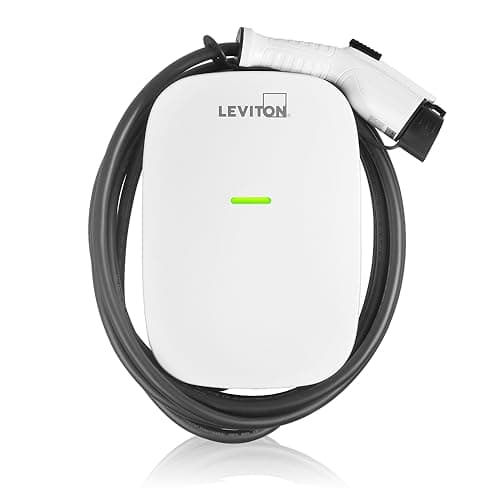
An electrician's default brand
Leviton Level 2 EV Charger (48 A, hardwired)
48 A and 11.6 kW from a company your electrician already stocks, which matters more than it sounds: a warranty claim on a Leviton goes through a supply house, not a startup's support queue.
#ad Price as of October 28, 2026. How we make money
A 40 A circuit, a PHEV, or a 100 A panel
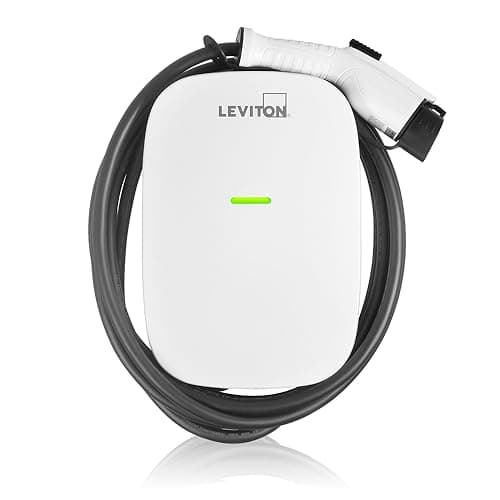
Leviton Level 2 EV Charger (32 A, hardwired)
A 32 A hardwired unit — the right size for a Wrangler 4xe, a Model 3 RWD, or any house whose load calculation will not support more.
#ad Price as of October 28, 2026. How we make money
We earn commission on qualifying purchases at no cost to you. Affiliate disclosure.