The short answer
Buy the Emporia Classic if your panel has clear room for a 60 A two-pole breaker — it is the same 48 A, 25 ft, NEMA 4 charger for less money. Buy the Emporia Pro if your load calculation is tight, because PowerSmart load management is standard on the Pro and a paid add-on on the Classic, and throttling is what lets a charger onto a panel that cannot otherwise take one.
Quick picks
Ranked by fit for the stated use case first, then price, then warranty and support. Tap any row to jump to the full assessment. Commission rate plays no part in the order.
| # | Product | Best for | Score | Price |
|---|---|---|---|---|
| 1 | 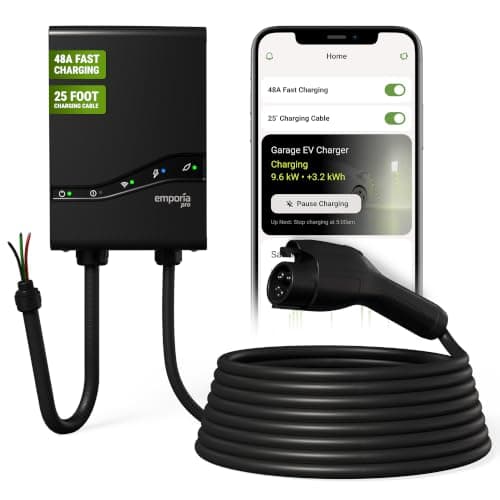 Emporia Pro Level 2 EV ChargerThe best-balanced 48 A charger for a typical US house: full 11.5 kW hardwired, and the only unit at this price that ships with a whole-home energy monitor so its load management is reading your actual panel rather than guessing. | Most households, and anyone with a tight panel | 9.0 | |
| 2 | 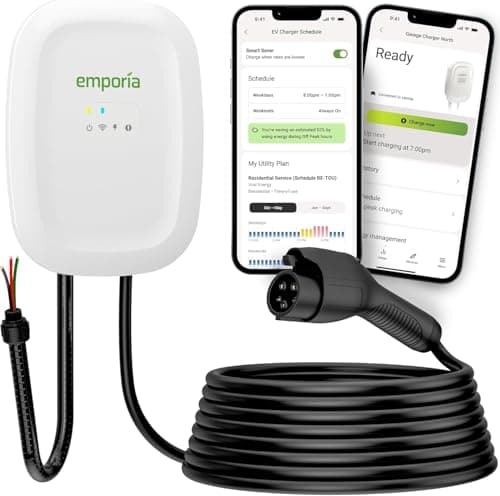 Emporia Classic Level 2 EV ChargerThe same 48 A hardware and the same 25 ft cable as the Pro, minus PowerSmart load management and minus the money. | The cheapest way into real 48 A charging | 8.7 |
What is genuinely the same
This is the unusual comparison where most of the spec sheet matches, so it is worth clearing the identical parts out of the way first. Per Emporia's own product line-up page, both the Classic and the Pro deliver up to 48 A hardwired (40 A on a NEMA 14-50 plug), both ship with a 25 ft cable, both are sold in J1772 and NACS, both carry a NEMA 4 enclosure for indoor or outdoor mounting, both are UL listed and ENERGY STAR certified, and both carry a 3 year warranty.
48 A x 240 V = 11,520 W
11.5 kW — on either unit, on the same breaker
Both chargers hit the same number because both are 48 A devices. No car charges faster on the Pro.
Both also need the same circuit. EV charging is a continuous load under NEC 625.42, and NEC 625.41 requires overcurrent protection at not less than 125% of that load, so 48 A continuous means a 60 A two-pole breaker and, at 75 degC terminations, 6 AWG copper. Nothing about choosing the Pro changes the electrician's quote.
The one difference that matters: PowerSmart
Emporia's own comparison lists PowerSmart Load Management as standard on the Pro and as a paid add-on on the Classic. That single line is the whole decision, so it is worth being precise about what load management does.
A charger with load management watches the whole-house draw at the service conductors and reduces its own output when the house is busy — the dryer, the oven and the heat pump all starting at once. A charger without it draws its configured current regardless, which means the circuit has to be sized for the charger plus everything else running at peak. On a panel with headroom that distinction is academic. On a 100 A service, or a 200 A service already carrying electric heat and an electric range, it is the difference between an afternoon's work and a service upgrade.
| Emporia Classic | Emporia Pro | |
|---|---|---|
| Max output, hardwired | 48 A / 11.5 kW | 48 A / 11.5 kW |
| Max output, NEMA 14-50 | 40 A / 9.6 kW | 40 A / 9.6 kW |
| Breaker for 48 A | 60 A two-pole | 60 A two-pole |
| Cable | 25 ft | 25 ft |
| Connector options | J1772 or NACS | J1772 or NACS |
| Enclosure | NEMA 4 | NEMA 4 |
| Certification | UL, ENERGY STAR | UL, ENERGY STAR |
| Warranty | 3 years | 3 years |
| Scheduling in the app | Yes | Yes |
| Intelligent Load Sharing (two chargers, one circuit) | Yes | Yes |
| PowerSmart load management | Paid add-on | Standard |
| Peak-demand and solar-following charging | Needs a Vue monitor | Needs a Vue monitor |
Both of them want a Vue monitor in the panel
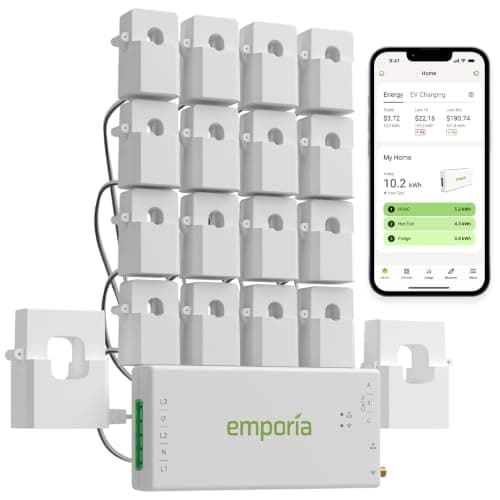
This is the part that catches people, and it catches Pro buyers as often as Classic buyers. Emporia's page lists peak demand management and solar charging as features that work with the Vue home energy monitor — on both units. The Vue is a separate device: current transformers that clamp around the service conductors inside your load center, with up to 16 branch sensors at 50 A each and two 200 A sensors on the mains.
So "the Pro includes load management" is true in the sense that the PowerSmart capability is switched on at no extra cost, and misleading if you read it as "nothing else to buy". If you want the charger to respond to what the rest of the house is doing, something has to be measuring the rest of the house. Our best home energy monitors for EV charging roundup covers the Vue and the alternatives, and EV charger load management explained covers how the throttling actually behaves.
Which one your panel picks for you
Run the load calculation before you run the comparison. Can my electrical panel handle an EV charger walks the arithmetic, and the answer sorts you into one of three groups.
- Comfortable headroom on a 200 A service — gas heat, gas water heater, gas range, and a free slot for a 60 A two-pole. Buy the Classic. You will never switch PowerSmart on.
- Marginal, or you are not sure — an all-electric 200 A service, or a 150 A one, or a calculation that lands within a few amps either way. Buy the Pro. Load management is what keeps this install from becoming a panel upgrade.
- A 100 A service — see EV charger on a 100 A panel first. The Pro plus a Vue is very often the configuration that works, and the Classic on its own very often is not.
Where each one is weak
Neither of these is a perfect charger, and the shared weaknesses are shared precisely because it is the same hardware.
- No physical timer on either. Scheduling is in the app. If the app or the account is down, the charger charges. A unit with on-device scheduling — see best EV chargers without an app — behaves better on a bad Wi-Fi day.
- The plug-in versions cap at 40 A. Buy either of these as a NEMA 14-50 unit and you are paying for 48 A of hardware you cannot use. That is a general rule rather than an Emporia quirk; hardwired vs plug-in explains why.
- The Classic's add-on pricing is a moving target. Emporia sells PowerSmart as an upgrade rather than bundling it, and an add-on price is easier to change than a product price.
- The Vue install is panel work. CTs go around live service conductors. Budget electrician time for it, on either unit.
- Wi-Fi in a garage panel is not guaranteed. Both units are 2.4 GHz Wi-Fi devices living inside or beside a steel box. Check signal where the charger will actually hang before you commit to a smart charger at all.
How these two fit against everything else we recommend
The Pro is our overall pick in best 48 amp EV chargers and it holds up against the obvious rivals: we have run it against the Tesla Wall Connector, the ChargePoint Home Flex, EVIQO and Enphase. The Classic changes one thing about those conclusions: where a comparison turned on price rather than on load management, the Classic is now the cheaper Emporia to put on that side of the table.
If you want the long-form view of the Pro on its own, the Emporia Pro review goes through the enclosure, the app and the warranty in detail. Everything structural in it applies to the Classic too.
The verdict, naming a loser
How we compared them
Both units were checked for stock and for a matching manufacturer listing on the date at the top of this page. Every specification below comes from Emporia's own published documentation, cited at the foot of the page; where Emporia does not publish a figure we say so rather than repeating one from a retailer listing. We verify specifications — we do not bench-test chargers, and our methodology says so in plain terms. Prices in the buy rows are live from the retailer and play no part in the verdict.