The short answer
Load management is a charger measuring your home's total electrical draw in real time and reducing its own output so the service is never overloaded. It matters because of NEC 625.42: the rating of an EVSE installation may be limited through an energy management system rather than taken at nameplate value — so a managed 48 A charger can enter a load calculation at a lower figure and pass where an unmanaged one fails. On a 100 A service, that is frequently the difference between installing a charger and paying for a service upgrade.
The problem it solves
A load calculation adds up everything your electrical service might have to carry at once and compares it against what the service can supply. An unmanaged 48 A charger enters that sum at 60 A — 125% of its continuous output, per NEC 625.41 — and 60 A is a large block of a 100 A service, or even a 150 A one that already has an electric range, a dryer and air conditioning.
48 A x 1.25
60 A of continuous load in the calculation
NEC 625.42 classifies EV charging as a continuous load; 625.41 requires the overcurrent device, and therefore the load entry, at not less than 125%. Our load calculation guide walks through a full calculation.
When that number does not fit, you have historically had three options: a smaller charger, a service upgrade, or no charger. Load management is the fourth.
Three things that all get called load management
This is where buyers get misled, because the term covers a spectrum from genuinely useful to barely anything.
| What it is | What it does | Does it help a load calculation? |
|---|---|---|
| Fixed output setting | You set the charger to 32 A once, and it stays there | Yes — but only to the figure you set, and you lose the headroom permanently |
| Scheduling | The charger runs at night and not at dinner time | No. Nothing stops the oven being on at 2 a.m., and a calculation does not assume good behavior |
| Measured dynamic management | Current transformers read whole-home draw; the charger throttles in real time | Yes — this is what NEC 625.42 contemplates |
How the measuring kind works
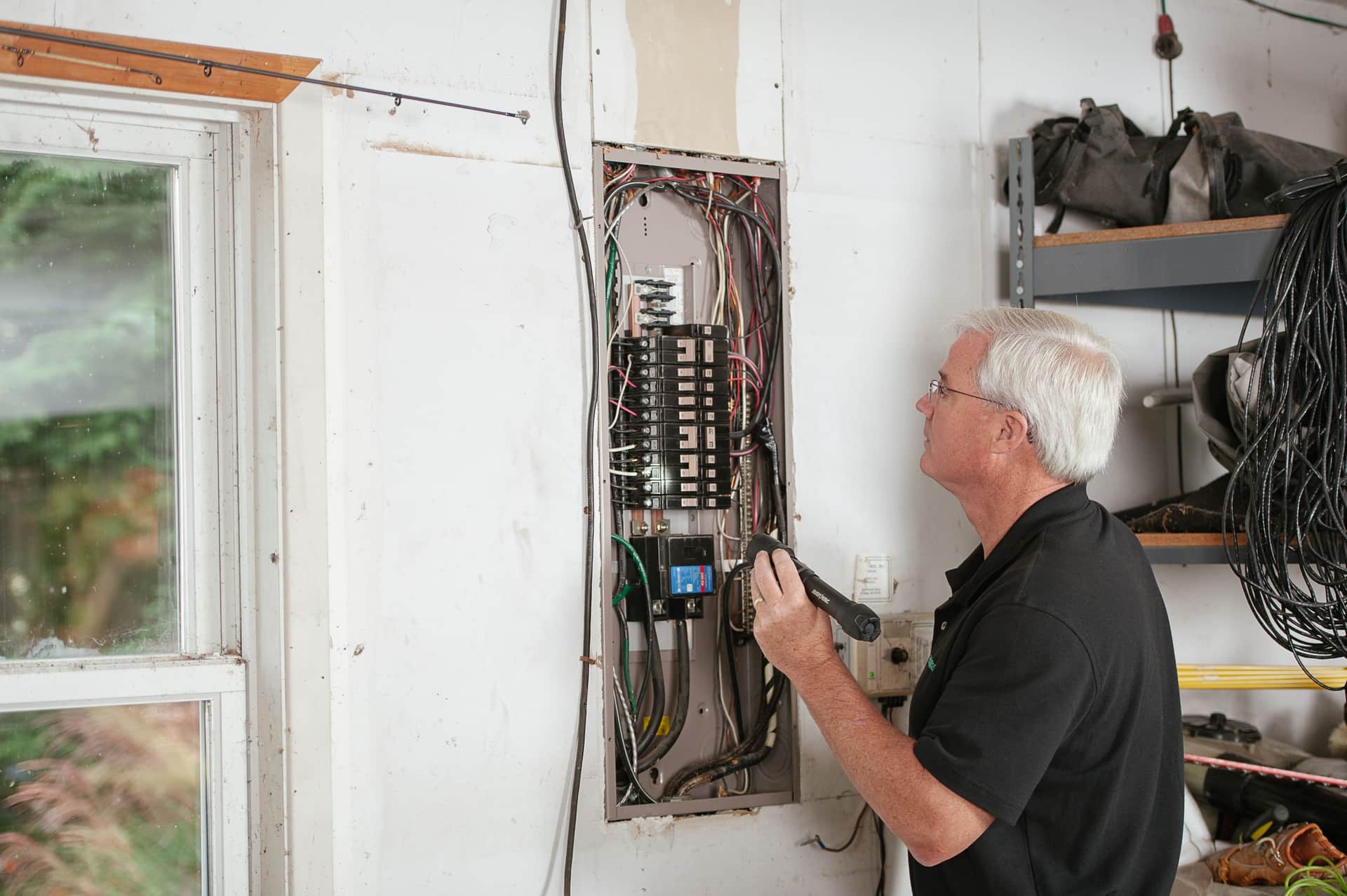
- Current transformers clamp around your service conductors inside the panel. They measure what the whole house is drawing, continuously, without being wired in series.
- The charger is told the service's limit — your 100 A, 150 A or 200 A main — during commissioning.
- It subtracts. House drawing 55 A on a 100 A service means roughly 45 A of headroom, minus a safety margin.
- It throttles its own output to fit, dropping from 48 A to whatever currently fits, and raising it again when the dryer finishes.
- The installation is documented at the managed figure, which is what enters the load calculation under NEC 625.42.
The practical effect is that the charger runs at full output most of the night, because most of the night the house is drawing very little. It backs off during the twenty minutes somebody runs the oven and the dryer together — which is exactly the moment an unmanaged charger would have tripped the main.
The units that actually do it
Chargers with real load management
The first two are a system: the Pro ships with the monitor, which is what makes its throttling measured rather than assumed. The ChargePoint and Autel are here for adjustability rather than dynamic measurement - see the table below for the distinction.
Most households, and anyone with a tight panel
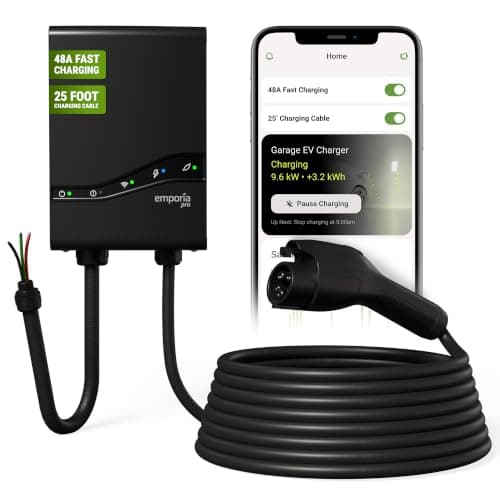
Emporia Pro Level 2 EV Charger
The best-balanced 48 A charger for a typical US house: full 11.5 kW hardwired, and the only unit at this price that ships with a whole-home energy monitor so its load management is reading your actual panel rather than guessing.
#ad Price as of October 10, 2026. How we make money
Knowing what your panel is actually doing
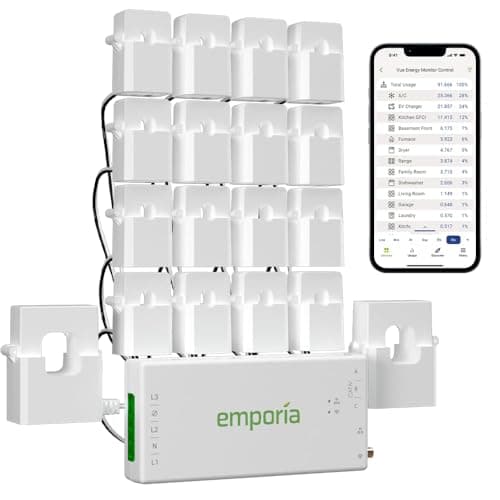
Emporia Vue 3 Home Energy Monitor
The cheapest way to replace a load calculation's assumptions with measurements. If your panel is marginal, a month of real data from this tells you whether a 48 A charger fits better than any rule of thumb will.
#ad Price as of October 10, 2026. How we make money
A house whose panel headroom is uncertain
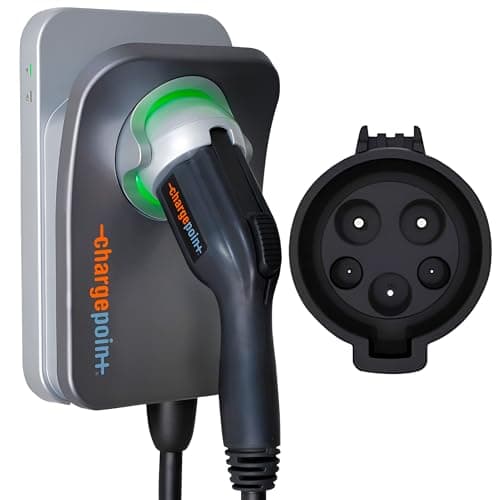
ChargePoint Home Flex (hardwired, 50 A)
The most adjustable charger on this page: output steps through 16, 24, 32, 40, 48 and 50 A in the app, so one unit fits almost any panel and can be turned up later if you upgrade the service.
#ad Price as of October 10, 2026. How we make money
Cold climates and 1 A output tuning
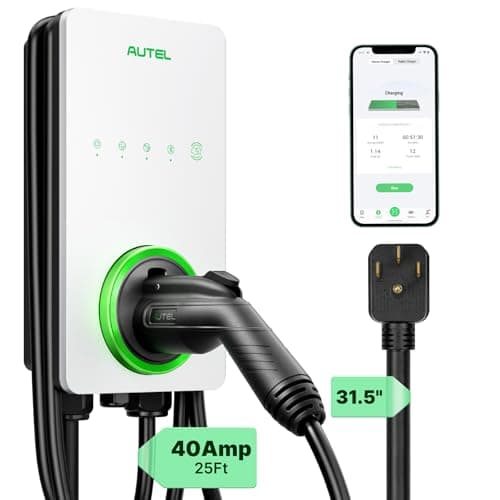
Autel MaxiCharger AC Lite (40 A)
The widest output adjustment range here — 6 A to 40 A in the app — plus an operating range down to -40 degF, which makes it the practical pick for an unheated garage in the north.
We earn commission on qualifying purchases at no cost to you. Affiliate disclosure.
| Unit | Mechanism | Dynamic? |
|---|---|---|
| Emporia Pro + Vue monitor | CTs on the service conductors, charger throttles against measured draw | Yes |
| Emporia Vue 3 on its own | Measures and reports; closes the loop with an Emporia charger | Monitoring |
| ChargePoint Home Flex | Six selectable fixed output levels: 16, 24, 32, 40, 48, 50 A | No — set once |
| Autel MaxiCharger AC Lite | Output set in 1 A steps from 6 to 40 A in the app | No — set once |
The Emporia is the one to look at first because the monitor is included rather than sold separately, which is unusual at its price. EVIQO vs Emporia Pro and Emporia Pro vs Tesla Wall Connector both turn on this feature.
Fixed setting versus dynamic: which you want
A fixed lower setting is simpler and cheaper, and it is genuinely the right answer in some houses. The trade is throughput.
| Approach | Load in the calculation | What the car gets at 2 a.m. |
|---|---|---|
| Unmanaged 48 A charger | 60 A — likely fails | n/a |
| Charger fixed at 32 A | 40 A — passes | 7.7 kW, always |
| Dynamically managed 48 A charger | The managed figure — passes | Up to 11.5 kW when the house is quiet |
What it does not do
- It does not add capacity. Your service is still your service. Load management shares it better; it does not make it bigger.
- It does not create breaker slots. If the panel is physically full, that is a different problem — see does an EV charger need its own circuit.
- It does not substitute for a load calculation. It changes the input to the calculation; somebody still has to do it, and an inspector will want to see it.
- It is not automatically accepted. Your jurisdiction's adopted code edition and your inspector decide whether a managed figure is acceptable. Ask before the work is quoted — permits and inspection covers the conversation.
For the specific case of a small service, best EV chargers for 100 amp panels and EV charger on a 100 amp panel go into the detail.