The short answer
Most two-EV households do not need two circuits. Do the arithmetic first: two cars doing an average US commute need roughly 20 to 25 kWh between them overnight, and a single 40 A charger delivers 9.6 kW — about 115 kWh over a twelve hour window. The usual right answer is one charger, used by both cars in turn, or a dual-cable unit that shares one circuit. Two separate circuits are only worth it when both cars genuinely arrive home near empty on the same nights.
Start with the arithmetic, not the hardware
This decision gets made on feel far too often, and feel says "two cars, two chargers". The numbers usually say otherwise.
2 cars x 40 miles x 0.30 kWh per mile
24 kWh between them
0.30 kWh per mile is near the EPA combined efficiency of a mid-size crossover EV; look both your cars up on fueleconomy.gov and substitute their real figures. 40 miles is around the US average daily drive.
9.6 kW x 12 h
115 kWh
Which is roughly five times what two commuting EVs need. The charger is not the constraint - the plugging-in is.
So for two cars on ordinary duty, a single Level 2 charger has four or five times the throughput required. The real problem is not capacity, it is that somebody has to move the cable — and that is a convenience problem with cheaper solutions than a second circuit.
The four ways, cheapest first
| Approach | Circuits | Each car gets | Cost |
|---|---|---|---|
| One charger, cars take turns | 1 | Full output, sequentially | Lowest |
| Dual-cable charger on one circuit | 1 | Roughly half output when both charge | Low |
| Two chargers with power sharing | 1 | Roughly half output when both charge | Medium |
| Two chargers, two circuits | 2 | Full output simultaneously | Highest |
1. One charger, cars take turns
The cheapest answer and, for a majority of two-EV households, the correct one. Buy one good 40 A or 48 A charger, mount it where it can reach both parking positions, and swap the cable when needed. Most households find a rhythm within a week.
The thing to get right is reach. Mount the unit between the two bays rather than beside one of them, measure to the further charge port along the cable's real route, and add slack — and buy a long cable. Our cable length guide and mounting height guide cover the method, and EV charger cable management covers keeping a long cable off the floor.
2. A dual-cable charger on one circuit
The one-circuit, two-cable option
A listed dual-cable unit shares its circuit between two handles. Both cars stay plugged in; the charger allocates the current. One breaker, one cable run, no second permit.
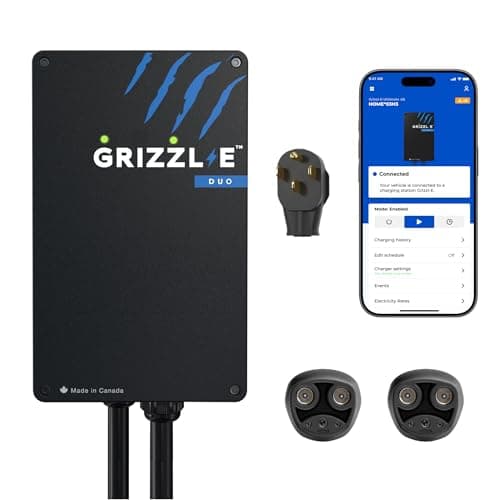
Two EVs sharing one circuit
Grizzl-E Duo Connect (dual 40 A)
Two cables, one circuit, one breaker. For a two-EV household this is cheaper and far less disruptive than running a second 240 V line across the garage.
#ad Price as of October 10, 2026. How we make money
We earn commission on qualifying purchases at no cost to you. Affiliate disclosure.
The Grizzl-E Duo Connect is the practical version of this: two J1772 handles on one 40 A circuit, in Grizzl-E's cast-aluminum NEMA 4 enclosure. Both cars plug in and neither has to be moved. The honest limitation is in the specification — 40 A total, shared — so two cars charging simultaneously get roughly 20 A each, about 4.8 kW. For two commuting cars that is still over 50 kWh a night between them, which is twice what they need. For two cars arriving home empty, it is slower than one 48 A unit used sequentially.
3. Two chargers with power sharing
Two units, one circuit
Some chargers can be configured to share a single circuit between separate wall units, each with its own cable in its own bay. The current is divided; the convenience is not.
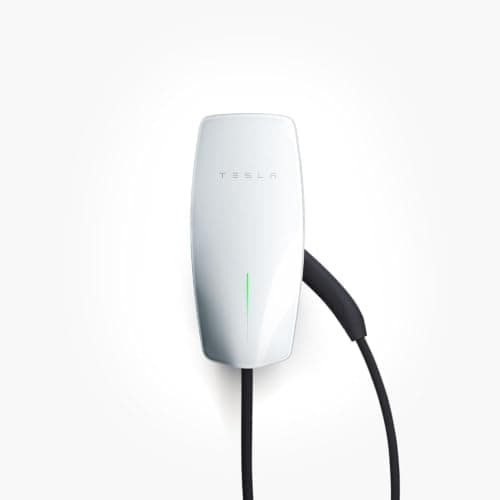
A Tesla-only household
Tesla Wall Connector (Gen 3)
If every car in the driveway is a Tesla, this is the cleanest answer: 48 A, a 24 ft cable, and a handle that opens the charge port for you — but it is NACS-only, so a J1772 car needs an adapter every single time.
#ad Price as of October 10, 2026. How we make money
We earn commission on qualifying purchases at no cost to you. Affiliate disclosure.
The Tesla Wall Connector supports power sharing between multiple units on one circuit, which is rare at this price. The advantage over a dual-cable unit is placement: each bay gets its own charger on its own wall, with a full-length cable, instead of two handles emerging from one box. The division of current is the same — on a 60 A circuit, two cars charging at once get roughly 24 A each. It is NACS-only, so a J1772 car needs an adapter; Emporia Pro vs Tesla Wall Connector covers that trade in full.
4. Two chargers, two circuits
The most capable and the most expensive. Two dedicated branch circuits means two breakers, two cable runs, and both loads in your load calculation at full value — two 48 A chargers add 120 A of continuous load, which very few 200 A services can absorb on top of existing loads.
If you go this route, manage the load
Two full-output circuits is where load management stops being a nice feature and becomes the thing that makes the install possible. A charger that measures whole-home draw can enter a load calculation at its managed figure under NEC 625.42.
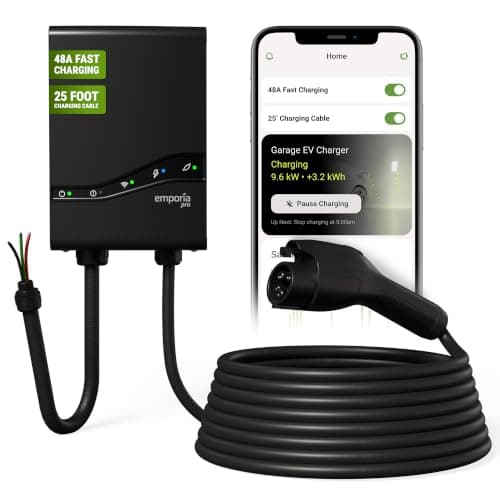
Most households, and anyone with a tight panel
Emporia Pro Level 2 EV Charger
The best-balanced 48 A charger for a typical US house: full 11.5 kW hardwired, and the only unit at this price that ships with a whole-home energy monitor so its load management is reading your actual panel rather than guessing.
#ad Price as of October 10, 2026. How we make money

Knowing what your panel is actually doing
Emporia Vue 3 Home Energy Monitor
The cheapest way to replace a load calculation's assumptions with measurements. If your panel is marginal, a month of real data from this tells you whether a 48 A charger fits better than any rule of thumb will.
#ad Price as of October 10, 2026. How we make money
We earn commission on qualifying purchases at no cost to you. Affiliate disclosure.
The Emporia Pro ships with a Vue energy monitor, so its load management is reading your actual panel rather than guessing. EV charger load management explained covers how that enters a load calculation, and does an EV charger need its own circuit covers the dedicated-circuit rule that applies to each one.
What two EVs do to your load calculation
This is the part that decides whether the expensive option is even available. Every charger on its own circuit enters the calculation at 125% of its continuous output under NEC 625.41 — so two unmanaged 48 A chargers is 120 A of added load.
| Approach | Load added to the calculation |
|---|---|
| One 48 A charger | 60 A |
| One 40 A dual-cable charger | 50 A total, for both cars |
| Two 48 A chargers with power sharing on one circuit | 60 A — the circuit is what is sized |
| Two 48 A chargers on two circuits | 120 A |
| Two 48 A chargers on two circuits, load managed | The managed figure, per NEC 625.42 |