The short answer
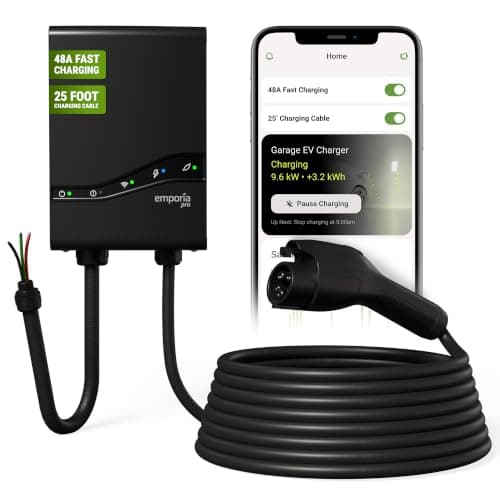
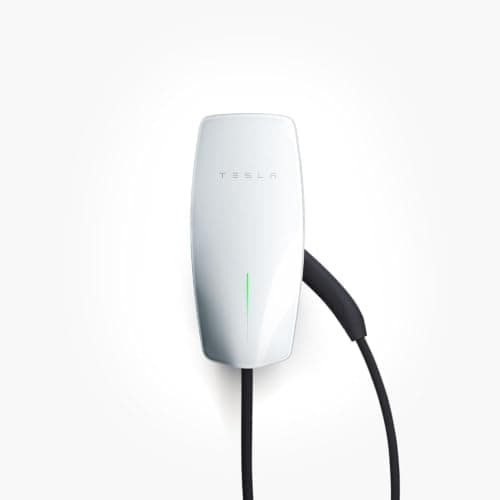
Buy the Tesla Wall Connector if every car in the driveway is a Tesla — the NACS handle opens the charge port without touching the car, and power sharing lets two units run off one circuit. Buy the Emporia Pro for anything else: you choose J1772 or NACS at purchase, the cable is a foot longer at 25 ft, it costs meaningfully less, and its load management reads real whole-home draw through an included energy monitor, which is what lets a marginal panel carry a 48 A charger at all.
| Emporia Pro | Tesla Wall Connector | |
|---|---|---|
| Max output | 48 A / 11.5 kW hardwired | 48 A / 11.5 kW |
| Output range | Adjustable in the app | 12-48 A |
| Cable | 25 ft | 24 ft |
| Connector | J1772 or NACS, chosen at purchase | NACS only |
| Install | Hardwired or plug-in | Hardwired only |
| Plug-in output | 40 A / 9.6 kW on a NEMA 14-50 | Not available |
| Whole-home load management | Yes — Vue monitor included | No |
| Power sharing between two units | No | Yes |
| Enclosure | NEMA 4, indoor or outdoor | Outdoor rated |
| Charge-port handshake | Standard handle | Handle opens a Tesla port |
| Warranty | 3 years | Manufacturer published |
The decision is the connector, not the charge rate
Both units deliver 11.5 kW. Both need the same 60 A circuit. At identical output on the same car, charging time is the same to the minute — so nothing in the speed column decides this.
What decides it is the handle. The Tesla is NACS only. If you own a Tesla, that is a feature: the handle talks to the car, the port door opens as you approach, and there is no adapter to lose. If you own anything else it is a permanent tax — every charge starts by fitting a NACS to J1772 adapter, and every adapter adds a connection that can work loose or go missing.
What load management actually buys you
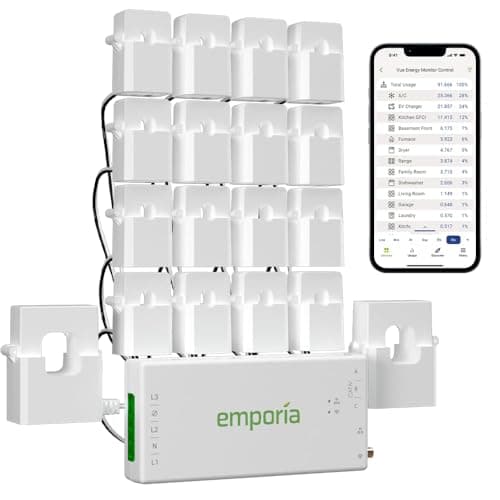
This is the Emporia's real advantage and it is easy to undersell. The Pro ships with an Emporia Vue energy monitor whose current transformers clamp around your service conductors, so the charger is not guessing at your spare capacity — it is measuring it.
The part that makes the difference
The Vue monitor is included with the Pro. It is also worth buying on its own if your panel is marginal and you want a month of real data before committing to a charger size.
Knowing what your panel is actually doing
Emporia Vue 3 Home Energy Monitor
The cheapest way to replace a load calculation's assumptions with measurements. If your panel is marginal, a month of real data from this tells you whether a 48 A charger fits better than any rule of thumb will.
#ad Price as of October 10, 2026. How we make money
We earn commission on qualifying purchases at no cost to you. Affiliate disclosure.
NEC 625.42 permits the rating of an EVSE installation to be limited through an energy management system rather than by the nameplate, which is the code mechanism behind this. On a 100 A service with an electric range and a dryer, a measured, managed 48 A charger can pass a load calculation that an unmanaged one fails. That is the difference between installing a charger and paying for a service upgrade.
What power sharing buys you
The Tesla's counterpart feature is power sharing: several Wall Connectors can be configured to share one circuit, splitting available current between whichever cars are plugged in. It is rare at this price and genuinely useful in exactly one situation — two EVs, one spare breaker.
The limitation is that sharing divides a fixed circuit. Two Tesla Wall Connectors on one 60 A circuit give roughly 24 A each when both cars are charging, not 48 A each. If both cars arrive home empty every night, that is slower than one charger used sequentially. Charging two EVs at home works through the arithmetic.
Which one solves which problem
| Your situation | The answer | Why |
|---|---|---|
| Every car is a Tesla | Tesla Wall Connector | No adapter, and the handle opens the port |
| One Tesla, one J1772 car | Emporia Pro (J1772) | One adapter in the Tesla instead of one per other car |
| Load calculation is marginal | Emporia Pro | Measured load management under NEC 625.42 |
| Two EVs, one spare breaker | Tesla Wall Connector x2 | Power sharing on a single circuit |
| Renting, or might move | Emporia Pro | Can be installed plug-in at 40 A and taken with you |
| Measured 25 feet to the port | Emporia Pro | 25 ft against 24 ft — a foot decides installs |
| Price is the constraint | Emporia Pro | Costs less, and includes the energy monitor |
The circuit, which is identical
Neither unit changes your electrical work. 48 A continuous requires a 60 A two-pole breaker at 125% under NEC 625.41, and 6 AWG copper at 75 degC terminations under Table 310.16. The Tesla is hardwired-only; the Emporia can be hardwired for 48 A or fitted with a NEMA 14-50 input cord for 40 A, in which case NEC 625.54 adds a GFCI breaker and the circuit's continuous ceiling drops to 40 A.
Our breaker size chart and wire size guide cover both routes, and hardwired vs plug-in covers the trade in full.