Skip to content
EV & Charger

Head to head

Emporia Pro vs ChargePoint Home Flex

Both reach 48 amps. One measures your panel and throttles; the other steps between six output levels. The answer depends on which problem you have.

By Mike M.Published Last verified

A wall-mounted Level 2 EV charger installed on the exterior wall of a house

The short answer

Buy the Emporia Pro if your panel is tight or you want the longest cable: load management that reads real whole-home draw through an included energy monitor, and a 25 ft lead. Buy the ChargePoint Home Flex if your electrical future is uncertain: six selectable output levels from 16 A to 50 A means one charger covers six circuit sizes. Both deliver an identical real-world charge rate.

Emporia Pro against ChargePoint Home Flex
Emporia ProChargePoint Home Flex
Max output48 A / 11.5 kW hardwired50 A / 12 kW hardwired
Plug-in output40 A / 9.6 kW40 A / 9.6 kW
Cable25 ft23 ft
Adjustable outputYes, in the app16, 24, 32, 40, 48, 50 A
Whole-home load managementYes — with the Vue monitor includedNo
Energy monitoringWhole-home and per-circuitCharger session only
EnclosureNEMA 4Outdoor rated
Connector optionsJ1772 or NACSJ1772 or NACS
InstallHardwired or plug-inHardwired or plug-in (NEMA 6-50 or 14-50)
Warranty3 yearsManufacturer published
Installed base / track recordEstablishedLargest in the US
Specifications per each manufacturer's own published documentation, checked October 5, 2026. The 12 kW figure on the Home Flex is largely theoretical: almost no vehicle accepts more than 48 A, and the 50 A setting needs a breaker above 60 A under NEC 625.41, which most panels cannot spare.

The difference that actually decides it

Both chargers can be set to a lower output. Only one of them watches your house and adjusts itself.

The Home Flex's adjustability is a setup-time decision: you pick 32 A because that is what your circuit supports, and it stays at 32 A. The Emporia's load management is a runtime behavior: it runs at 48 A when the house is quiet and backs off when the oven, the dryer and the air conditioning are competing.

Which one solves which problem
Your problemThe answerWhy
A load calculation says my service won't take 48 AEmporia ProMeasured throttling lets the installation enter the calculation at a managed figure — NEC 625.42 permits limiting the rating through controls
I'm upgrading my service next yearChargePoint Home FlexWire for 32 A now, change a setting later rather than buying a new charger
My measurement came out at 24 feetEmporia Pro25 ft against 23 ft. Two feet decides installs
I want to know what my house drawsEmporia ProThe Vue monitor is useful well beyond charging
I want the longest support historyChargePoint Home FlexThe largest installed base in the US, and an ecosystem that will still exist in a decade
I might need 16 A on a very tight circuitChargePoint Home Flex16 A is its lowest setting; no load calculation objects to it

Charge rate: identical in practice

The Home Flex's 12 kW ceiling looks like an advantage over the Emporia's 11.5 kW and is not, because almost nothing can use it.

What vehicles actually accept
Vehicle groupMax ACBenefits from 50 A?
Most current battery EVs10.5-11.5 kW / 48 ANo — 48 A is the ceiling
Plug-in hybrids, entry trims7.2-7.7 kW / 32 ANo
F-150 Lightning ER, Hummer EV 2024+19.2 kW / 80 ACould take more, but needs a 100 A circuit
Per-vehicle figures verified against each manufacturer's published specification; sources on the individual vehicle pages.

The cable, which is not a footnote

25 feet against 23 feet. It sounds trivial until you measure your own garage: park the car where it will live, note the charge port position, measure to the intended mounting point along the cable's route, and add three to five feet of slack so it loops rather than stretches.

A meaningful number of installs land between 23 and 25 feet, and in those cases this is the whole decision. Mounting height and position covers the method.

The circuit, which is the same either way

What both chargers need
OutputBreakerCopper (conduit)GFCI?
32 A40 A8 AWGOnly if plug-in
40 A50 A8 AWGOnly if plug-in
48 A60 A6 AWGNot if hardwired
Breaker sizes per NEC 625.41's 125% rule; conductor sizes per the 75 degC copper column of NEC Table 310.16. NEC 625.54 requires GFCI protection for receptacles installed for EV charging, which is why hardwiring avoids it.

The verdict, naming a loser

Both units

The two, side by side

Most households, and anyone with a tight panel

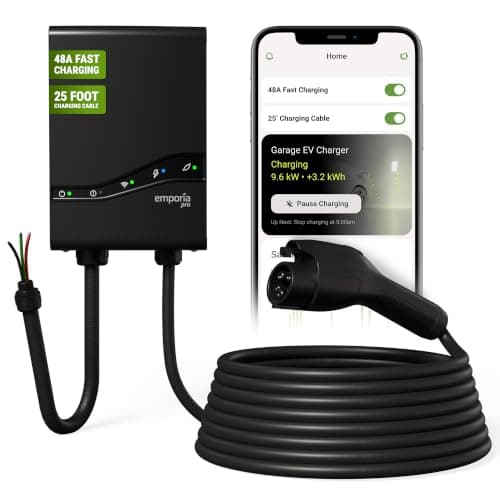
Emporia Pro Level 2 EV Charger

Emporia Pro Level 2 EV Charger charger

9.0/ 10

$599.00View on Amazon

#ad Price as of October 5, 2026. How we make money

Our verdict

The best-balanced 48 A charger for a typical US house: full 11.5 kW hardwired, and the only unit at this price that ships with a whole-home energy monitor so its load management is reading your actual panel rather than guessing.

What works

  • Hardwires at the full 48 A for 11.5 kW — matches the onboard limit of most current BEVs exactly
  • PowerSmart load management reads whole-home draw through the included Vue monitor, so it can throttle instead of tripping a breaker
  • 25 ft cable reaches across a two-car garage without an extension
  • NEMA 4 enclosure and a real UL listing, not just an ETL mark

What doesn't

  • The energy monitor has to be installed in the panel to be useful, which means the electrician is in there longer
  • App-dependent for scheduling — there is no physical timer
  • At 40 A on the plug-in version you are paying for 48 A of hardware you cannot use
Emporia Pro Level 2 EV Charger specifications
Max output48 A / 11.5 kW hardwired; 40 A / 9.6 kW on a NEMA 14-50 plug
Breaker60 A dedicated 2-pole for 48 A; 50 A for 40 A
Cable25 ft
ConnectorJ1772 or NACS, chosen at purchase
EnclosureNEMA 4, indoor or outdoor
CertificationUL certified, ENERGY STAR
Warranty3 years
Load managementPowerSmart, with the Vue home energy monitor included

Specifications checked against Emporia Pro sell sheet. We verify published specifications; we do not bench-test hardware — how we assess products.

How it scored

Fit to a typical panel
9.4
Charge rate
9.0
Cable and reach
9.0
Smart features
9.2
Weather and build
8.6
Warranty and support
8.4
A house whose panel headroom is uncertain

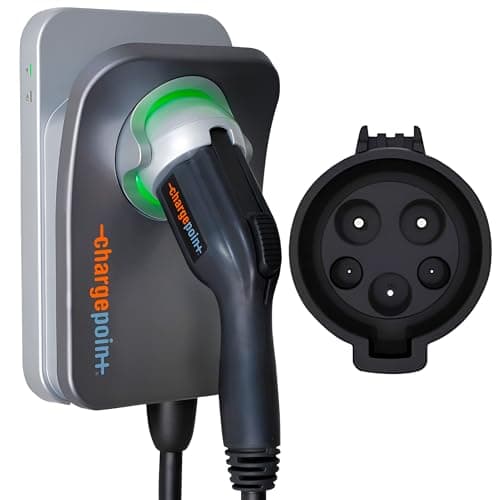
ChargePoint Home Flex (hardwired, 50 A)

ChargePoint Home Flex (hardwired, 50 A) charger

8.9/ 10

$549.00View on Amazon

#ad Price as of October 5, 2026. How we make money

Our verdict

The most adjustable charger on this page: output steps through 16, 24, 32, 40, 48 and 50 A in the app, so one unit fits almost any panel and can be turned up later if you upgrade the service.

What works

  • Six selectable output levels mean one unit fits a 100 A panel today and a 200 A panel after an upgrade
  • 12 kW ceiling is the highest here, which matters only for the handful of cars that accept more than 11.5 kW
  • Mature app with Alexa and Google Home support, and the largest installed base of any home charger in the US
  • Available in both J1772 and NACS, hardwired or plug-in

What doesn't

  • 23 ft cable is the shortest of the premium units — measure before you commit to a mounting spot
  • The adjustable amperage lives in the app, so a phone and a working account stand between you and a setting change
  • Costs more than units that charge at an identical real-world rate
ChargePoint Home Flex (hardwired, 50 A) specifications
Max output50 A / 12 kW (240 V x 50 A)
Adjustable output16, 24, 32, 40, 48, 50 A, set in the app
BreakerDedicated 2-pole rated 125% of the output you set — a 50 A breaker for 40 A output
Cable23 ft
ConnectorJ1772 (a NACS version is sold separately)
InstallHardwired, or NEMA 6-50 / NEMA 14-50 input cord on the plug-in version
Weight13.8 lb

Specifications checked against ChargePoint Home Flex datasheet. We verify published specifications; we do not bench-test hardware — how we assess products.

How it scored

Fit to a typical panel
9.6
Charge rate
9.3
Cable and reach
7.8
Smart features
9.0
Weather and build
8.8
Warranty and support
8.8

FAQ

Questions people actually ask

Which is better, the Emporia Pro or the ChargePoint Home Flex?

The Emporia Pro for most households: a 25 ft cable against 23 ft, and load management with an included whole-home energy monitor, for less money. The ChargePoint Home Flex if your electrical capacity might change, because six selectable output levels mean you can raise it later without a new charger.

Is the ChargePoint's 50 amp output an advantage?

Barely. Almost no vehicle accepts more than 48 A, and the 50 A setting needs a breaker above 60 A under NEC 625.41 — more than most panels can spare. The feature that earns its money is the 16 A end of the range, not the 50.

Do both chargers have load management?

No, and this is the key difference. The ChargePoint is adjustable at setup; the Emporia actively watches whole-home consumption through an included energy monitor and throttles in real time. On a marginal panel only the second behavior helps.

Which has the longer cable?

The Emporia Pro, at 25 ft against the ChargePoint's 23 ft. Measure from your intended mounting point to the car's charge port and add slack before choosing — a meaningful number of installs land between those two figures.

Can both be hardwired?

Yes, and hardwiring is how each reaches its full output. Both are also available plug-in, where a receptacle circuit caps them at 40 A and NEC 625.54 requires a GFCI breaker.

Sources

What we checked this against

Read next

Disclosure. Some links on this page are affiliate links. If you buy through one, we earn a commission at no extra cost to you. We are a participant in the Amazon Services LLC Associates Program. Prices come from Amazon's live data and are shown with the date they were checked; where no live price is available we say "check price" rather than show an old number. Commission rate plays no part in which products we recommend or in what order — see our methodology and our full affiliate disclosure.