The short answer
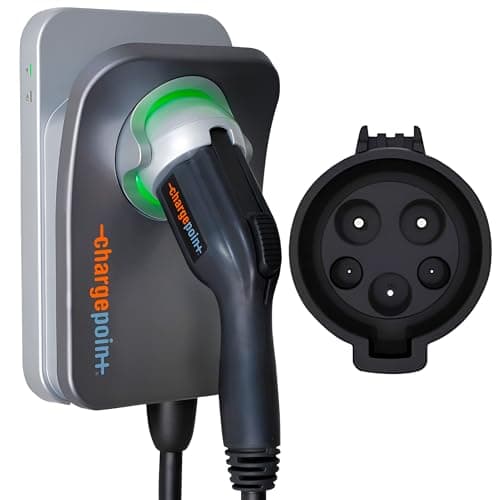
The ChargePoint Home Flex's defining feature is adjustable output: 16, 24, 32, 40, 48 and 50 A, set in the app. Maximum is 12 kW (240 V x 50 A), the highest here, with a 23 ft cable and NEMA 6-50 or 14-50 input on the plug-in version. It is the unit to buy when you are not sure what your panel will support next year, and the cable is the one spec that counts against it.
ChargePoint also has the largest installed base of any home charger in the US, which matters in a way that is easy to under-weight: a mature app, a long support history, and an ecosystem that will still exist in a decade. On a device bolted to your house for ten years, that is worth something real.
Who this is for
- A house whose electrical future is uncertain. Wire for 32 A today, turn it up to 48 A after a service upgrade, without buying a new charger.
- A marginal load calculation. Stepping down to 16 A gives you a charger no calculation will object to, and 24 A or 32 A covers most daily driving comfortably.
- Anyone who wants cost tracking that holds up — ChargePoint's reporting is the most mature in the category.
- Polestar owners, for whom ChargePoint is the named US home charging partner. Convenient rather than required; any 48 A J1772 charger does the same job.
- Anyone cross-shopping NACS and J1772, since the same unit is sold in both.
Who should buy something else instead
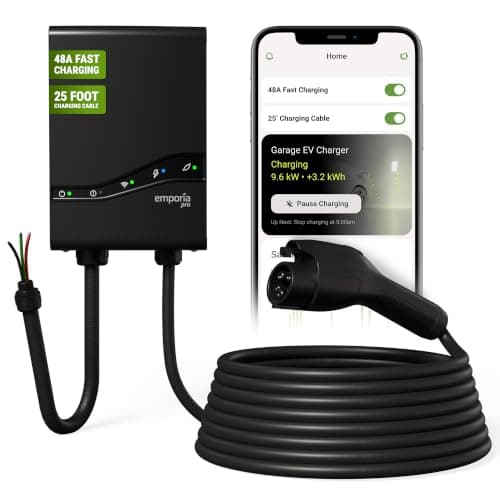
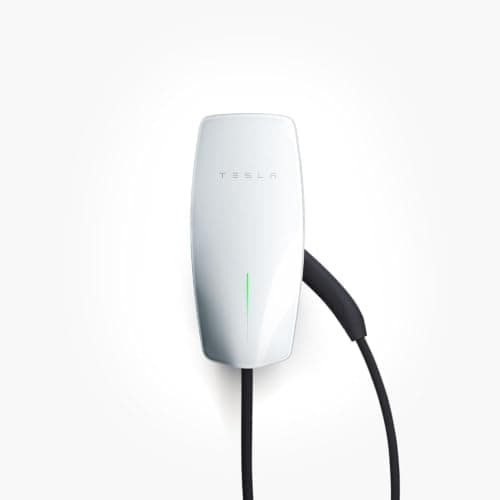
- Anyone whose measurement comes out over 23 feet. This is the real limitation. The Emporia Pro and EVIQO are 25 ft, the Tesla units 24 ft. Two feet decides installs.
- Anyone who needs load management that measures. The Home Flex adjusts, which is not the same as watching whole-home draw and throttling. On a genuinely tight panel the Emporia Pro is the stronger answer.
- Anyone who distrusts app dependencies. The adjustable amperage lives in the app, so a phone and a working account sit between you and a setting change. The Grizzl-E Classic uses physical switches instead.
- Anyone buying purely on price. It costs more than units that deliver an identical real-world charge rate.
The 12 kW ceiling is mostly theoretical
50 A output at 240 V gives 12 kW, which is the highest figure on any unit we recommend. In practice almost nothing can use it.
| Vehicle group | Max AC | Uses 50 A? |
|---|---|---|
| Most current battery EVs | 10.5-11.5 kW / 48 A | No — 48 A is the ceiling |
| Plug-in hybrids, entry trims | 7.2-7.7 kW / 32 A | No |
| F-150 Lightning ER, Hummer EV 2024+ | 19.2 kW / 80 A | Could take more, but needs a 100 A circuit |
So treat 50 A as a specification footnote rather than a buying reason. The feature that earns the money is the 16 A end of the range, not the 50.
Adjustability is an electrical feature, not an app feature
This is worth separating from the general smart-charger question. Six selectable output levels means one charger covers six different circuit sizes:
| Setting | Power | Breaker | Copper (conduit) |
|---|---|---|---|
| 16 A | 3.8 kW | 20 A | 12 AWG |
| 24 A | 5.8 kW | 30 A | 10 AWG |
| 32 A | 7.7 kW | 40 A | 8 AWG |
| 40 A | 9.6 kW | 50 A | 8 AWG |
| 48 A | 11.5 kW | 60 A | 6 AWG |
The practical value: you can wire the circuit your panel supports today and raise the charger later. On every fixed-output unit, upgrading means a new charger.
What this charger needs from your electrical system
| Item | Requirement | Code basis |
|---|---|---|
| Charger output | 50 A / 12 kW | Manufacturer published |
| Breaker | 70 A, two-pole | NEC 625.41 — 125% of a continuous load; NEC 625.42 makes EV charging continuous |
| Copper conductor (conduit, 75 degC) | 6 AWG | NEC Table 310.16 |
| GFCI breaker | Required if plug-in; not required if hardwired | NEC 625.54 |
| Install type | hardwired or plug-in | Manufacturer published |
Known issues, from owner reports
- The 23 ft cable. Not a defect, but the spec most often regretted. Measure before buying.
- App-gated amperage. A phone, an account and a working connection stand between you and a setting change. Owners report occasional pairing friction after a phone change.
- GFCI nuisance tripping on plug-in installs, as with every charger on a receptacle circuit. Hardwiring removes the GFCI requirement under NEC 625.54.
- Cloud dependency for reporting. Charging continues during an outage; the data does not.
Plug-in or hardwired
The plug-in version takes a NEMA 6-50 or NEMA 14-50 input cord and is capped at 40 A, because a receptacle circuit carries 80% of its rating continuously. The hardwired version reaches the full 50 A.
A note on the 6-50 option, which is unusual and worth knowing: a charger uses two hots and a ground and has no use for a neutral, so NEMA 6-50 means one fewer conductor to pull and no capped neutral in the box. If you are running a new dedicated circuit and will never plug an RV into it, ask your electrician about 6-50. More on receptacle choice.