The short answer
A NEMA 6-50 is the cheaper and technically cleaner choice for EV charging, because an EV charger uses only two hots and a ground — it has no use for a neutral, and the 6-50 does not carry one. A NEMA 14-50 is the better choice if you want the outlet to serve anything else, because its neutral makes it the standard RV, range and welder connection. Both are 50 A circuits, both give a 40 A charger, and both need a GFCI breaker under NEC 625.54. The decision is about the outlet's future, not the car.
| NEMA 6-50 | NEMA 14-50 | |
|---|---|---|
| Configuration | 2 hot, 1 ground (3-wire) | 2 hot, 1 neutral, 1 ground (4-wire) |
| Rating | 50 A, 250 V | 50 A, 125/250 V |
| 120 V available at the outlet | No | Yes |
| Cable needed | 6/2 or 8/2 with ground | 6/3 or 8/3 with ground |
| Conductor count in conduit | 3 | 4 |
| Cost of the wire run | Lower | Higher |
| Maximum EV charger output | 40 A / 9.6 kW | 40 A / 9.6 kW |
| GFCI breaker required for EV use | Yes — NEC 625.54 | Yes — NEC 625.54 |
| Also serves an RV | No | Yes — the standard RV 50 A plug |
| Also serves a range or welder | A welder, yes | Both |
| Plug-in chargers that offer this cord | Several | Almost all |
What the neutral is for, and why your charger ignores it
A 240 V circuit in a US house is two hot legs 180 degrees out of phase. Connect a load across the two hots and it sees 240 V. Connect a load between one hot and neutral and it sees 120 V.
An EV charger is a pure 240 V load. Its internal electronics, its display and its Wi-Fi radio all run off the 240 V supply — it does not tap a 120 V leg, so it does not connect the neutral at all. Look at the wiring diagram in any Level 2 charger's manual and you will find three terminals: L1, L2 and ground. On a 14-50 install the neutral conductor is landed in the receptacle and goes nowhere.
A range needs the neutral because its clock, controls and some elements run at 120 V. An RV needs it because the coach is full of 120 V circuits. A car does not.
When to install a 6-50
- The outlet is only ever going to charge a car. Three conductors instead of four is cheaper wire, an easier pull and one less termination.
- The run is long. On a long pull, dropping a conductor is a real saving in both material and conduit fill. Our wire size guide covers voltage drop over distance.
- You already own a charger with a 6-50 cord, or one with interchangeable input cords.
- A welder shares the circuit. Most 240 V welders are 6-50.
When to install a 14-50
- You might park an RV there. This is the strongest reason, and it is not hypothetical — a 50 A RV hookup in a driveway is a genuinely useful thing to have.
- You want the widest charger compatibility. Nearly every plug-in Level 2 charger ships with a 14-50 cord, and a Tesla Mobile Connector has a 14-50 adapter available.
- You are selling the house in the foreseeable future. A 14-50 is the configuration a buyer recognizes.
- The run is short and the extra conductor costs very little.
The receptacle grade matters more than the configuration
Whichever you choose, the thing that actually determines whether the install survives is the quality of the receptacle — because an EV draws 40 A continuously for hours, which is a duty cycle a builder-grade device was never designed for.
Industrial-grade receptacles worth the money
These are 14-50 devices, which is the configuration most EV installs use. The same rule applies to a 6-50: buy industrial or specification grade, not the cheapest part on the shelf.
The one part not to save money on
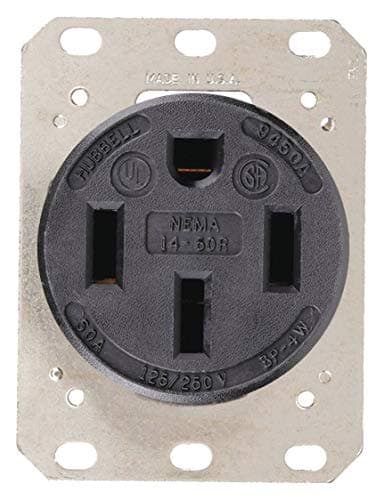
Hubbell HBL9450A NEMA 14-50 Receptacle (industrial)
An industrial-grade 14-50 receptacle. An EV draws 40 A continuously for hours, which is a duty cycle the cheap builder-grade receptacles were never designed for — this is the part that stops a plug-in install from browning its own contacts.
#ad Price as of October 10, 2026. How we make money
The same quality, slightly cheaper
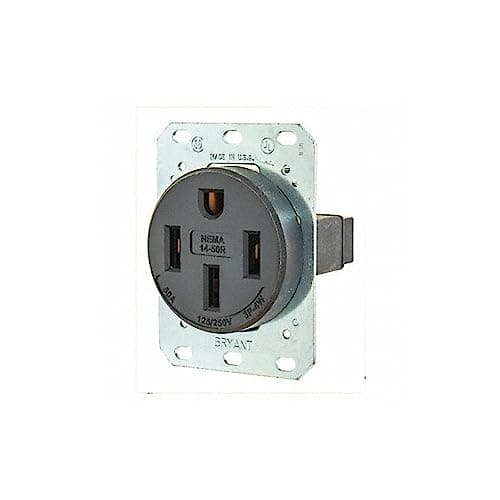
Bryant 9450FR NEMA 14-50 Receptacle
Bryant is Hubbell's sister brand and the 9450FR is the same class of part for a little less — the sensible alternative when the Hubbell is out of stock.
#ad Price as of October 10, 2026. How we make money
A budget that cannot stretch to the Hubbell
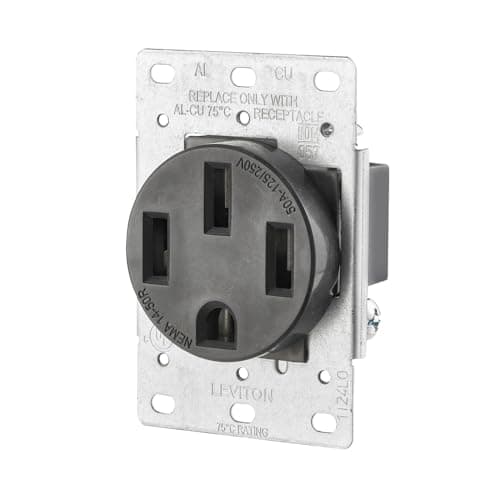
Leviton 279-S00 NEMA 14-50 Receptacle
An industrial-grade Leviton 14-50 at a fraction of the Hubbell's price. Better than any builder-grade part, and the right compromise if your charger is set to 32 A rather than 40 A.
#ad Price as of October 10, 2026. How we make money
We earn commission on qualifying purchases at no cost to you. Affiliate disclosure.
Our best NEMA 14-50 receptacles roundup covers these in detail and explains the heat-feedback failure mode that kills cheap ones.
What neither configuration gives you
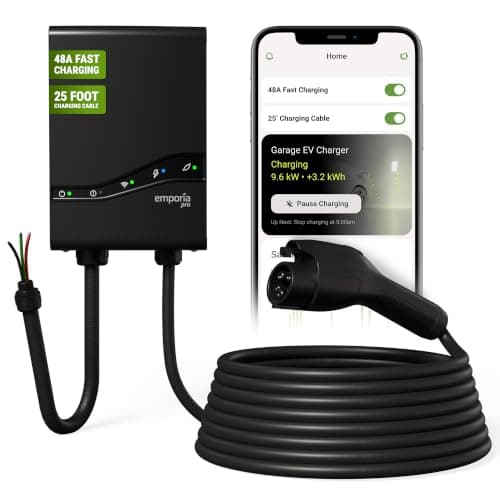
48 amps. A receptacle circuit carries only 80% of its rating continuously, so a 50 A outlet of either configuration supports a 40 A charger. If you want 11.5 kW you are hardwiring to a 60 A breaker with 6 AWG copper, and at that point the receptacle question disappears entirely — along with the GFCI requirement that NEC 625.54 attaches to receptacles. Hardwired vs plug-in is the page for that decision, and best 48 A chargers covers the units.
The short version
| Your situation | Install |
|---|---|
| Car only, long run, cost matters | NEMA 6-50 |
| Might park an RV, or might sell the house | NEMA 14-50 |
| Charger already has a 14-50 cord | NEMA 14-50 |
| Welder shares the circuit | NEMA 6-50 |
| You want 48 A | Neither — hardwire it |