The short answer
Yes. An EV charger requires a dedicated branch circuit — one breaker, one cable, one load, with nothing else connected to it. NEC 625.40 states that each outlet installed for electric vehicle charging shall be supplied by an individual branch circuit with no other outlets or devices on it. The practical reason is NEC 625.42: EV charging is a continuous load, so it occupies its circuit's entire capacity for hours at a time and leaves nothing for anything else to share.
What "dedicated" actually means
The term gets used loosely, so here is the precise version. A dedicated branch circuit for an EV charger means:
- Its own two-pole breaker in the panel, sized at 125% of the charger's continuous output under NEC 625.41.
- Its own conductors from that breaker to the charger or receptacle, with nothing spliced off along the way.
- No other outlet, light or device on the circuit — not a garage light, not a convenience receptacle, not a second 240 V outlet.
- One charger per circuit, unless the chargers themselves are designed to share one through load management or a listed dual-cable unit.
The last point is the exception worth knowing about: some chargers are specifically designed to share a circuit between two cars, and that is a different thing from putting two unrelated loads on one breaker. Charging two EVs at home covers how that works.
Why continuous changes everything
A branch circuit is sized on the assumption that its loads come and go. A garage circuit with a light, a freezer and a couple of receptacles works because nothing on it draws its full share for very long.
48 A continuous / 60 A breaker
80% of the circuit, for as long as the car is charging
NEC 625.42 classifies EV charging as a continuous load - three hours or more at maximum current. NEC 625.41 then requires the overcurrent device to be rated at not less than 125% of that load, which is where the 60 A figure comes from.
Eighty percent of a circuit, held for six hours, is not a share — it is occupancy. Add a 1.5 kW space heater on the same circuit and the breaker trips. And because the charger is the thing that will be running at 3 a.m., the trip happens at 3 a.m.
Does it need its own subpanel?
Usually no, and this is where people over-buy. A dedicated circuit is a code requirement; a subpanel is a solution to a specific problem, and it is only worth the money if you have that problem.
| Situation | Subpanel? | Why |
|---|---|---|
| Main panel has two adjacent free slots | No | Fit the breaker and run the circuit — done |
| Main panel is physically full but the service has capacity | Maybe | A subpanel buys slots. So does a tandem-breaker rearrangement, which is cheaper — ask about both |
| Charger is in a detached garage or outbuilding | Often yes | A feeder plus a local subpanel is usually better than a long single branch circuit, and gives you lights and receptacles out there too |
| You are adding a charger plus a heat pump plus a shop | Yes | Multiple new 240 V loads in one area is exactly what a subpanel is for |
| Service itself is too small | No — that is a different job | A subpanel does not add capacity. That is a service upgrade |
For the detached-garage case specifically, EV charger in a detached garage covers the feeder, the grounding and the permit questions, which are genuinely different from an attached install.
Three options when the panel is full
"Full" has two meanings and they have different answers. Out of physical slots is a layout problem. Out of capacity is a load problem. Find out which before anyone quotes you.
- Out of slots, capacity to spare. The cheap fixes come first: tandem breakers to consolidate existing single-pole circuits where the panel's listing allows them, or a small subpanel fed from the main. Either is far cheaper than a service upgrade.
- Out of capacity, slots to spare. This is where a load-managed charger earns its money. NEC 625.42 permits the rating of an EVSE installation to be limited through an energy management system, so a charger that measures whole-home draw and throttles can enter a load calculation at its managed figure rather than its nameplate. EV charger load management explained covers it, and best EV chargers for 100 amp panels covers the units.
- Out of both. A service upgrade, and what that costs is worth reading before you commit, because it is frequently the largest single number in a home charging project.
What to buy once the circuit question is settled
The breaker and the receptacle the circuit needs
A dedicated circuit is a breaker, conductors and a termination. The breaker must match your panel's listed type, and if the install is plug-in rather than hardwired, the receptacle grade matters more than any other single part.
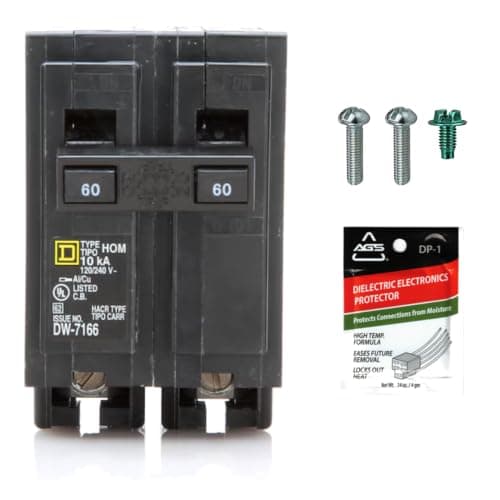
A 48 A charger in a Square D Homeline panel
Square D HOM260 60 A Double-Pole Breaker
The Homeline 60 A two-pole, for the single most common residential panel in the US. Match the breaker to the panel's listing, not to price.
#ad Price as of October 10, 2026. How we make money
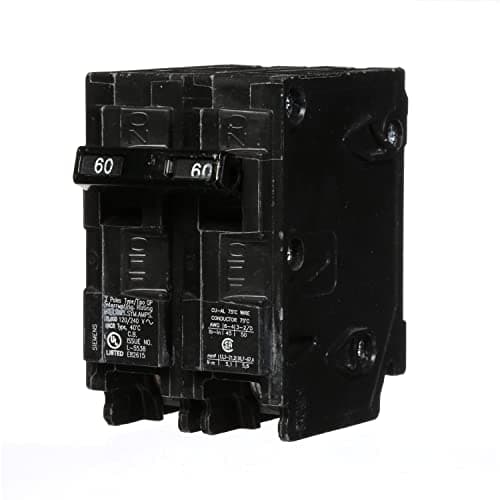
A 48 A charger in a Siemens or Murray panel
Siemens Q260 60 A Double-Pole Breaker
The standard 60 A two-pole breaker for a 48 A hardwired charger — 48 A x 125% = 60 A, exactly as NEC 625.41 requires.
#ad Price as of October 10, 2026. How we make money
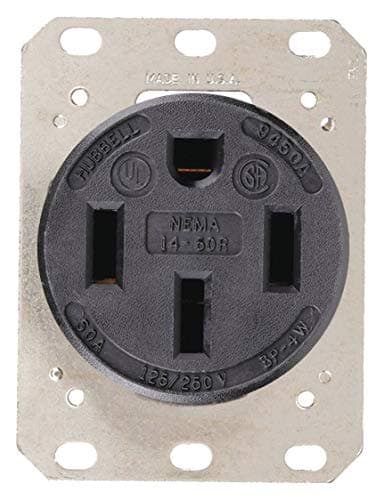
The one part not to save money on
Hubbell HBL9450A NEMA 14-50 Receptacle (industrial)
An industrial-grade 14-50 receptacle. An EV draws 40 A continuously for hours, which is a duty cycle the cheap builder-grade receptacles were never designed for — this is the part that stops a plug-in install from browning its own contacts.
#ad Price as of October 10, 2026. How we make money
We earn commission on qualifying purchases at no cost to you. Affiliate disclosure.
Our best EV charger breakers roundup has the full compatibility matrix by panel brand, and best NEMA 14-50 receptacles covers the plug-in side.
Permits, because this is a new circuit
Adding a dedicated 240 V branch circuit is permitted, inspected electrical work in most US jurisdictions, and a load calculation is normally part of the submission. That is a feature rather than a nuisance: the inspection is the only independent check that the circuit feeding a 48 A continuous load was done properly. EV charger permits and inspection covers the process.