The short answer
A manufactured home can take a 240 V EV charger, but the circuit usually has to come from the service equipment on the pedestal or pole, not from the breaker panel inside the unit — NEC 550.32(D) requires a fixed wiring method from the service equipment or its external disconnect for structures like a carport. Service equipment for a mobile home must be rated at least 100 A at 120/240 V (NEC 550.32(C)), and on a 100 A service that usually means a 32 A charger or load management, not 48 A.
Why this is a different job from a house
Searches like "220 EV plug for mobile home" get answered with generic home-charging advice, and most of it is wrong for this situation in at least one important way. Three structural differences drive everything below.
- The service is usually not on the building. NEC 550.32(A) states that service equipment cannot be mounted on or in a mobile home. It lives on a pedestal or pole nearby, and the home is fed from it. Manufactured homes get an exception under 550.32(B) when seven listed conditions are met, but the pedestal arrangement is still the common one.
- The service is often small. NEC 550.32(C) sets a floor of 100 A at 120/240 V for mobile home service equipment. A floor is not a typical value, and plenty of lots are at or near it — which is a very different starting point from the 200 A service most charger advice silently assumes.
- You may not own the service. On a rented lot in a manufactured home community, the pedestal, the feeder and often the meter belong to the park. That makes this partly an electrical question and partly a permission question.
Start by finding out what your service actually is
Before anything else, establish three facts. None of them requires an electrician to determine, though acting on them does.
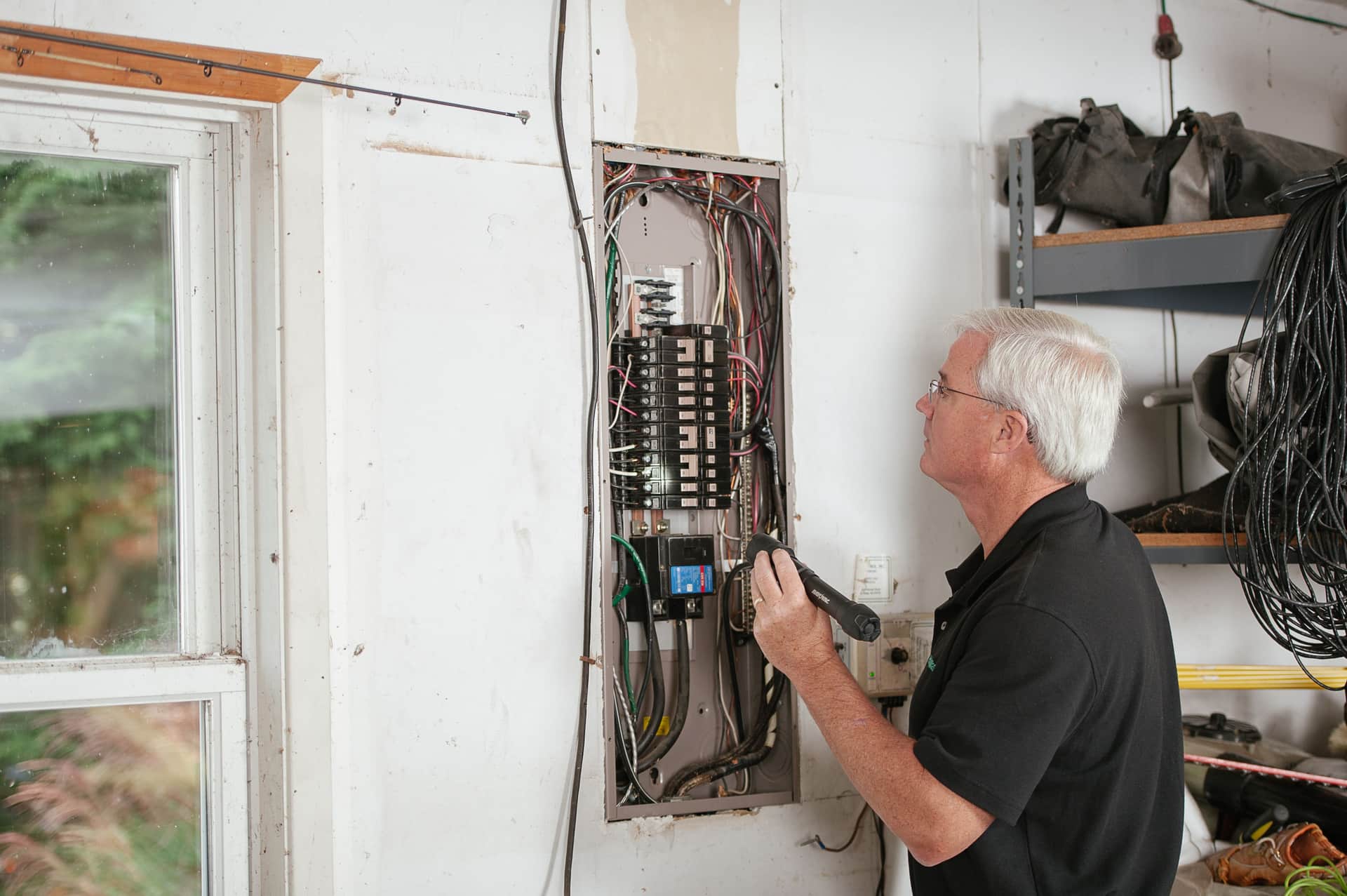
- The service rating at the pedestal. Look at the main breaker in the service equipment outside, not at the panel inside the home. 100 A and 200 A are both common; so is 125 A.
- Whether the service equipment has spare spaces. A dedicated 240 V circuit for a charger needs a two-pole breaker in that enclosure, and some pedestals are full.
- Who owns it. On an owned lot, this is your equipment. In a community, it is very often not, and the park's rules decide what happens next.
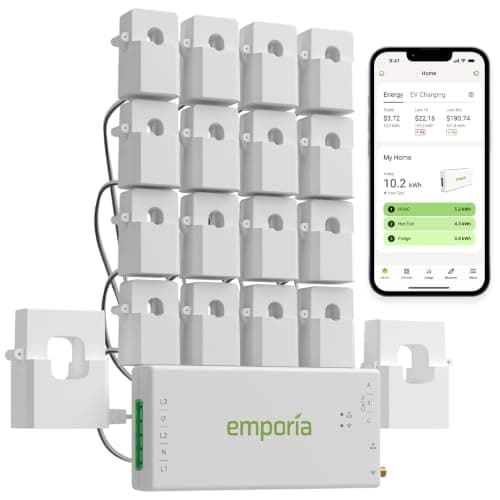
Then run a load calculation against what you found. Can my electrical panel handle an EV charger walks the arithmetic, and it matters more here than almost anywhere else, because a 100 A service with electric heat and an electric range has very little to give. If the answer lands somewhere ambiguous, a month of measured data settles it — best home energy monitors for EV charging covers what to clamp into the service equipment and what to do with the number.
| Service | Realistic charger | Breaker | Notes |
|---|---|---|---|
| 100 A, all-electric | 16-24 A, or load-managed | 20-30 A two-pole | Often needs throttling or a dryer-circuit arrangement |
| 100 A, gas heat and range | 32 A / 7.7 kW | 40 A two-pole | Run the calculation; this is frequently the ceiling |
| 125 A | 32-40 A | 40-50 A two-pole | 40 A is usually achievable with gas appliances |
| 200 A | 40-48 A | 50-60 A two-pole | Same as a conventional house, if the pedestal has spaces |
Route 1: a dedicated 240 V circuit from the service equipment
This is the proper answer and the one to aim for if the service allows it and you own the lot. A two-pole breaker goes into the service equipment on the pedestal, a fixed wiring method runs from there to where the car parks, and the charger is either hardwired or lands on a NEMA 14-50 receptacle.
Because the run is outdoors and often underground, this is a weather job as well as an electrical one. Outdoor EV charger installation covers conduit, fittings and enclosure ratings, and EV charger mounting height covers the post or carport-column mount you will most likely end up with.
The one part not to save money on
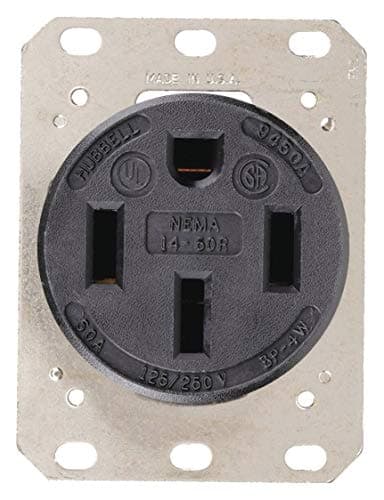
Hubbell HBL9450A NEMA 14-50 Receptacle (industrial)
If the circuit terminates in a receptacle, this is the one to specify
A note on receptacles, because it bites hard here: a NEMA 14-50 installed for EV charging requires GFCI protection under NEC 625.54, and the cheap residential 14-50s sold for ranges are built for a plug that gets inserted once. A charger plug that is cycled, or that lives outdoors, deserves an industrial-specification device. Best NEMA 14-50 receptacles goes through the difference, and NEMA 14-50 outlet for EV charging covers the install itself.
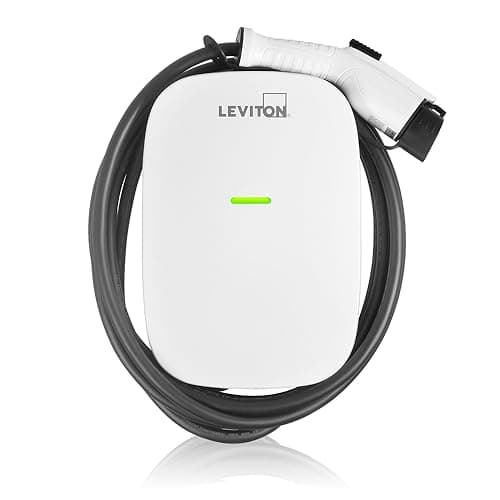
If the service has room for 48 A, the charger choice is the same as anywhere else — start at best 48 amp EV chargers. If the calculation lands at 32 A, best 32 amp EV chargers is the right list, and there is no shame in it: 32 A is 7.7 kW, which adds far more range overnight than any commuter uses in a day.
Route 2: the dryer circuit, done properly
A great many manufactured homes have a 30 A, 240 V dryer circuit and no other 240 V outlet. Using it for charging is possible, and it is also the single most dangerous idea in home EV charging when done badly — a splitter that lets both loads run at once is a fire looking for a date.
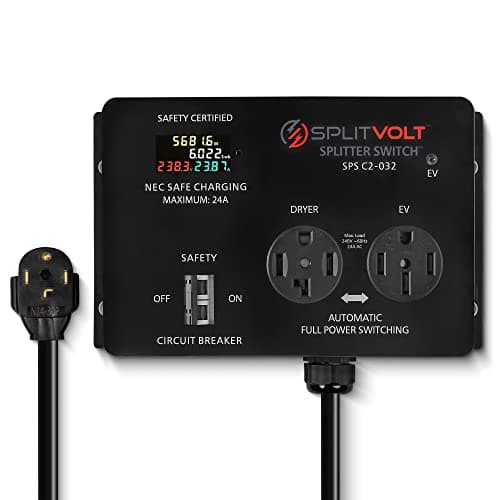
Charging off a dryer outlet without rewiring
Splitvolt NEMA 14-30/14-50 Splitter Switch
A listed automatic switch, not a splitter — the dryer always wins
#ad Price as of October 30, 2026. How we make money
The workable version uses a certified automatic switch that gives the dryer priority and never allows both loads simultaneously, feeding the charger at 24 A / about 5.8 kW. That is a legitimate overnight charge rate. What it is not is a free upgrade: a 30 A dryer circuit was wired for intermittent use, and before you put a nightly continuous load on it an electrician should confirm the conductors and the terminations are up to it. Our full treatment is in using a dryer outlet for EV charging and best EV charger splitters, both of which lead with the caveats rather than the product.
Route 3: a portable cordset, when the lot is not yours
If you rent the lot, if the park will not permit a new circuit, or if you are waiting on one, a portable Level 2 cordset plugged into an existing 240 V outlet is the pragmatic answer. It is also the right answer while you are still finding out what the service can take.
Portable options that suit a manufactured-home lot
One for a circuit you cannot characterize, one for a lot that already has a real 14-50.
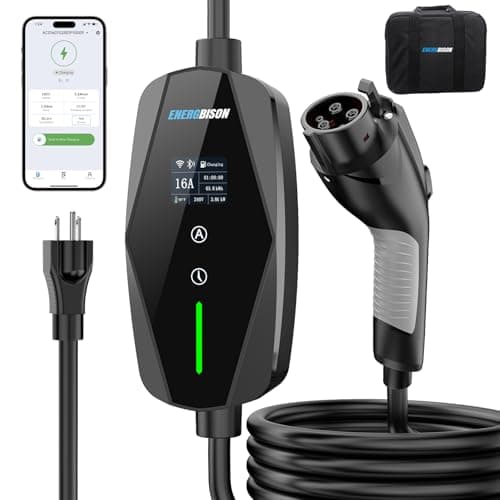
A shared or uncertain circuit
Portable Level 1 & 2 EV Charger with Timer (8-16 A)
Adjustable from 8 to 16 A with a built-in timer, which is the right feature set for a circuit you do not own and cannot characterize: dial it down until nothing else on the circuit complains.
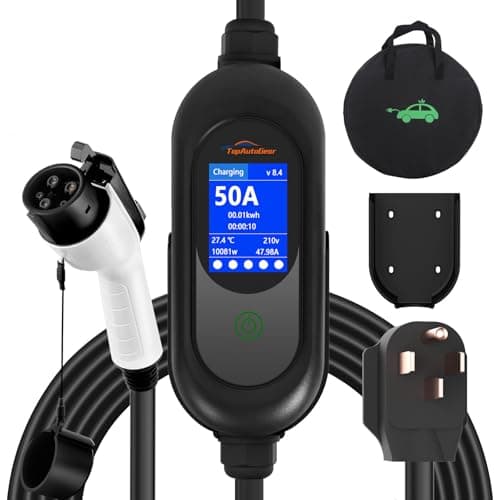
A renter who has a real 14-50 outlet
TopAutoGear Portable Level 2 EV Charger (50 A)
A portable cordset at up to 50 A, which is unusual — most portables stop at 40. If a rental genuinely has a 14-50 on its own circuit, this gets close to a wall charger without touching the wall.
We earn commission on qualifying purchases at no cost to you. Affiliate disclosure.
The adjustable unit is the one to buy if you are unsure about the circuit, because dialing output down to 8 or 12 A lets you charge from something you do not fully trust while you find out more. The 50 A cordset only makes sense where a properly installed 14-50 on its own circuit already exists. Portable Level 2 charging for renters covers the category in full, and best portable Level 2 EV chargers ranks them.
16 A x 240 V x 10 h = 38.4 kWh
Roughly 110-130 miles of range for a typical BEV, overnight
Arithmetic at nameplate output; real-world charging loses a few percent to conversion and conditioning. Per-model efficiency figures come from the EPA data on our vehicle pages.
If the lot is rented: the conversation to have
This is the part no code book covers. In a manufactured home community the pedestal, the feeder and the park's distribution are the park's property, and a new 240 V circuit is a modification to their equipment on their land. Approach it as a request rather than a notification, and bring specifics:
- Name the amperage. "A 32 amp charger on a 40 amp two-pole breaker" is a proposal. "An EV charger" is a worry.
- Offer the load calculation. A park manager's real fear is their distribution, not your car. A calculation showing the lot stays inside its allocation addresses the actual objection.
- Offer to pay for it, and for the permit. Adding a 240 V branch circuit is permitted, inspected work in most US jurisdictions — EV charger permits and inspection covers the process. An inspected install is also the park's best protection.
- Ask about metering. If the lot is sub-metered or the electricity is bundled into the rent, charging changes the arithmetic for them, and it is better raised by you than discovered by them.
- Have a fallback ready. If the answer is no, a portable cordset on an existing outlet is usually within what you are already permitted to do.
Costs, honestly
We do not publish a single number for this because the variable is the trench, not the charger. The cost drivers specific to a manufactured-home lot are: the distance from the pedestal to where the car parks, whether that run is buried (usually) and what it crosses, whether the service equipment has a spare two-pole space, and whether the service itself needs upgrading. EV charger installation cost breaks a conventional install into line items you can map onto a quote, and electrical panel upgrade cost covers the expensive branch.
One thing genuinely in your favor: the federal and state incentive programs do not care what kind of home you have. EV charger rebates in 2026 is worth reading before you buy anything, because some programs reimburse the installation rather than the hardware, which is the larger number here.