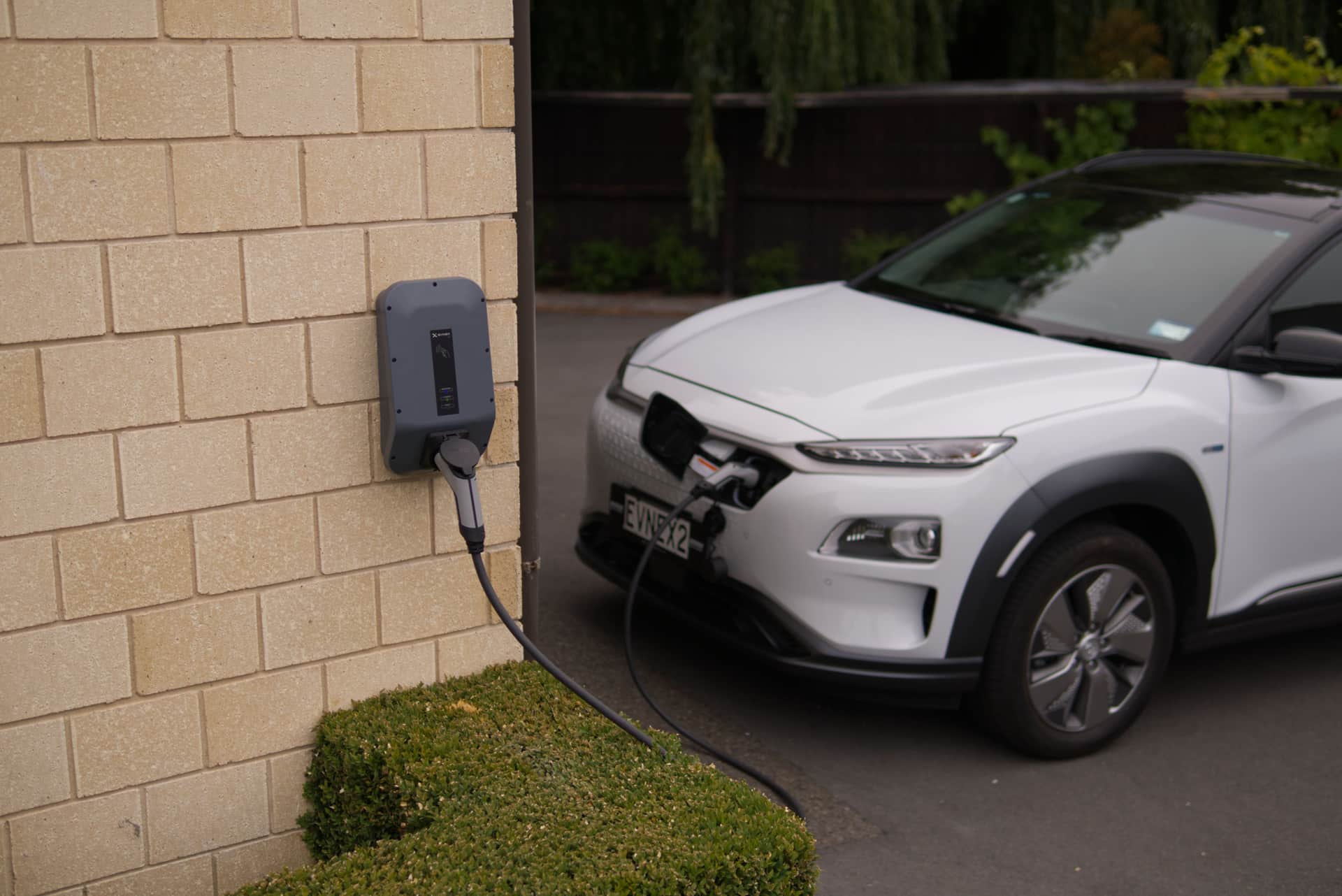
The short answer
Every Mustang Mach-E trim carries a 10.5 kW onboard charger, which is about 44 A at 240 V — so a 48 A charger on a 60 A breaker with 6 AWG copper is the correct size and the car will draw just under its maximum. There is no trim-by-trim complication here, which makes this one of the simpler charger decisions on the site.
Ford standardized the onboard charger across the Mach-E range — standard and extended battery, rear-wheel drive and all-wheel drive, GT and Rally. That is unusual and genuinely helpful: you do not need to know which Mach-E you have to buy the right charger.
The constraint: what this car accepts
Everything else on this page follows from one number. The Ford Mustang Mach-E's onboard charger accepts a maximum of 10.5 kW, which is 48 amps at 240 volts. No wall charger can exceed it, and a charger rated above it delivers no extra speed.
| Specification | Value | Source |
|---|---|---|
| Maximum AC power accepted | 10.5 kW | Ford Mustang Mach-E charging specifications |
| Maximum AC current at 240 V | 48 A | Ford Mustang Mach-E charging specifications |
| Connector | J1772 | Ford Mustang Mach-E charging specifications |
| EPA range (2026 Mustang Mach-E RWD Extended) | 320 mi | US DOE / EPA fueleconomy.gov |
| EPA efficiency | 30.7 kWh / 100 mi (110 MPGe) | US DOE / EPA fueleconomy.gov |
| EPA published 240 V charge time | 9.6 hours | US DOE / EPA fueleconomy.gov |
The consequence: the circuit you actually need
Take the car's 48 A ceiling and work backwards. NEC 625.42 classifies EV charging as a continuous load, and NEC 625.41 requires overcurrent protection at not less than 125% of the maximum load — so a 48 A charger needs a 60 A two-pole breaker and 6 AWG copper at the 75 degC column of NEC Table 310.16.
| Item | This car | Why |
|---|---|---|
| Charger output | 48 A | Matches the car's 48 A ceiling exactly |
| Power delivered | 10.5 kW | The lower of the charger's output and the car's limit |
| Breaker | 60 A, two-pole | NEC 625.41 — 125% of a continuous load |
| Copper conductor (conduit, 75 degC) | 6 AWG | NEC Table 310.16 |
| A bigger charger would | deliver nothing extra — this is already the car's ceiling | The lower of the two numbers always wins |
Charge times, with the arithmetic shown
EPA rates the 2026 Mustang Mach-E RWD Extended at 30.7 kWh per 100 miles. That single figure lets you calculate any charge time you like, and it is why we show the formula rather than asserting a number.
hours = (miles x 30.7 / 100) / (kW x 0.9)
At 10.5 kW, this car gains about 31 miles of range per hour
The 0.9 allows for AC-to-DC conversion losses in the onboard charger — roughly 10% of what your meter records never reaches the battery. EPA efficiency figure from the US DOE / EPA fueleconomy.gov service, 2026 Mustang Mach-E RWD Extended, queried 2026-10-05.
| Charger | Miles added per hour | Hours to add 100 miles |
|---|---|---|
| 16 A (3.8 kW) | 11 | 8h 59m |
| 24 A (5.8 kW) | 17 | 5h 53m |
| 32 A (7.7 kW) | 23 | 4h 26m |
| 40 A (9.6 kW) | 28 | 3h 33m |
| 48 A (11.5 kW) | 31 | 3h 15m |
For context, EPA's own published figure for a full charge at 240 V on this trim is 9.6 hours.
What to buy for a Ford Mustang Mach-E
Our picks for the Ford Mustang Mach-E
Both are 48 A units that reach this car's full 11.5 kW. The top pick is most households, and anyone with a tight panel; the alternative is there because 48 a on a budget.
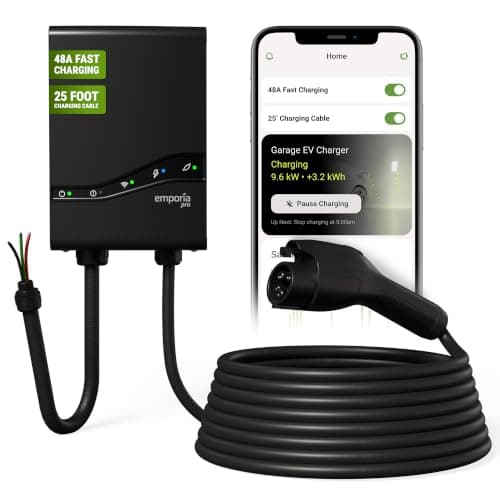
Most households, and anyone with a tight panel
Emporia Pro Level 2 EV Charger
The best-balanced 48 A charger for a typical US house: full 11.5 kW hardwired, and the only unit at this price that ships with a whole-home energy monitor so its load management is reading your actual panel rather than guessing.
#ad Price as of October 5, 2026. How we make money
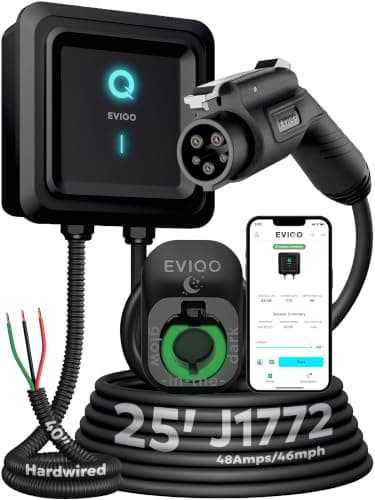
48 A on a budget
EVIQO Level 2 EV Charger (48 A, hardwired)
The cheapest way to get a genuine 11.5 kW hardwired install, with IP66/NEMA 4 weatherproofing and an internal switch for 16/32/40/48 A. The trade is a younger brand with a shorter support record.
We earn commission on qualifying purchases at no cost to you. Affiliate disclosure.
Connector and adapters
The Ford Mustang Mach-E uses a J1772 port for AC charging, which is what the large majority of home chargers in the US have. No adapter is needed for a J1772 charger.
You need a NACS to J1772 adapter only if you intend to use a Tesla Wall Connector, a Tesla Destination charger or a Tesla Mobile Connector. Rated headroom matters on a part carrying 48 A for eight hours — see best NACS to J1772 adapters.
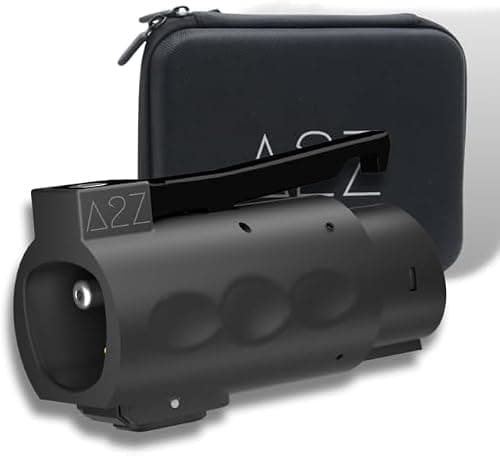
A J1772 car on a Tesla Wall Connector or Destination charger
A2Z EV Stellar Plug NACS to J1772 AC Adapter
80 A / 19.2 kW rated, which is genuine headroom over any home charger. The part to buy if a Tesla charger is in the picture.
#ad Price as of October 5, 2026. How we make money
What differs by trim is how much charging you need
| Trim | kWh / 100 mi | EPA range | EPA 240 V time | Miles per hour at 10.5 kW |
|---|---|---|---|---|
| Mustang Mach-E RWD Extended | 30.7 | 320 mi | 9.6 h | 31 |
| Mustang Mach-E RWD | 31.4 | 260 mi | 7.8 h | 30 |
| Mustang Mach-E AWD Extended | 32.3 | 300 mi | 10.2 h | 29 |
| Mustang Mach-E AWD | 33.6 | 240 mi | 7.7 h | 28 |
| Mustang Mach-E GT | 37.4 | 280 mi | 9.9 h | 25 |
| Mustang Mach-E Rally | 40.2 | 255 mi | 10.0 h | 23 |
The spread from the RWD Extended to the Rally is about 30% in efficiency, which translates directly into charge time. All of them are comfortably covered overnight by a 48 A charger.
Is 40 amps enough?
For a Mach-E, usually yes. The car accepts 10.5 kW; a 40 A charger delivers 9.6 kW. That is a 9% difference, which on replacing 100 miles is about twenty minutes.
100 mi x 0.307 kWh/mi = 30.7 kWh; at 10.5 kW x 0.9 = 3h 15m; at 9.6 kW x 0.9 = 3h 33m
An 18-minute difference
EPA efficiency figure from the US DOE / EPA fueleconomy.gov service, 2026 Mustang Mach-E RWD Extended, queried October 5, 2026.
So if a 40 A circuit is materially cheaper for you — a shorter 8 AWG pull rather than 6 AWG, a 50 A breaker rather than 60 A, a kinder load calculation — take the 40 A charger. The eighteen minutes is at 2am.
Where we would push for 48 A on a Mach-E: the GT and the Rally, which at 37-40 kWh per 100 miles need noticeably more energy per mile, and any household covering 150+ miles daily.
Connector and the Ford charging ecosystem
The Mach-E uses J1772 for AC charging, so any mainstream home charger plugs straight in. Ford's own Connected Charge Station is a competent 48 A unit; it does nothing a third-party 48 A charger does not, and the third-party units offer load management and solar tracking that Ford's does not.
Ford has arranged Supercharger access via a DC adapter, which is a different part from the AC adapters covered here. For AC charging at a Tesla Wall Connector or Destination charger, you need a NACS-to-J1772 adapter.
Charge port position
The Mach-E's charge port is front left, which is unusual — most EVs put it at the rear. If you pull into the garage nose-first, the port ends up at the far end of the bay from where a charger is often mounted. Measure before you mark the wall; our mounting guide covers the method.
What to add
A holster for the handle, and the adapter if a Tesla charger is ever in your future.
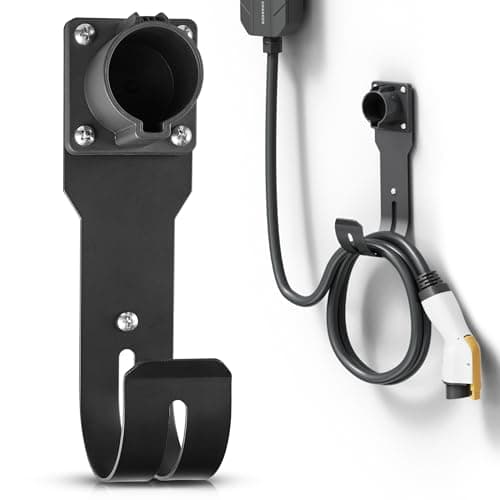
Getting the handle and the cable off the floor
MECMO J1772 Holster Dock and J-Hook
A holster for the handle plus a hook for the loop. The cheapest meaningful upgrade to any charging setup, because a handle that lives on the floor gets stepped on, driven over and eventually fails.
#ad Price as of October 5, 2026. How we make money
A J1772 car on a Tesla Wall Connector or Destination charger
A2Z EV Stellar Plug NACS to J1772 AC Adapter
Rated 80 A / 19.2 kW, which is well above any home charger's output and the margin you want in a part that carries 48 A continuously for eight hours a night.
#ad Price as of October 5, 2026. How we make money
We earn commission on qualifying purchases at no cost to you. Affiliate disclosure.