The short answer
The fastest home chargers are 80 A / 19.2 kW units, which need a 100 A circuit — half of a 200 A service before anything else in the house is counted. For almost every household the fastest charger you can actually install is 48 A / 11.5 kW on a 60 A circuit, and for most cars that is also the fastest the vehicle can accept. The car is the limit more often than the charger is.
Three ceilings, and the lowest one wins
Home charging speed is set by whichever of three numbers is smallest:
- Your car's onboard AC charger. Most current BEVs accept 10.5-11.5 kW. Plug-in hybrids accept 7.2-7.7 kW. Three vehicles accept 19.2 kW.
- Your electrical service's spare capacity. A load calculation decides this, and it is usually what rules out 80 A.
- The charger's rating. The one people shop on, and usually the least binding of the three.
What the fastest cars can accept
| Vehicle | Max AC | Circuit needed | Realistic in a house? |
|---|---|---|---|
| Ford F-150 Lightning Extended Range | 19.2 kW / 80 A | 100 A breaker, 3 AWG copper | Rarely — half a 200 A service |
| GMC Hummer EV, 2024 onwards | 19.2 kW / 80 A | 100 A breaker, 3 AWG copper | Rarely |
| Chevrolet Equinox EV with the 19 kW charger | 19.2 kW / 80 A | 100 A breaker, 3 AWG copper | Rarely |
| Everything else we cover | 7.2-11.5 kW / 32-48 A | 40-60 A breaker | Yes |
EPA's own data illustrates what 80 A capability is worth when a house can supply it: the 2025 F-150 Lightning 4WD ER1 is listed at 14.6 hours at 240 V, while the 4WD PRO ER1 — same battery, same efficiency, shipping with the 80 A Charge Station Pro — is listed at 10.1 hours.
Why 100 amps is usually impossible rather than merely expensive
An 80 A continuous load requires a 100 A two-pole breaker under NEC 625.41. A 100 A continuous load is half of a 200 A service before general lighting, a range, HVAC or a water heater is counted.
So this is a capacity problem, not a cost problem. The conductor and breaker are expensive; what actually stops it is that the amps are not there, and the fix is a service upgrade rather than a thicker wire. Can my panel handle an EV charger and panel upgrade cost.
The fastest charger you can actually install
48 A / 11.5 kW on a 60 A circuit with 6 AWG copper. This is the practical ceiling for residential charging, and it is not a compromise for most vehicles — it is exactly the rate the majority of current BEVs accept.
| Vehicle (EPA trim) | kWh / 100 mi | Miles per hour at 48 A | EPA 240 V full charge |
|---|---|---|---|
| Hyundai Ioniq 6 RWD 18in (2025) | 26.0 | 38 | 7.5 h |
| Tesla Model Y Long Range AWD (2026) | 27.5 | 38 | 8.0 h |
| Volkswagen ID.4 (2026) | 29.8 | 33 | 8.0 h |
| Ford Mustang Mach-E RWD Ext (2026) | 30.7 | 31 | 9.6 h |
| Kia EV9 Long Range RWD (2026) | 38.0 | 26 | 10.7 h |
| Rivian R1T Dual Large (2026) | 44.4 | 23 | 12.0 h |
| GMC Hummer EV Pickup 3X (2025) | 65.1 | 16 | 11.2 h |
Notice how much the vehicle matters: at the same 48 A, an Ioniq 6 gains 38 miles an hour and a Hummer EV gains 16. Efficiency is a bigger lever on charge speed than amperage is, which is worth knowing when you choose a car rather than a charger.
What “fastest” should actually mean at home
Three things that are not the charger's fault
- A charger set below its maximum. The EVIQO 48 A ships at 40 A; several units default low. Check the setting before suspecting anything else. How to test it.
- Charging tapering near full. Most cars slow the last 10%, so a 0-100% time is not twice a 0-50% time.
- Cold weather. A cold battery accepts less power while it warms, which visibly slows the first part of a winter charge.
What to buy if speed is genuinely your priority
The fastest practical home chargers
All three deliver the full 48 A / 11.5 kW hardwired, which is the ceiling a normal residential service can supply. Get a load calculation before committing to the 60 A circuit.
Most households, and anyone with a tight panel
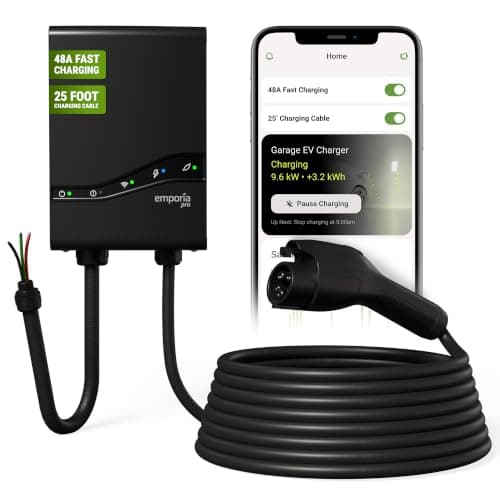
Emporia Pro Level 2 EV Charger
The best-balanced 48 A charger for a typical US house: full 11.5 kW hardwired, and the only unit at this price that ships with a whole-home energy monitor so its load management is reading your actual panel rather than guessing.
#ad Price as of October 5, 2026. How we make money
48 A on a budget
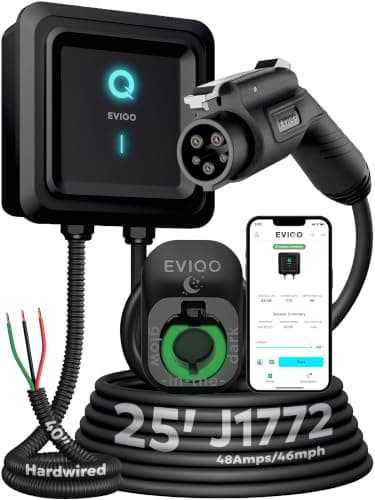
EVIQO Level 2 EV Charger (48 A, hardwired)
The cheapest way to get a genuine 11.5 kW hardwired install, with IP66/NEMA 4 weatherproofing and an internal switch for 16/32/40/48 A. The trade is a younger brand with a shorter support record.
A house with rooftop solar
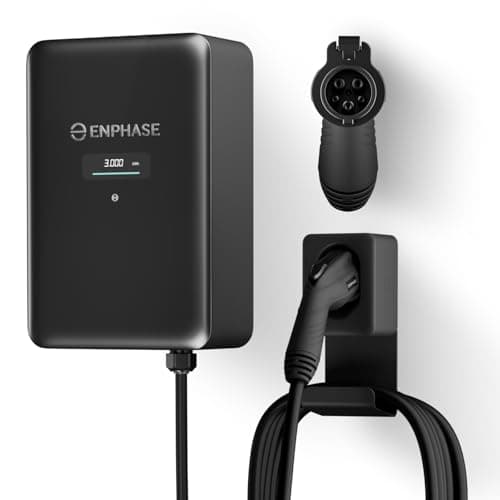
Enphase IQ EV Charger 2 (48 A)
The charger to buy if you have solar: it adjusts in 1 A increments to absorb whatever the array is exporting, and it carries a 5-year warranty, the longest here.
#ad Price as of October 5, 2026. How we make money
We earn commission on qualifying purchases at no cost to you. Affiliate disclosure.