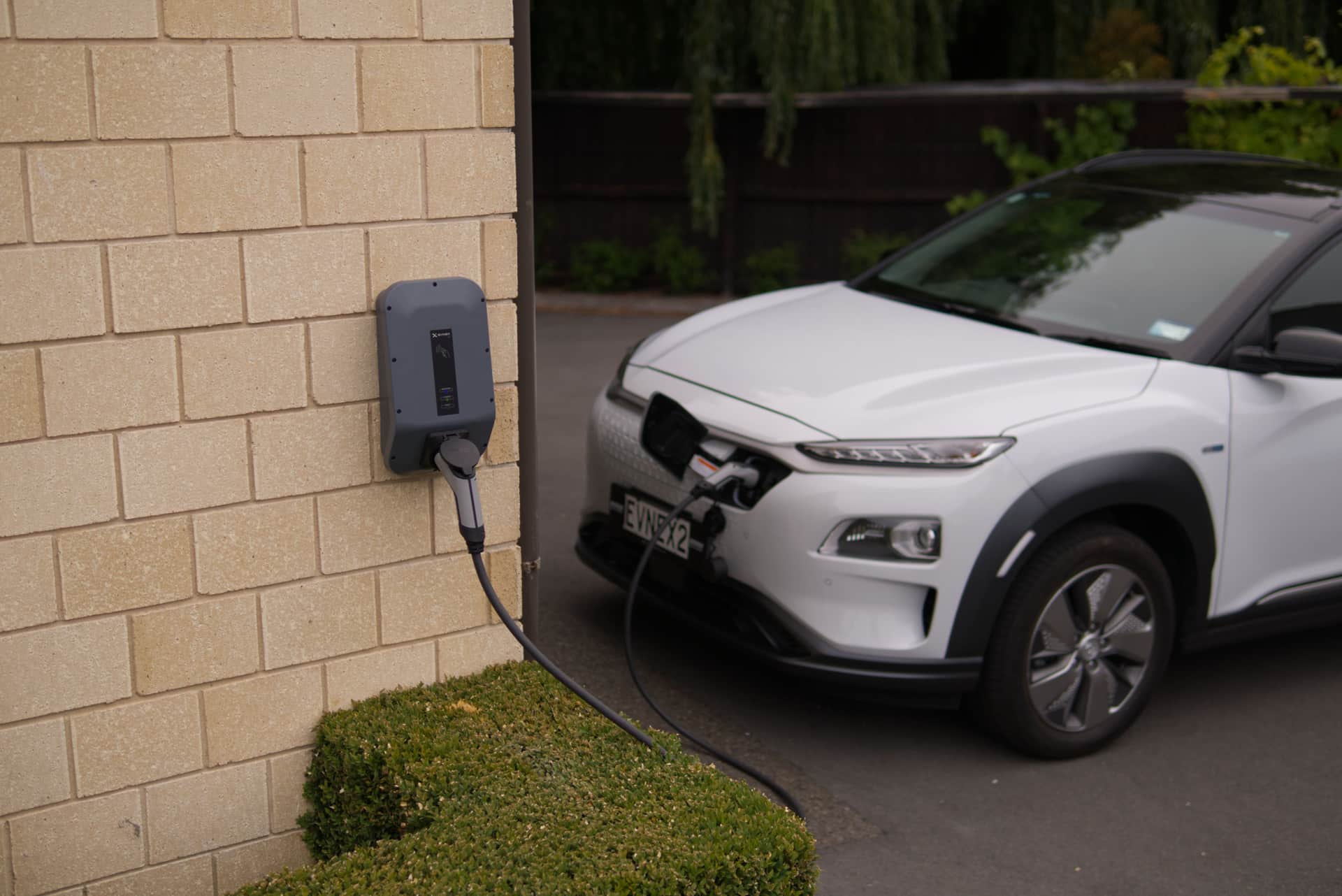
The short answer
Divide the energy you need by the power you are delivering, allowing about 10% for conversion losses: hours = (miles x kWh-per-100-miles / 100) / (kW x 0.9). On a typical EV at 48 A you gain roughly 30-37 miles of range per hour; at 32 A roughly 20-25. EPA publishes a full-charge time at 240 V for every model, and those range from 2.4 hours for a Wrangler 4xe to 15 hours for a max-pack Rivian R1S.
hours = (miles needed x kWh-per-100-miles / 100) / (kW x 0.9)
Two inputs: your car's EPA efficiency, and the power your charger actually delivers
kWh-per-100-miles is on your EPA window sticker and on fueleconomy.gov. The kW figure is the LOWER of your charger's output and your car's onboard limit. The 0.9 allows for AC-to-DC conversion losses — roughly 10% of what the meter records never reaches the battery.
A worked example
A 2026 Tesla Model Y Long Range, EPA-rated at 27.5 kWh per 100 miles, on a 48 A charger. You drove 60 miles today and plug in at 10pm.
60 x 27.5 / 100 = 16.5 kWh needed; 16.5 / (11.5 x 0.9) = 1.59 hours
1 hour 36 minutes — finished before midnight
EPA efficiency figure from the US DOE / EPA fueleconomy.gov service, 2026 Model Y Long Range AWD, queried October 5, 2026.
Which is the point most charge-time articles miss. You are almost never charging from empty. You are replacing what you used, and what you used is usually a fraction of the battery. The overnight window is twelve hours and the job takes two.
Miles of range per hour, by charger and car
| Vehicle (EPA trim) | kWh / 100 mi | 16 A | 32 A | 40 A | 48 A |
|---|---|---|---|---|---|
| Tesla Model Y | 27.5 | 12 | 25 | 31 | 38 |
| Tesla Model 3 | 24.6 | 14 | 28 | 35 | 42 |
| Tesla Cybertruck | 42.9 | 8 | 16 | 20 | 24 |
| Hyundai Ioniq 5 | 30 | 11 | 23 | 29 | 33 |
| Hyundai Ioniq 6 | 26 | 13 | 27 | 33 | 38 |
| Kia EV6 | 29.6 | 12 | 23 | 29 | 33 |
| Kia EV9 | 38 | 9 | 18 | 23 | 26 |
| Jeep Wrangler 4xe | 68 | 5 | 10 | 10 | 10 |
| Jeep Grand Cherokee 4xe | 58 | 6 | 11 | 11 | 11 |
| Rivian R1T and R1S | 44.4 | 8 | 16 | 19 | 23 |
| Ford F-150 Lightning | 47.9 | 7 | 14 | 18 | 22 |
| Ford Mustang Mach-E | 30.7 | 11 | 23 | 28 | 31 |
Read the columns rather than the rows. The spread across cars at the same charger size is far wider than the spread across charger sizes for the same car — which is to say your car's efficiency matters more than your charger's amperage.
EPA's own full-charge times
Rather than estimating, EPA publishes a 240 V charge time per trim. Those figures are the most authoritative single answer available, and they vary enormously:
| Vehicle (EPA trim) | EPA 240 V charge time |
|---|---|
| Jeep Wrangler 4xe (2026) | 2.4 hours |
| Jeep Grand Cherokee 4xe (2026) | 3.4 hours |
| Chevrolet Bolt EUV (2023) | 7.5 hours |
| Hyundai Ioniq 6 RWD 18in (2025) | 7.5 hours |
| Volkswagen ID.4 (2026) | 8.0 hours |
| Tesla Model Y Long Range AWD (2026) | 8.0 hours |
| BMW i4 eDrive40 18in (2026) | 9.0 hours |
| Chevrolet Blazer EV FWD (2026) | 9.5 hours |
| Kia EV9 Long Range RWD (2026) | 10.7 hours |
| Tesla Cybertruck AWD (2026) | 11.7 hours |
| Rivian R1T Dual Large (2026) | 12.0 hours |
| Ford F-150 Lightning 4WD ER1 (2025) | 14.6 hours |
| Rivian R1S Dual Max (2026) | 15.0 hours |
The top and bottom of that list differ by a factor of six. No charger decision produces a spread like that — the vehicle does.
What slows charging in the real world
- Your car's onboard limit, not your charger. Check it on our limits table. This is the first thing to rule out.
- The charger set below its maximum. Several units ship at a lower default — the EVIQO 48 A arrives set to 40 A. Check the setting.
- Cold weather. A cold battery accepts less power while it warms, which can visibly slow the first part of a winter charge.
- A high state of charge. Charging tapers near full on most cars, so the last 10% takes disproportionately long.
- Load management throttling, if your charger is managing against household consumption. Working as intended, and it catches up later.
- Supply voltage. 240 V nominal is often 236-242 V in practice, which is a few percent either way.
Level 1, Level 2 and DC, per the US DOE
| Level | Voltage | Power | Range added |
|---|---|---|---|
| Level 1 | 120 V | 1.9 kW | approximately 5 miles per hour |
| Level 2 | 240 V residential | 2.9 to 19.2 kW | approximately 25 miles per hour |
| DC fast charging | n/a — DC | up to 500 kW | approximately 100 to 200+ miles per 30 minutes |
So what should you actually buy?
The honest summary of everything above: for most households, a 40 A or 48 A charger replaces a normal day's driving in two to three hours, inside a window twelve hours long. The charger is rarely the constraint.
Where it becomes the constraint is a large, inefficient vehicle driven a long way daily — the Rivian, the F-150 Lightning, the Hummer EV. Those households should take every amp their panel will give. Everyone else should buy the size that matches their car's ceiling and spend the saving on the install quality.
The two sizes that cover almost everyone
A 48 A unit for a BEV household, and a 32 A unit for a PHEV or an entry-trim car. Both correctly sized rather than maximal.
Most households, and anyone with a tight panel
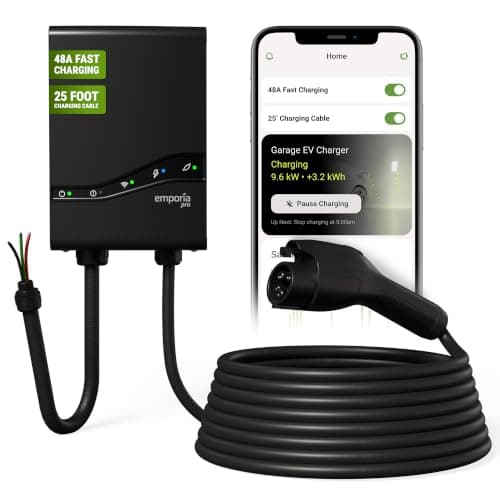
Emporia Pro Level 2 EV Charger
The best-balanced 48 A charger for a typical US house: full 11.5 kW hardwired, and the only unit at this price that ships with a whole-home energy monitor so its load management is reading your actual panel rather than guessing.
#ad Price as of October 5, 2026. How we make money
A 40 A circuit, a PHEV, or a 100 A panel
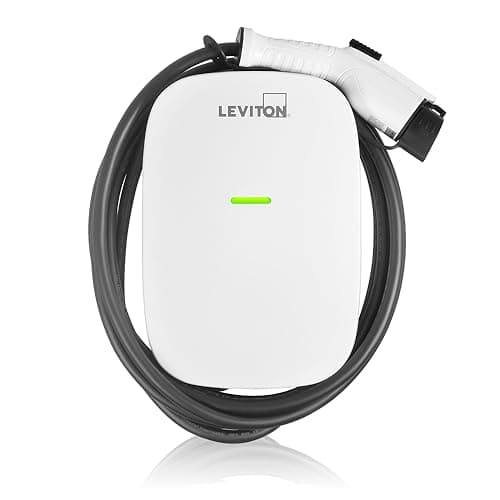
Leviton Level 2 EV Charger (32 A, hardwired)
A 32 A hardwired unit — the right size for a Wrangler 4xe, a Model 3 RWD, or any house whose load calculation will not support more.
#ad Price as of October 5, 2026. How we make money
The cheapest charger worth owning
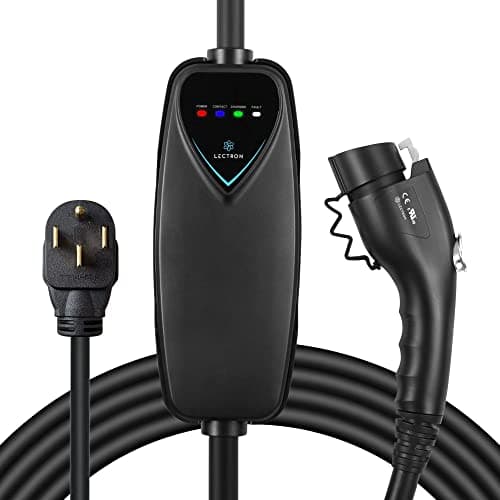
Lectron Level 2 EV Charger (40 A, NEMA 14-50)
A 40 A ETL-certified portable charger for roughly half what the smart units cost. It does one thing, it does it at 9.6 kW, and for a household charging overnight on a flat rate that is the whole job.
#ad Price as of October 5, 2026. How we make money
We earn commission on qualifying purchases at no cost to you. Affiliate disclosure.