The short answer
The Rivian R1T and R1S both accept 11.5 kW / 48 A on AC through a J1772 port. Buy 48 A, on a 60 A breaker with 6 AWG copper, and do not compromise. EPA's published 240 V charge time for a 2026 max-pack R1S is 15 hours — longer than any other vehicle on this site, and the clearest case for maximum amperage we have.
Rivian owners are the group most likely to feel the limits of a home circuit, for two reasons that compound: a very large battery, and efficiency in the low 40s of kWh per 100 miles. A big battery takes a long time to fill, and poor efficiency means every mile costs more of that time.
The constraint: what this car accepts
Everything else on this page follows from one number. The Rivian R1T and R1S's onboard charger accepts a maximum of 11.5 kW, which is 48 amps at 240 volts. No wall charger can exceed it, and a charger rated above it delivers no extra speed.
| Specification | Value | Source |
|---|---|---|
| Maximum AC power accepted | 11.5 kW | Rivian R1T/R1S charging specifications |
| Maximum AC current at 240 V | 48 A | Rivian R1T/R1S charging specifications |
| Connector | J1772 | Rivian R1T/R1S charging specifications |
| EPA range (2026 R1T All-Terrain Dual Large (20in)) | 289 mi | US DOE / EPA fueleconomy.gov |
| EPA efficiency | 44.4 kWh / 100 mi (76 MPGe) | US DOE / EPA fueleconomy.gov |
| EPA published 240 V charge time | 12 hours | US DOE / EPA fueleconomy.gov |
A second trim worth knowing about: EPA lists the 2026 R1S All-Terrain Dual Max (20in) at 43.2 kWh per 100 miles, 370 miles of range, and 15 hours at 240 V. That spread is why the trim matters as much as the model when you are sizing a circuit.
The consequence: the circuit you actually need
Take the car's 48 A ceiling and work backwards. NEC 625.42 classifies EV charging as a continuous load, and NEC 625.41 requires overcurrent protection at not less than 125% of the maximum load — so a 48 A charger needs a 60 A two-pole breaker and 6 AWG copper at the 75 degC column of NEC Table 310.16.
| Item | This car | Why |
|---|---|---|
| Charger output | 48 A | Matches the car's 48 A ceiling exactly |
| Power delivered | 11.5 kW | The lower of the charger's output and the car's limit |
| Breaker | 60 A, two-pole | NEC 625.41 — 125% of a continuous load |
| Copper conductor (conduit, 75 degC) | 6 AWG | NEC Table 310.16 |
| A bigger charger would | deliver nothing extra — this is already the car's ceiling | The lower of the two numbers always wins |
Charge times, with the arithmetic shown
EPA rates the 2026 R1T All-Terrain Dual Large (20in) at 44.4 kWh per 100 miles. That single figure lets you calculate any charge time you like, and it is why we show the formula rather than asserting a number.
hours = (miles x 44.4 / 100) / (kW x 0.9)
At 11.5 kW, this car gains about 23 miles of range per hour
The 0.9 allows for AC-to-DC conversion losses in the onboard charger — roughly 10% of what your meter records never reaches the battery. EPA efficiency figure from the US DOE / EPA fueleconomy.gov service, 2026 R1T All-Terrain Dual Large (20in), queried 2026-10-05.
| Charger | Miles added per hour | Hours to add 100 miles |
|---|---|---|
| 16 A (3.8 kW) | 8 | 12h 59m |
| 24 A (5.8 kW) | 12 | 8h 30m |
| 32 A (7.7 kW) | 16 | 6h 24m |
| 40 A (9.6 kW) | 19 | 5h 08m |
| 48 A (11.5 kW) | 23 | 4h 17m |
For context, EPA's own published figure for a full charge at 240 V on this trim is 12 hours.
What to buy for a Rivian R1T and R1S
Our picks for the Rivian R1T and R1S
Both are 48 A units that reach this car's full 11.5 kW. The top pick is most households, and anyone with a tight panel; the alternative is there because a house with rooftop solar.
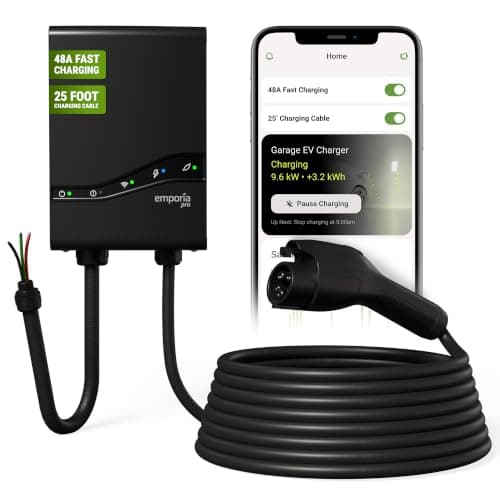
Most households, and anyone with a tight panel
Emporia Pro Level 2 EV Charger
The best-balanced 48 A charger for a typical US house: full 11.5 kW hardwired, and the only unit at this price that ships with a whole-home energy monitor so its load management is reading your actual panel rather than guessing.
#ad Price as of October 5, 2026. How we make money
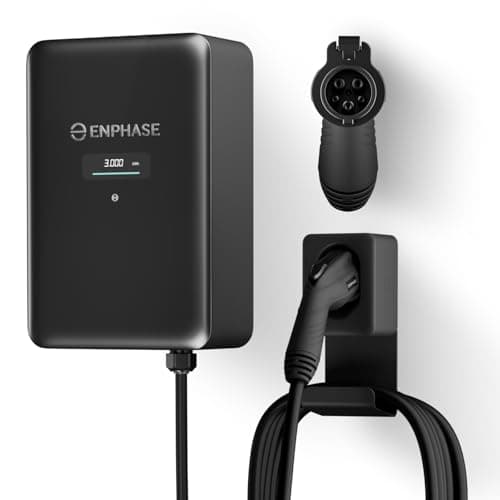
A house with rooftop solar
Enphase IQ EV Charger 2 (48 A)
The charger to buy if you have solar: it adjusts in 1 A increments to absorb whatever the array is exporting, and it carries a 5-year warranty, the longest here.
#ad Price as of October 5, 2026. How we make money
We earn commission on qualifying purchases at no cost to you. Affiliate disclosure.
Connector and adapters
The Rivian R1T and R1S uses a J1772 port for AC charging, which is what the large majority of home chargers in the US have. No adapter is needed for a J1772 charger.
You need a NACS to J1772 adapter only if you intend to use a Tesla Wall Connector, a Tesla Destination charger or a Tesla Mobile Connector. Rated headroom matters on a part carrying 48 A for eight hours — see best NACS to J1772 adapters.
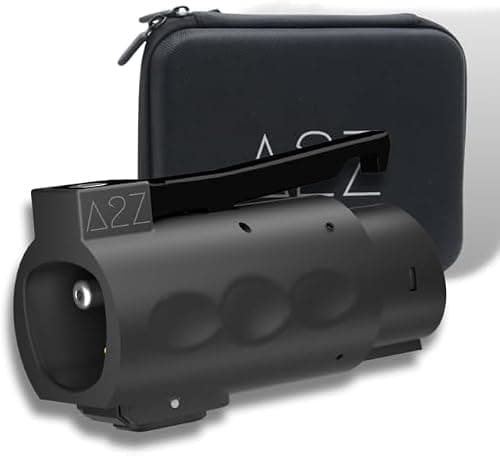
A J1772 car on a Tesla Wall Connector or Destination charger
A2Z EV Stellar Plug NACS to J1772 AC Adapter
80 A / 19.2 kW rated, which is genuine headroom over any home charger. The part to buy if a Tesla charger is in the picture.
#ad Price as of October 5, 2026. How we make money
The numbers that make this a 48 A car
| Trim | kWh / 100 mi | EPA range | EPA 240 V time |
|---|---|---|---|
| R1T All-Terrain Dual Large (20in) | 44.4 | 289 mi | 12.0 h |
| R1T All-Terrain Dual Large Plus (20in) | 46.9 | 292 mi | 12.0 h |
| R1T All-Terrain Dual Max (20in) | 43.2 | 370 mi | 15.0 h |
| R1S All-Terrain Dual Large (20in) | 44.4 | 289 mi | 12.0 h |
| R1S All-Terrain Dual Max (20in) | 43.2 | 370 mi | 15.0 h |
Twelve to fifteen hours is longer than any overnight window. Which means a Rivian owner is frequently not charging to full overnight — they are topping up what they used, and the rate at which they can do that is what matters.
| Charger | Power delivered | Miles per hour | Hours for 150 miles |
|---|---|---|---|
| 32 A | 7.7 kW | 16 | 9h 38m |
| 40 A | 9.6 kW | 19 | 7h 42m |
| 48 A | 11.5 kW | 23 | 6h 26m |
A 32 A charger cannot replace a 150-mile day inside a typical overnight window. A 40 A one just manages it. A 48 A one has an hour and a half in hand. That is the practical argument, and it is specific to this vehicle rather than a general preference for bigger numbers.
Rivian's own charger, or a third party?
Rivian sells a wall charger and it is a competent 48 A unit. The honest position is that it does not do anything a third-party 48 A charger does not, and several third-party units do more — load management on the Emporia Pro, solar tracking on the Enphase, a smaller footprint on the Wallbox.
If vehicle-app integration matters to you, the Rivian unit is the cleaner experience. If your panel is tight, or you have solar, a third-party unit with the matching feature is the better engineering choice.
Connector and adapters
Both the R1T and R1S use J1772 for AC charging, so any mainstream home charger plugs straight in. Rivian has announced access to Tesla's Supercharger network, which involves a DC adapter — a different part from the AC adapters covered on this site. For AC charging at a Tesla Destination charger or Wall Connector you need a NACS-to-J1772 adapter, and on a 48 A car the rating headroom genuinely matters.
Cable length on a full-size truck
The R1T's charge port is front left. On a truck this long, parked nose-in, that puts the port a long way from a charger mounted at the back of a garage — and a long way again if you back in. Measure from the port's actual position before choosing a cable length; our mounting guide walks through it.
The 25 ft cables on the Emporia Pro, Wallbox Pulsar Plus and EVIQO units are the ones to look at. The 18 ft Leviton is a poor match for this vehicle.
Accessories worth adding
On a vehicle with a long, heavy cable in daily use, the holster and the steel hook are not optional extras — they are what stops the handle being driven over.
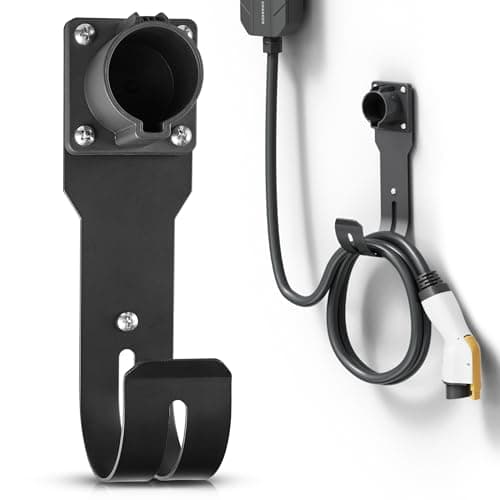
Getting the handle and the cable off the floor
MECMO J1772 Holster Dock and J-Hook
A holster for the handle plus a hook for the loop. The cheapest meaningful upgrade to any charging setup, because a handle that lives on the floor gets stepped on, driven over and eventually fails.
#ad Price as of October 5, 2026. How we make money
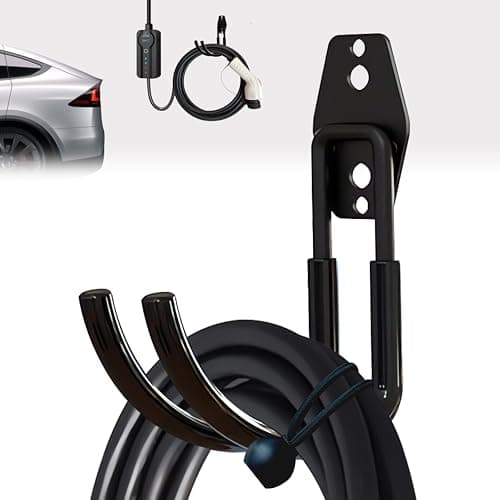
A heavy 25 ft cable that bends plastic hooks
Nexoroot Heavy-Duty Steel EV Cable J-Hook
Steel rather than plastic, which matters with 25 feet of 8 AWG cable hanging on it — the full loop of a premium charger's lead is heavier than people expect.
#ad Price as of October 5, 2026. How we make money
A J1772 car on a Tesla Wall Connector or Destination charger
A2Z EV Stellar Plug NACS to J1772 AC Adapter
Rated 80 A / 19.2 kW, which is well above any home charger's output and the margin you want in a part that carries 48 A continuously for eight hours a night.
#ad Price as of October 5, 2026. How we make money
We earn commission on qualifying purchases at no cost to you. Affiliate disclosure.