The short answer
Yes, for most EV owners. A Level 2 charger adds roughly 25 to 40 miles of range per hour against Level 1's 3 to 5, and the question that decides it is not how fast you want to charge — it is whether a 12 hour overnight window on a 120 V outlet covers your daily driving. Under about 40 miles a day in a full battery EV, it often does. Above that, or with a car parked outdoors in winter, Level 2 stops being a convenience and becomes the thing that makes the car work.
The arithmetic that actually decides it
Forget charger marketing for a moment. There is one calculation, and you can do it with your own numbers in thirty seconds.
1.4 kW x 12 h / 0.30 kWh per mile
about 56 miles added overnight
1.4 kW is a typical 12 A Level 1 draw on a 120 V circuit, per the US DOE AFDC's charging-at-home figures. 0.30 kWh per mile is near the EPA combined efficiency of a mid-size crossover EV; look yours up on fueleconomy.gov and substitute it.
9.6 kW x 12 h / 0.30 kWh per mile
about 384 miles added overnight
In practice the battery fills long before the twelve hours are up, which is the real point: Level 2 turns charging into something that finishes, rather than something that runs continuously.
The honest reading of those two numbers is that Level 1 is not slow in absolute terms — it is slow relative to a bad day. Fifty-six miles overnight covers an average US commute comfortably. It does not cover the day you drive 120 miles, and it does not cover two such days in a row, because the deficit compounds.
Four reasons Level 2 is worth it that are not speed
- Headroom, not throughput. A Level 2 charger means an unexpected 150 mile day costs you nothing, because the car refills before morning regardless. That is the benefit owners actually report, and it is about not having to think.
- Cold weather. A car parked outdoors below freezing spends part of a Level 1 charge keeping the battery warm rather than filling it, and on a cold night a 1.4 kW supply can be nearly all overhead. Our cold weather charging guide covers what to expect.
- Time-of-use tariffs. If your utility charges less overnight you need to fit the whole charge inside the cheap window. At 1.4 kW you cannot; at 9.6 kW you almost always can. On many tariffs this alone pays for the installation — see time-of-use rates and EV charging.
- Not using public charging. DC fast charging typically costs two to three times home electricity. Every session you avoid is money, and home vs public charging cost does the comparison with real tariff figures.
Three cases where Level 1 is genuinely enough
We are an affiliate site and it would be easy to say everyone needs a charger. These are the cases where we would tell you not to buy one yet.
| Situation | Why Level 1 works | Revisit if |
|---|---|---|
| Under about 30-40 miles a day in a BEV, parked in a garage | A 12 hour overnight window on 120 V covers that with margin | Your commute changes, or the car moves outdoors |
| A small plug-in hybrid with a 20-30 mile electric range | The battery is small enough that Level 1 fills it overnight | You get a second PHEV, or want to top up between trips |
| Renting, with no permission to install | The circuit is not yours to change | You can get landlord consent, or a plug-in unit fits |
For the renting case there is a middle path that does not need an electrician: a portable Level 2 unit on an existing 240 V outlet, or a listed dryer-circuit switch. EV charging for renters and portable Level 2 charging for renters cover both.
What it costs to find out
The charger is usually the smaller half of the number. A 40 A unit is a few hundred dollars; the circuit depends entirely on how far your panel is from where the car parks, and whether the panel has a spare pair of slots.
- A panel in the garage, car parked on the other side of it. The cheapest possible case — a short run, a breaker and a few hours of labor.
- A panel on the far side of a finished house. This is where quotes climb, because the cost is the route, not the amperage.
- A full panel. Adding a breaker is impossible until something changes, which may mean a subpanel, a load-managed charger, or a service upgrade.
Before you get quotes, do the two things that change the answer: run a load calculation so you know what your service can carry, and check EV charger rebates for 2026 — utility and state programs frequently cover a real fraction of both the unit and the install. Our installation cost page breaks a quote into its parts so you can see what you are being charged for.
If the answer is yes, what to buy
Three chargers that cover most households
Match the charger to your car's onboard limit and your panel's headroom, in that order. Buying more amps than your car accepts is the most common waste of money in this category.
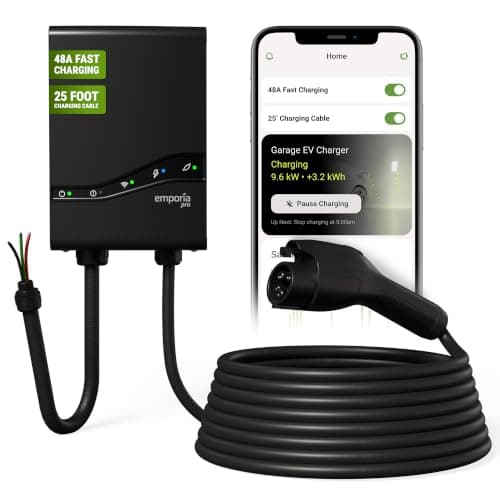
Most households, and anyone with a tight panel
Emporia Pro Level 2 EV Charger
The best-balanced 48 A charger for a typical US house: full 11.5 kW hardwired, and the only unit at this price that ships with a whole-home energy monitor so its load management is reading your actual panel rather than guessing.
#ad Price as of October 10, 2026. How we make money
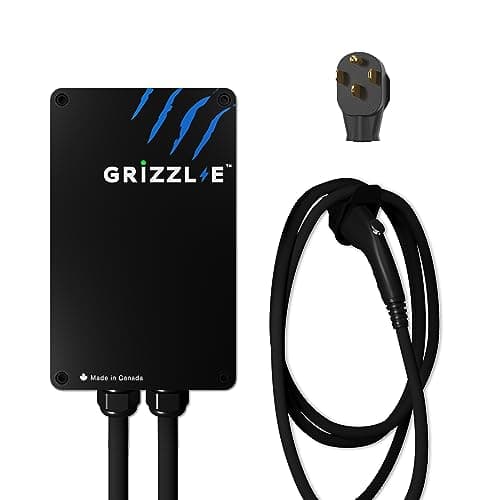
An outdoor install, and anyone who distrusts apps
Grizzl-E Classic
A cast-aluminum 40 A charger with dip switches instead of a cloud account. Nothing about it is clever, which is exactly why it is the unit to buy for a driveway post in a cold climate.
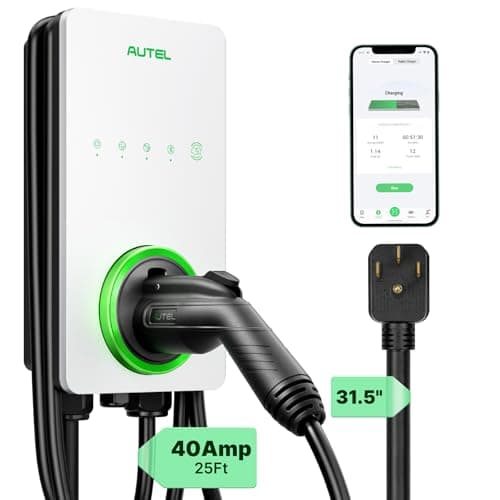
Cold climates and 1 A output tuning
Autel MaxiCharger AC Lite (40 A)
The widest output adjustment range here — 6 A to 40 A in the app — plus an operating range down to -40 degF, which makes it the practical pick for an unheated garage in the north.
We earn commission on qualifying purchases at no cost to you. Affiliate disclosure.
| Your situation | Buy | Circuit |
|---|---|---|
| Current BEV, panel has headroom | Emporia Pro (48 A) | 60 A breaker, 6 AWG |
| Outdoor or cold-climate install | Grizzl-E Classic (40 A) | 50 A breaker, 8 AWG |
| Load calculation lands on an odd figure | Autel MaxiCharger AC Lite (40 A) | 50 A breaker, 8 AWG |
| Plug-in hybrid or entry Model 3 RWD | A 32 A unit | 40 A breaker, 8 AWG |
If you are still deciding between sizes rather than brands, what amp EV charger do I need is the page to read next, and level 1 vs level 2 charging covers the two levels in detail.