The short answer
Home chargers divide four ways, and each is a separate decision: by level (Level 1 at 120 V, Level 2 at 240 V — there is no residential Level 3), by form factor (portable cordset against wall-mounted unit), by connection (hardwired against plug-in), and by connector (J1772 against NACS). Everything else — apps, load management, enclosure ratings — sits inside those four.
1. By level
| Level | Voltage | Power | Range added | Available at home? |
|---|---|---|---|---|
| Level 1 | 120 V | 1.9 kW | approximately 5 miles per hour | Yes — no installation |
| Level 2 | 240 V | 2.9 to 19.2 kW | approximately 25 miles per hour | Yes — dedicated circuit |
| DC fast charging | DC | up to 500 kW | approximately 100 to 200+ miles per 30 minutes | No, at any price |
2. By form factor: portable cordset or wall unit
| Portable cordset | Wall-mounted unit | |
|---|---|---|
| Mounting | None — hangs on a hook | Bolted to the wall |
| Typical output | 16-40 A | 32-48 A |
| Moves with you | Yes | Plug-in versions do; hardwired do not |
| Works at a relative's house | Yes | No |
| Cable management | Coils on the floor unless you fit a hook | Integrated, usually with a holster |
| Enclosure | Usually plastic | Often NEMA 4, sometimes metal |
| Durability | Lower — it gets handled and moved | Higher |
| Price | Lower | Higher |
A portable cordset is the right purchase for a renter, a travel charger, or a second car that barely moves. A wall unit is the right purchase for a daily driver in a home you own — mainly because of cable management, which sounds trivial and is the leading cause of physical damage to charging equipment.
3. By connection: hardwired or plug-in
This is the decision with the most consequences, and most of them are code consequences rather than convenience ones.
| Hardwired | Plug-in | |
|---|---|---|
| Maximum continuous output | The charger's full rating, up to 48 A | 40 A on a NEMA 14-50 |
| GFCI breaker | Not required — NEC 625.54 covers receptacles | Required |
| Nuisance tripping risk | Low | Real |
| Connections in the current path | One | Three |
| Moves with you | No | Yes |
| Extra parts needed | None | GFCI breaker, industrial receptacle, in-use cover outdoors |
4. By connector: J1772 or NACS
J1772 is the long-standing North American AC standard and what most non-Tesla EVs use. NACS (standardized as SAE J3400) is Tesla's connector, now adopted by others — the Hyundai Ioniq 5 from the 2025 model year, with more to follow.
An adapter bridges either direction for AC charging, so this is a convenience decision rather than a compatibility one. Buy the connector your current car uses so you are not fitting an adapter every night, and know that many manufacturers sell the same unit in both. Which plug does my EV use.
What sits inside those four categories
Everything else is a feature rather than a type, and most of it is optional:
| Feature | What it does | Do you need it? |
|---|---|---|
| Whole-home load management | Watches total household draw and throttles | Yes, if your panel is tight. This is the most valuable feature in the category |
| App scheduling | Charges in a chosen window | Only if your car cannot do it, or two cars share the charger |
| Solar tracking | Varies draw to absorb array surplus | Only with solar on unfavourable export terms |
| Adjustable output | Sets the charger to a smaller circuit | Yes, if your electrical future is uncertain |
| Energy reporting | Per-session consumption | Nice to have; your car usually estimates it |
| Power sharing | Two units on one circuit | Yes, for two EVs without a second circuit |
| Cold-weather rating | Operating range | Yes, if your garage is unheated and cold |
| Metal enclosure | Physical robustness | Yes outdoors; less indoors |
Putting it together
- Level. Level 2 unless your mileage is genuinely small or you cannot install anything.
- Amperage. The lower of your car's onboard limit and your panel's headroom. What amp do I need.
- Connection. Hardwired if you own the home and want 48 A; plug-in if you might move.
- Form factor. Wall unit for a daily driver; portable if you rent or travel.
- Connector. Whatever your car uses.
- Then features, and only the ones that match your actual situation.
One good example of each main type
A 48 A hardwired smart unit, a 40 A metal-bodied outdoor unit, a 40 A plug-in portable, and a 16 A dual-voltage cordset.
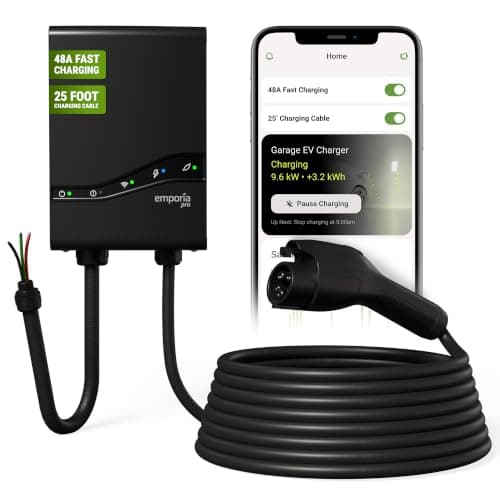
Most households, and anyone with a tight panel
Emporia Pro Level 2 EV Charger
The best-balanced 48 A charger for a typical US house: full 11.5 kW hardwired, and the only unit at this price that ships with a whole-home energy monitor so its load management is reading your actual panel rather than guessing.
#ad Price as of October 5, 2026. How we make money
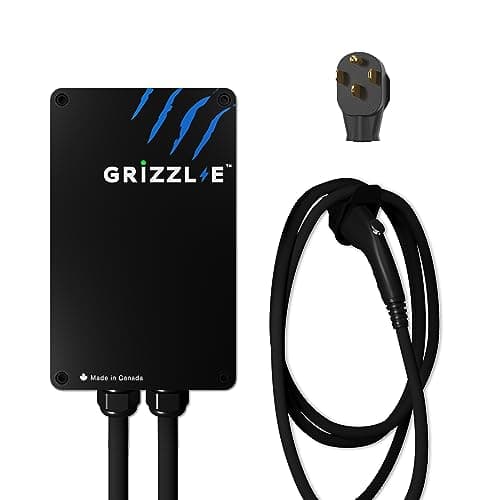
An outdoor install, and anyone who distrusts apps
Grizzl-E Classic
A cast-aluminum 40 A charger with dip switches instead of a cloud account. Nothing about it is clever, which is exactly why it is the unit to buy for a driveway post in a cold climate.
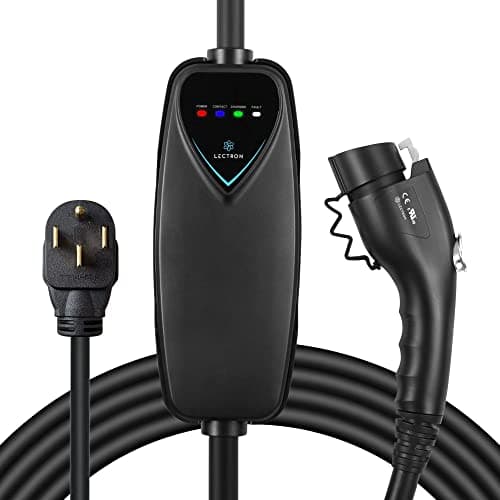
The cheapest charger worth owning
Lectron Level 2 EV Charger (40 A, NEMA 14-50)
A 40 A ETL-certified portable charger for roughly half what the smart units cost. It does one thing, it does it at 9.6 kW, and for a household charging overnight on a flat rate that is the whole job.
#ad Price as of October 5, 2026. How we make money
A renter with access to a 240 V outlet
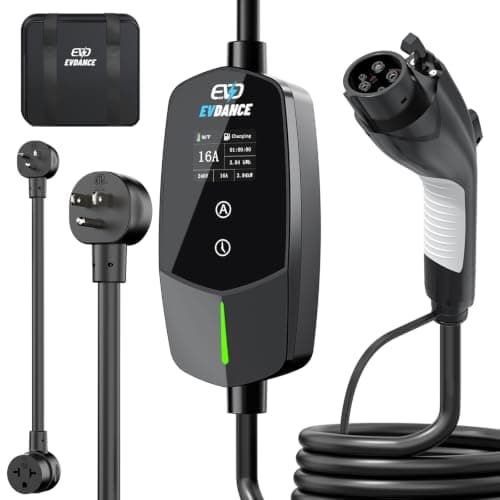
EVDANCE Level 1 & 2 Portable EV Charger (16 A)
A dual-voltage 16 A cordset. On 240 V that is about 3.8 kW — roughly twice the Level 1 cordset that came with the car, from an outlet you may already be allowed to use.
#ad Price as of October 5, 2026. How we make money
We earn commission on qualifying purchases at no cost to you. Affiliate disclosure.