The short answer
A smart EV charger is one with network connectivity — Wi-Fi, Bluetooth or both — that can schedule charging, report energy use, adjust its output remotely and, on the better units, monitor whole-home consumption and throttle itself. That last capability is the one that genuinely saves money, because it can avoid a service upgrade. The rest mostly duplicates something your car already does.
The first question: can your car already do this?
Most EVs can schedule their own charging. If yours can, a smart charger's scheduling is duplicate functionality and you are paying for it twice.
Before going further, open your car's charging settings and look for a departure time or a scheduled charging window. If it is there, you already own the feature most smart chargers are sold on.
| Capability | Car can do it? | Need the charger? |
|---|---|---|
| Schedule charging to off-peak hours | Usually yes | Only if the car cannot, or two cars share the charger |
| Whole-home load management | No | Yes — this is the real one |
| Charge on surplus solar | No | Yes |
| Per-session energy reporting | Usually, roughly | Only if you want accurate metering |
| Change output amperage without an electrician | No | Yes, and it has electrical consequences |
| Firmware updates over the air | n/a | Yes — a genuine benefit over a decade |
| Enforce a window regardless of which car plugs in | No | Yes |
The feature that is worth real money
There is an important distinction inside this feature. Some chargers implement load management as a setting: you tell it your service rating and it limits itself to an assumed headroom. Others measure, using current transformers on the service conductors.
Measuring is substantially better. A charger reading real whole-home draw can run at full output at 2am and back off at 6pm; a charger working from an assumption throttles conservatively all the time and cannot react to anything. The Emporia Pro ships with the monitor that does the measuring, which is why it is our pick in this category.
The other two features worth paying for
Solar tracking
If you have an array on unfavourable export terms, a charger that varies its draw to absorb surplus changes the economics of charging. Granularity matters: the Enphase IQ EV Charger 2 adjusts in 1 A increments, which is fine-grained enough to follow a cloudy afternoon. A charger that steps in 8 A jumps either over-draws from the grid or wastes the surplus.
If your net metering credits exports at or near retail, this matters much less. Solar EV charging at home covers what to check.
Enforcing a time-of-use window across multiple cars
Scheduling in the car works until someone else plugs in, you swap cars, or a guest charges. A charger that enforces the off-peak window does it regardless of what is on the end of the cable. On a tariff with a 2-3x peak-to-off-peak spread, that is real money across a year — see time-of-use rates.
The question to ask about any smart charger
When to buy a charger with no app at all
A genuine recommendation rather than a hedge. If three or more of these apply, buy a non-smart charger and spend the difference on the install:
- A flat electricity tariff. Nothing to schedule around.
- Your car schedules charging. Duplicate functionality.
- A panel with clear headroom. No load management needed.
- No solar.
- An outdoor install in a cold climate, where a cast-aluminum body and a physical switch are more robust than any app.
- You dislike cloud dependencies on a device bolted to your house for a decade. That is a legitimate engineering position, not technophobia.
A monitor without a smart charger
Worth knowing: you can get most of the useful data without buying a smart charger. A standalone whole-home energy monitor tells you what your house is drawing, which is the information that actually informs decisions — including which charger to buy.
The three situations, in hardware
Load management, solar tracking, and the monitor on its own. If none of these describes you, a charger with physical switches does the same charging job.
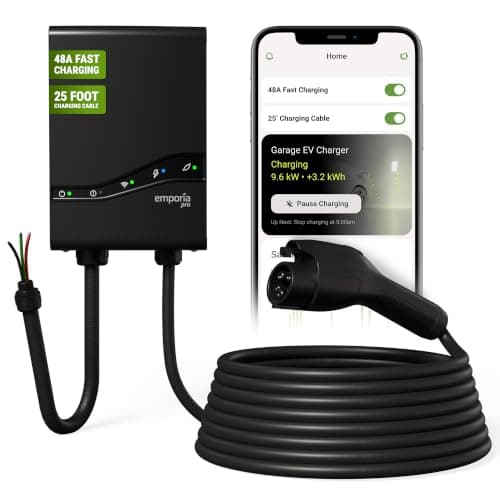
Most households, and anyone with a tight panel
Emporia Pro Level 2 EV Charger
The best-balanced 48 A charger for a typical US house: full 11.5 kW hardwired, and the only unit at this price that ships with a whole-home energy monitor so its load management is reading your actual panel rather than guessing.
#ad Price as of October 5, 2026. How we make money
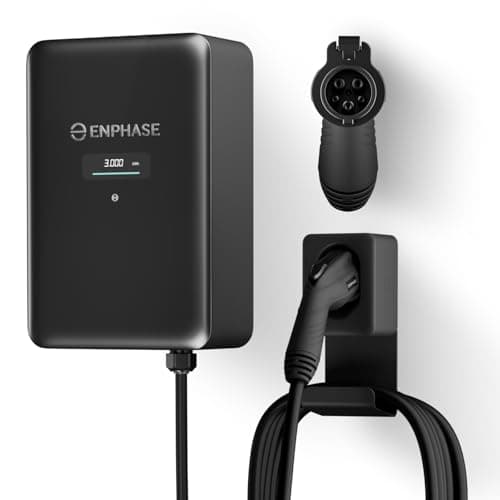
A house with rooftop solar
Enphase IQ EV Charger 2 (48 A)
The charger to buy if you have solar: it adjusts in 1 A increments to absorb whatever the array is exporting, and it carries a 5-year warranty, the longest here.
#ad Price as of October 5, 2026. How we make money
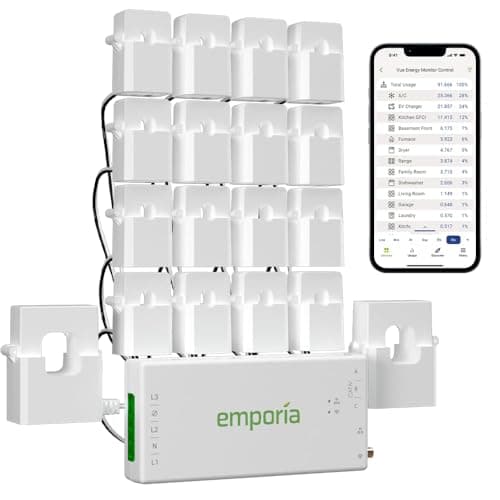
Knowing what your panel is actually doing
Emporia Vue 3 Home Energy Monitor
The cheapest way to replace a load calculation's assumptions with measurements. If your panel is marginal, a month of real data from this tells you whether a 48 A charger fits better than any rule of thumb will.
#ad Price as of October 5, 2026. How we make money
An outdoor install, and anyone who distrusts apps
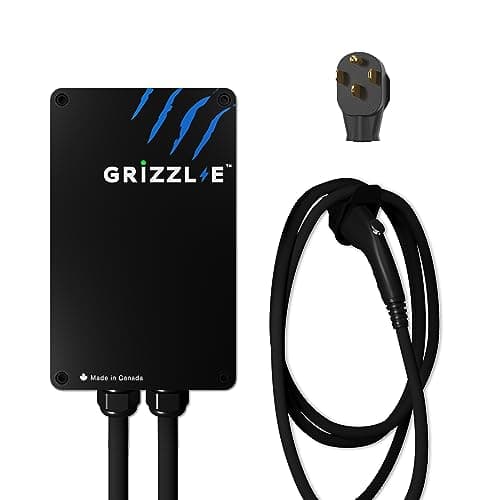
Grizzl-E Classic
A cast-aluminum 40 A charger with dip switches instead of a cloud account. Nothing about it is clever, which is exactly why it is the unit to buy for a driveway post in a cold climate.
We earn commission on qualifying purchases at no cost to you. Affiliate disclosure.