The short answer
The Cybertruck accepts 11.5 kW / 48 A through a NACS port. Buy 48 A — on a 60 A breaker with 6 AWG copper — and do not compromise down to 40 A unless your panel forces it. At 42.9 kWh per 100 miles this is one of the least efficient vehicles on this site, and EPA's published 240 V charge time is 11.7 hours.
Most of this site is about telling people not to overbuy amperage. The Cybertruck is the exception that proves the rule is about the car rather than about frugality: when a vehicle needs 42.9 kWh to go 100 miles, the kilowatts actually matter.
The constraint: what this car accepts
Everything else on this page follows from one number. The Tesla Cybertruck's onboard charger accepts a maximum of 11.5 kW, which is 48 amps at 240 volts. No wall charger can exceed it, and a charger rated above it delivers no extra speed.
| Specification | Value | Source |
|---|---|---|
| Maximum AC power accepted | 11.5 kW | Tesla onboard charger specification |
| Maximum AC current at 240 V | 48 A | Tesla onboard charger specification |
| Connector | NACS | Tesla charging support |
| EPA range (2026 Cybertruck AWD) | 325 mi | US DOE / EPA fueleconomy.gov |
| EPA efficiency | 42.9 kWh / 100 mi (79 MPGe) | US DOE / EPA fueleconomy.gov |
| EPA published 240 V charge time | 11.7 hours | US DOE / EPA fueleconomy.gov |
The consequence: the circuit you actually need
Take the car's 48 A ceiling and work backwards. NEC 625.42 classifies EV charging as a continuous load, and NEC 625.41 requires overcurrent protection at not less than 125% of the maximum load — so a 48 A charger needs a 60 A two-pole breaker and 6 AWG copper at the 75 degC column of NEC Table 310.16.
| Item | This car | Why |
|---|---|---|
| Charger output | 48 A | Matches the car's 48 A ceiling exactly |
| Power delivered | 11.5 kW | The lower of the charger's output and the car's limit |
| Breaker | 60 A, two-pole | NEC 625.41 — 125% of a continuous load |
| Copper conductor (conduit, 75 degC) | 6 AWG | NEC Table 310.16 |
| A bigger charger would | deliver nothing extra — this is already the car's ceiling | The lower of the two numbers always wins |
Charge times, with the arithmetic shown
EPA rates the 2026 Cybertruck AWD at 42.9 kWh per 100 miles. That single figure lets you calculate any charge time you like, and it is why we show the formula rather than asserting a number.
hours = (miles x 42.9 / 100) / (kW x 0.9)
At 11.5 kW, this car gains about 24 miles of range per hour
The 0.9 allows for AC-to-DC conversion losses in the onboard charger — roughly 10% of what your meter records never reaches the battery. EPA efficiency figure from the US DOE / EPA fueleconomy.gov service, 2026 Cybertruck AWD, queried 2026-10-05.
| Charger | Miles added per hour | Hours to add 100 miles |
|---|---|---|
| 16 A (3.8 kW) | 8 | 12h 33m |
| 24 A (5.8 kW) | 12 | 8h 13m |
| 32 A (7.7 kW) | 16 | 6h 11m |
| 40 A (9.6 kW) | 20 | 4h 58m |
| 48 A (11.5 kW) | 24 | 4h 09m |
For context, EPA's own published figure for a full charge at 240 V on this trim is 11.7 hours.
What to buy for a Tesla Cybertruck
Our picks for the Tesla Cybertruck
Both are 48 A units that reach this car's full 11.5 kW. The top pick is a two-car household running one tesla and one j1772 ev; the alternative is there because a tesla-only household.
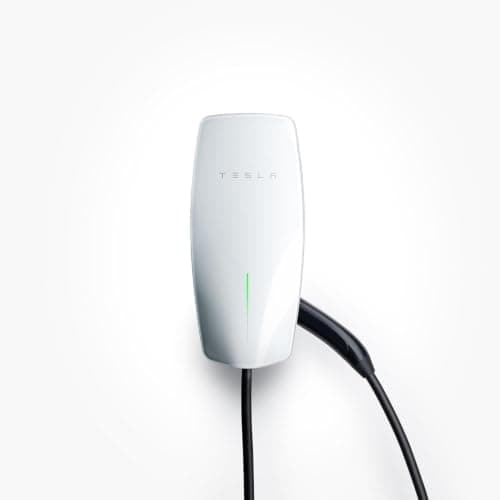
A two-car household running one Tesla and one J1772 EV
Tesla Universal Wall Connector
The only mainstream charger that handles both connectors without a loose adapter: a NACS handle with the J1772 adapter docked in the unit, which is the right answer for a mixed-fleet driveway and overkill for anything else.
#ad Price as of October 5, 2026. How we make money
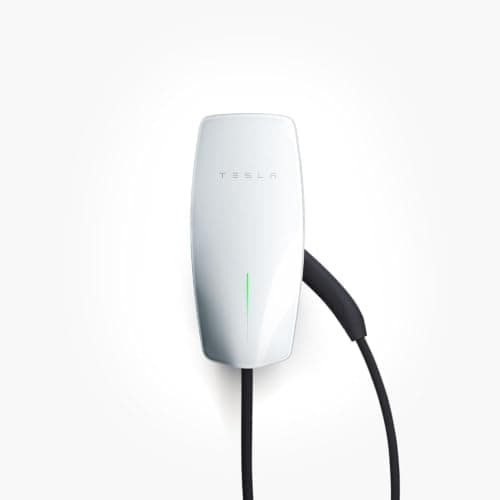
A Tesla-only household
Tesla Wall Connector (Gen 3)
If every car in the driveway is a Tesla, this is the cleanest answer: 48 A, a 24 ft cable, and a handle that opens the charge port for you — but it is NACS-only, so a J1772 car needs an adapter every single time.
#ad Price as of October 5, 2026. How we make money
We earn commission on qualifying purchases at no cost to you. Affiliate disclosure.
Connector and adapters
The Tesla Cybertruck uses a NACS port (standardized as SAE J3400). Two consequences for home charging: a NACS-handled charger plugs straight in with no adapter, and a J1772 charger — which is most of the installed base — needs a J1772 to NACS adapter.
Our pick there is the A2Z Atom Plug, which carries UL 2252 and CSA certification and an 80 A rating — real headroom over a 48 A home charger. Full comparison on best J1772 to NACS adapters, and the connector landscape on which plug does my EV use.
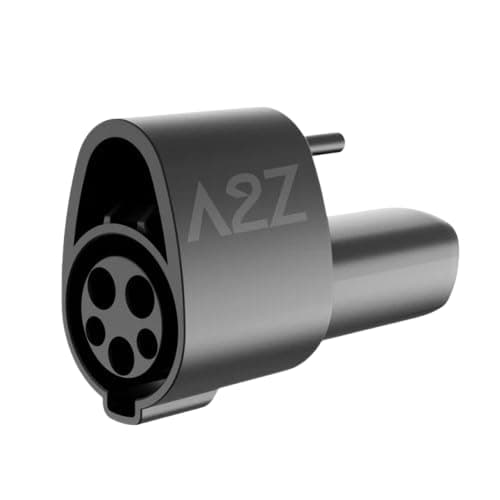
A Tesla on a J1772 charger — the one to buy
A2Z EV Atom Plug J1772 to NACS Adapter
UL 2252 and CSA certified, 80 A rated. The adapter to buy if a J1772 charger is in your future.
#ad Price as of October 5, 2026. How we make money
Why efficiency changes the charger decision
A Model Y needs 27.5 kWh to travel 100 miles. A Cybertruck needs 42.9 kWh — 56% more energy for the same distance. That means every hour of charging buys the Cybertruck considerably less range, and the difference between 40 A and 48 A stops being a rounding error.
| Vehicle | kWh / 100 mi | Miles per hour at 40 A | Miles per hour at 48 A | Difference |
|---|---|---|---|---|
| Tesla Model Y Long Range AWD | 27.5 | 31 | 38 | 7 mi/h |
| Tesla Cybertruck AWD | 42.9 | 20 | 24 | 4 mi/h |
The absolute difference is smaller for the Cybertruck, which looks like an argument against 48 A — but read it as hours rather than miles. Replacing 200 miles takes 10 hours at 40 A and 8h 20m at 48 A. On an overnight window that is the difference between finishing and not.
Powershare, and what it means for the charger
The Cybertruck is currently the only Tesla that supports Powershare — using the truck's battery to power a house during an outage. That capability runs through Tesla's own equipment, and it is the one genuine argument for choosing a Tesla charger on this vehicle rather than any 48 A unit.
If backup power is not on your list, the Powershare argument does not apply and a third-party 48 A charger plus a J1772-to-NACS adapter does the same charging job for less money. If backup power is on your list, that is a conversation with Tesla about the full home-integration hardware, not just a wall charger.
Cable length matters more on a truck
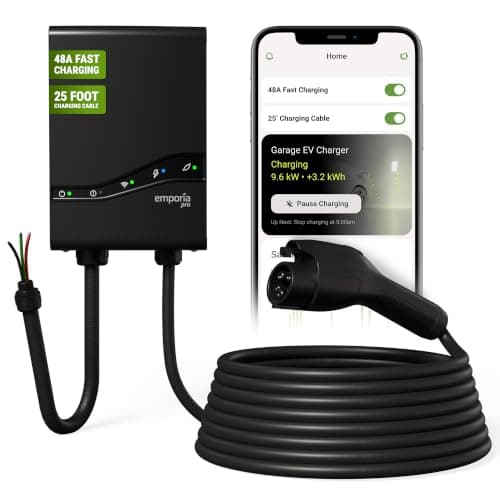
A Cybertruck is a large vehicle, and the charge port is on the rear left. In a garage where the truck only just fits, the distance from a sensible mounting point to the port can be surprising. The Tesla Wall Connector and the Universal Wall Connector both carry 24 ft cables; the Emporia Pro, Wallbox Pulsar Plus and EVIQO units carry 25 ft.
Measure before you buy — our mounting height and position page walks through how. An 18 ft cable on a full-size truck is the kind of mistake that is only discoverable after the electrician has left.
Getting the handle and cable off the floor
On a truck with a long, heavy cable, these two cheap parts matter more than on a small car — 25 feet of 8 AWG cable on a garage floor is a lot of weight finding the ground.
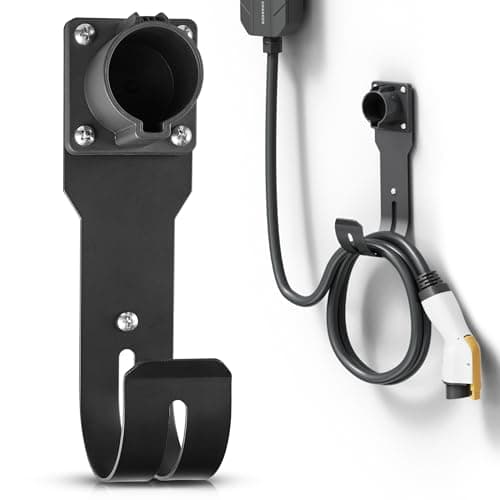
Getting the handle and the cable off the floor
MECMO J1772 Holster Dock and J-Hook
A holster for the handle plus a hook for the loop. The cheapest meaningful upgrade to any charging setup, because a handle that lives on the floor gets stepped on, driven over and eventually fails.
#ad Price as of October 5, 2026. How we make money
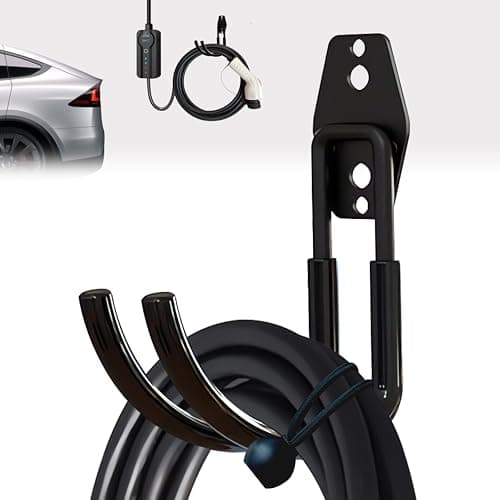
A heavy 25 ft cable that bends plastic hooks
Nexoroot Heavy-Duty Steel EV Cable J-Hook
Steel rather than plastic, which matters with 25 feet of 8 AWG cable hanging on it — the full loop of a premium charger's lead is heavier than people expect.
#ad Price as of October 5, 2026. How we make money
We earn commission on qualifying purchases at no cost to you. Affiliate disclosure.