The short answer
Check your trim first. The Model 3 Premium and Performance accept 11.5 kW / 48 A; the entry Model 3 Standard RWD accepts 7.7 kW / 32 A. A 48 A charger on an entry RWD charges no faster than a 32 A one, while requiring a 60 A breaker instead of a 40 A one and 6 AWG copper instead of 8 AWG.
This is the single most expensive misunderstanding in Tesla home charging, and it is entirely the fault of how the trims are marketed. Two cars with the same badge, the same port and the same app have onboard chargers that differ by 50%.
If you are reading this before buying the circuit, it is worth five minutes to confirm which car you have. The onboard charger rating is in the owner's manual's charging section, and the car's charging screen will show its own ceiling the first time you plug into a charger rated above it.
The constraint: what this car accepts
Everything else on this page follows from one number. The Tesla Model 3's onboard charger accepts a maximum of 11.5 kW, which is 48 amps at 240 volts. No wall charger can exceed it, and a charger rated above it delivers no extra speed.
| Specification | Value | Source |
|---|---|---|
| Maximum AC power accepted | 11.5 kW | Tesla onboard charger specification |
| Maximum AC current at 240 V | 48 A | Tesla onboard charger specification |
| Connector | NACS | Tesla charging support |
| EPA range (2026 Model 3 Premium RWD) | 363 mi | US DOE / EPA fueleconomy.gov |
| EPA efficiency | 24.6 kWh / 100 mi (137 MPGe) | US DOE / EPA fueleconomy.gov |
| EPA published 240 V charge time | 11.7 hours | US DOE / EPA fueleconomy.gov |
A second trim worth knowing about: EPA lists the 2026 Model 3 Standard RWD at 24.3 kWh per 100 miles, 321 miles of range, and 12.1 hours at 240 V. That spread is why the trim matters as much as the model when you are sizing a circuit.
The consequence: the circuit you actually need
Take the car's 48 A ceiling and work backwards. NEC 625.42 classifies EV charging as a continuous load, and NEC 625.41 requires overcurrent protection at not less than 125% of the maximum load — so a 48 A charger needs a 60 A two-pole breaker and 6 AWG copper at the 75 degC column of NEC Table 310.16.
| Item | This car | Why |
|---|---|---|
| Charger output | 48 A | Matches the car's 48 A ceiling exactly |
| Power delivered | 11.5 kW | The lower of the charger's output and the car's limit |
| Breaker | 60 A, two-pole | NEC 625.41 — 125% of a continuous load |
| Copper conductor (conduit, 75 degC) | 6 AWG | NEC Table 310.16 |
| A bigger charger would | deliver nothing extra — this is already the car's ceiling | The lower of the two numbers always wins |
Charge times, with the arithmetic shown
EPA rates the 2026 Model 3 Premium RWD at 24.6 kWh per 100 miles. That single figure lets you calculate any charge time you like, and it is why we show the formula rather than asserting a number.
hours = (miles x 24.6 / 100) / (kW x 0.9)
At 11.5 kW, this car gains about 42 miles of range per hour
The 0.9 allows for AC-to-DC conversion losses in the onboard charger — roughly 10% of what your meter records never reaches the battery. EPA efficiency figure from the US DOE / EPA fueleconomy.gov service, 2026 Model 3 Premium RWD, queried 2026-10-05.
| Charger | Miles added per hour | Hours to add 100 miles |
|---|---|---|
| 16 A (3.8 kW) | 14 | 7h 12m |
| 24 A (5.8 kW) | 21 | 4h 43m |
| 32 A (7.7 kW) | 28 | 3h 33m |
| 40 A (9.6 kW) | 35 | 2h 51m |
| 48 A (11.5 kW) | 42 | 2h 23m |
For context, EPA's own published figure for a full charge at 240 V on this trim is 11.7 hours.
What to buy for a Tesla Model 3
Our picks for the Tesla Model 3
Both are 48 A units that reach this car's full 11.5 kW. The top pick is a tesla-only household; the alternative is there because a tesla household that wants a non-tesla app.
A Tesla-only household
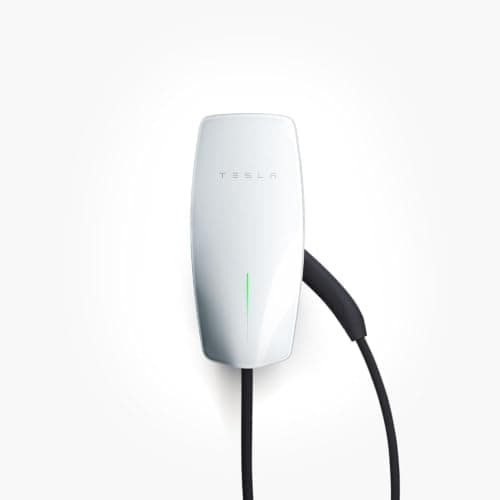
Tesla Wall Connector (Gen 3)
If every car in the driveway is a Tesla, this is the cleanest answer: 48 A, a 24 ft cable, and a handle that opens the charge port for you — but it is NACS-only, so a J1772 car needs an adapter every single time.
#ad Price as of October 5, 2026. How we make money
A Tesla household that wants a non-Tesla app
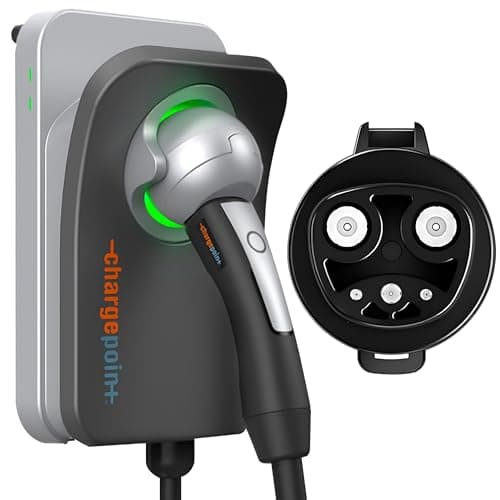
ChargePoint Home Flex NACS (hardwired)
A NACS-handled Home Flex: the same adjustable 16-50 A hardware with a Tesla-shaped plug, which removes the adapter from a Tesla owner's daily routine without locking them into Tesla's ecosystem.
#ad Price as of October 5, 2026. How we make money
We earn commission on qualifying purchases at no cost to you. Affiliate disclosure.
Connector and adapters
The Tesla Model 3 uses a NACS port (standardized as SAE J3400). Two consequences for home charging: a NACS-handled charger plugs straight in with no adapter, and a J1772 charger — which is most of the installed base — needs a J1772 to NACS adapter.
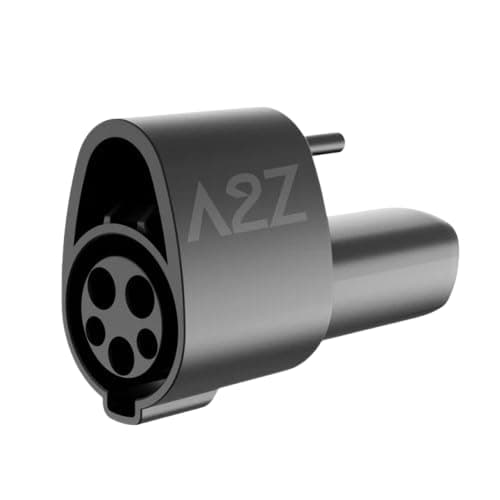
Our pick there is the A2Z Atom Plug, which carries UL 2252 and CSA certification and an 80 A rating — real headroom over a 48 A home charger. Full comparison on best J1772 to NACS adapters, and the connector landscape on which plug does my EV use.
A Tesla on a J1772 charger — the one to buy
A2Z EV Atom Plug J1772 to NACS Adapter
UL 2252 and CSA certified, 80 A rated. The adapter to buy if a J1772 charger is in your future.
#ad Price as of October 5, 2026. How we make money
Which Model 3 do you have?
| Trim | Max AC | Charger | Breaker | EPA kWh/100mi | EPA 240 V time |
|---|---|---|---|---|---|
| Model 3 Premium RWD (2026) | 11.5 kW / 48 A | 48 A | 60 A | 24.6 | 11.7 h |
| Model 3 Premium AWD (2026) | 11.5 kW / 48 A | 48 A | 60 A | 26.4 | 11.7 h |
| Model 3 Performance (2026) | 11.5 kW / 48 A | 48 A | 60 A | 29.6 | 12.0 h |
| Model 3 Standard RWD (2026) | 7.7 kW / 32 A | 32 A | 40 A | 24.3 | 12.1 h |
Note the last row carefully: the Standard RWD is the most efficient Model 3 in the range at 24.3 kWh per 100 miles, and EPA still shows the longest 240 V charge time — because it is charging at 7.7 kW rather than 11.5 kW. Efficiency and charge speed are different properties.
If you have the 32 A car
Buy a 32 A charger and spend the saving on the parts that actually improve the install — a hardwired connection rather than a receptacle, or an industrial-grade 14-50 if you do plug in, plus a handle holster.
A 32 A circuit is materially cheaper: a 40 A breaker, 8 AWG copper rather than 6 AWG, and a conductor that is genuinely easier to pull through tight bends. On a long run that difference is the largest single saving available to you.
And the charging penalty is smaller than it sounds. At 7.7 kW the Standard RWD gains roughly 28 miles of range per hour — a 40-mile commute replaced in about an hour and a half.
If you have the 48 A car
Then you are in the same position as a Model Y: 48 A, a 60 A breaker, 6 AWG copper, and a choice between the Tesla Wall Connector's 24 ft cable and a third-party unit's load management or lower price.
One Model 3-specific note: the charge port is at the rear left. If the car reverses into the garage, that puts the port at the front — which changes which wall the charger belongs on. Measure before you mark. See mounting height and position.