The short answer
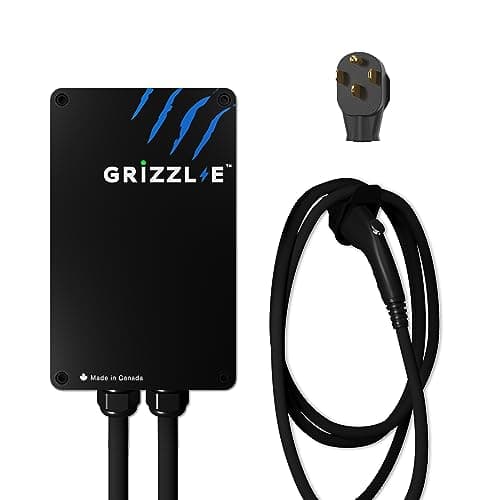
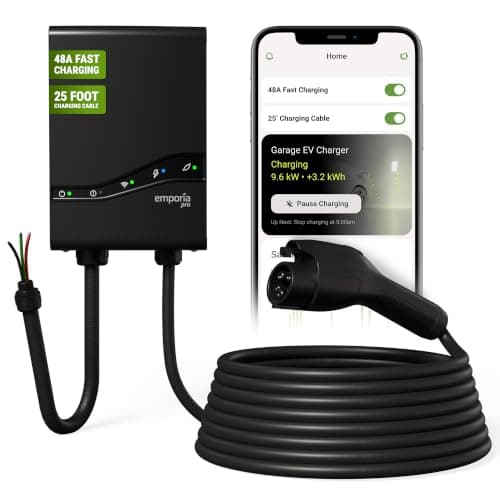
Buy the Grizzl-E Classic for an outdoor post in a cold climate, or if you want a charger with no cloud dependency: NEMA 4 cast aluminum, IP67, physical amperage switches, 24 ft cable, 40 A. Buy the Emporia Pro if your panel is tight or you need 48 A: full 11.5 kW, a 25 ft cable, and load management that measures whole-home draw through an included energy monitor.
| Grizzl-E Classic | Emporia Pro | |
|---|---|---|
| Max output | 40 A / 9.6 kW | 48 A / 11.5 kW hardwired |
| Cable | 24 ft, 8 AWG | 25 ft |
| Enclosure | NEMA 4 cast aluminum, IP67, fire resistant | NEMA 4 |
| Amperage adjustment | Physical switches: 16/24/32/40 A | App |
| App / scheduling | None | Yes |
| Load management | None | Yes, with the Vue monitor included |
| Energy monitoring | None | Whole-home and per-circuit |
| Certification | UL certified, ENERGY STAR | UL certified, ENERGY STAR |
| Warranty | 3 years | 3 years |
| Cloud dependency | None | For app features |
| Price | Lower | Higher |
Two different philosophies, and both defensible
The Grizzl-E's argument is permanence. A cast-aluminum NEMA 4 body and a physical switch mean the charger will be doing exactly what it does now in fifteen years, regardless of what happens to any company's app, servers or account system. On a device bolted to a house for a decade, that is not nostalgia — it is a design position.
The Emporia's argument is information. A charger that knows what the rest of your house is drawing can do something no amount of metal can: run at full output when the house is quiet and back off when it is not, which is what turns a marginal load calculation into a workable install.
Which problem do you have?
| Your situation | Buy | Why |
|---|---|---|
| Outdoor post, cold climate | Grizzl-E Classic | Cast aluminum, IP67, and a setting that cannot be lost |
| Tight panel, marginal load calculation | Emporia Pro | Measured throttling; NEC 625.42 permits limiting the rating through controls |
| A 48 A car and the circuit for it | Emporia Pro | The Grizzl-E is 40 A |
| Flat tariff, car schedules its own charging | Grizzl-E Classic | The app is duplicate functionality |
| Time-of-use tariff, two drivers | Emporia Pro | The charger enforces the window regardless of which car plugs in |
| You distrust cloud dependencies | Grizzl-E Classic | Physical switch, no account, no server |
| You want to know what your house draws | Emporia Pro | The monitor is useful well beyond charging |
| Budget is the constraint | Grizzl-E Classic | Lower price, and the metal body is a genuine bonus at it |
40 amps against 48, on real vehicles
| Vehicle (EPA trim) | kWh / 100 mi | Grizzl-E (40 A) | Emporia (48 A) | Difference |
|---|---|---|---|---|
| Hyundai Ioniq 6 RWD 18in (2025) | 26.0 | 3h 00m | 2h 31m | 29 min |
| Tesla Model Y Long Range AWD (2026) | 27.5 | 3h 11m | 2h 39m | 32 min |
| Rivian R1T Dual Large (2026) | 44.4 | 5h 08m | 4h 17m | 51 min |
| GMC Hummer EV Pickup 3X (2025) | 65.1 | 7h 32m | 6h 17m | 1h 15m |
On an efficient car the difference is half an hour at 2am. On a truck it is over an hour, and it compounds on a high-mileage day. Which is the honest version of “do I need 48 amps”: it depends on the vehicle, not on the principle.
The outdoor case for the Grizzl-E
Both chargers are rated NEMA 4 for outdoor use, so this is not about whether they survive rain. It is about everything else an outdoor post does to equipment: UV, physical knocks, ice, and the handle ending up on wet ground.
Cast aluminum with an IP67 rating — dust-tight and protected against temporary immersion — is a materially tougher package than a molded NEMA 4 enclosure, and the physical switch means the amperage setting cannot be lost to a firmware update or a dead account. For a driveway post, that combination is worth more than an app. Our outdoor hub covers the rest of what an outdoor install needs.
The panel case for the Emporia
If a load calculation has come back marginal, the Grizzl-E cannot help you and the Emporia can. Its PowerSmart load management ships with the Vue energy monitor, so it throttles against measured whole-home draw rather than an assumed figure — and NEC 625.42 explicitly permits an EVSE installation's overall rating to be limited through controls.
That is frequently the difference between a charger install and a service upgrade quote, which makes it worth far more than the price gap between these two units. Can my panel handle an EV charger.