The short answer
Start with the car, not the charger. The most common cause of slow home charging is that the car's onboard charger is the limit — many EVs accept only 7.7 or 9.6 kW no matter what you installed. Next most common: the charger is set below its rating (dip switches or an app setting left at 16 or 24 A), then a cold battery, then taper above about 80%, then voltage drop on a long undersized run. Check them in that order and you will find it without buying anything.
First, measure what you are actually getting
Before diagnosing, get a number. Your car's screen or app reports charging power in kW or the rate in miles per hour; the charger's app, if it has one, reports amps and volts. Then compare with what the circuit should deliver.
240 V x 16 A = 3.8 kW; x 24 A = 5.8 kW; x 32 A = 7.7 kW; x 40 A = 9.6 kW; x 48 A = 11.5 kW
match your reading to the nearest line
Delivered power runs a few percent under these figures because of conversion losses and the car's own overhead. If your reading matches a lower line than you expect, the cause is a setting or a limit, not a fault.
The eight causes, in diagnostic order
1. Your car's onboard charger is the ceiling
This explains most cases. A Model 3 RWD accepts about 7.7 kW; a Jeep Wrangler 4xe is 32 A / 7.7 kW; several PHEVs stop near 3.6 kW. A 48 A charger cannot push past any of them. Look yours up on EV onboard charger limits by model or your own vehicle page — if your reading matches the car's published limit, nothing is wrong.
2. The charger is configured below its rating
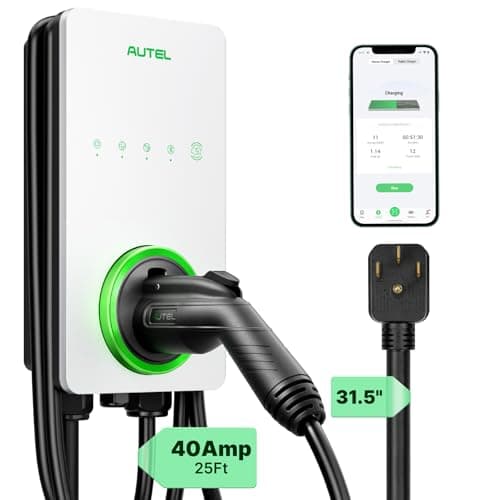
Almost every Level 2 unit can be set lower than its maximum, and plenty are installed that way — sometimes correctly, to suit the circuit, sometimes because nobody changed the default. The EVIQO 48 A, for example, ships set to 40 A and needs its internal switch changed. The Grizzl-E Classic has physical switches for 16, 24, 32 and 40 A. Ask your electrician what the unit was set to, or check the app.
3. The circuit is smaller than the charger
A 40 A charger on a 30 A circuit has to be commissioned at 24 A, and that is correct behavior rather than a fault. Breaker and output pair under NEC 625.41 at 125% — see the breaker size chart.
4. The battery is cold
A pack below freezing accepts well under its rated AC maximum until it warms, and part of the energy goes to heating the pack rather than filling it. The charge starts slow and speeds up — the car's doing, not the charger's. Cold weather EV charging at home has the detail, and preconditioning while still plugged in is the usual fix.
5. The battery is nearly full
Charge rate tapers as the pack fills, usually noticeably above 80%. If you only ever watch the last part of a session, you are watching the slowest part of it.
6. Load management is throttling the charger
If the unit has measured load management, it is supposed to back off when the house draw rises — an electric oven and a dryer running together can take a 48 A charger down to a trickle for an hour. That is the feature working. EV charger load management explained covers how to see it happening.
7. Voltage drop on a long run
A long conductor run sized at the minimum can sag under a continuous 40 A load, and lower voltage means lower power at the same current. This is the one genuine installation fault on the list, and it is a reason to size conductors generously on runs over about 50 ft — EV charger wire size guide and cable gauge explained.
8. You are on Level 1 without realizing
A 120 V cordset is about 1.9 kW by the US DOE's own assumption — roughly 3-5 miles of range an hour. If the car was plugged into a household outlet with the travel cable, everything above is irrelevant. Level 1 vs Level 2 is the comparison.
If the answer is "everything is working, it is just slow"
Then the fix is hardware, and it is worth knowing exactly which part to change. If the car is the limit, nothing helps. If the charger or circuit is the limit and your car accepts more, upgrading output is real: 32 A to 48 A is 7.7 kW to 11.5 kW, about a 50% improvement in rate.
The two upgrades that actually change the number
A monitor first, if you want to know what the panel is doing before spending anything; then a 48 A charger, but only if your car can use 11.5 kW and the load calculation allows a 60 A breaker.
Knowing what your panel is actually doing
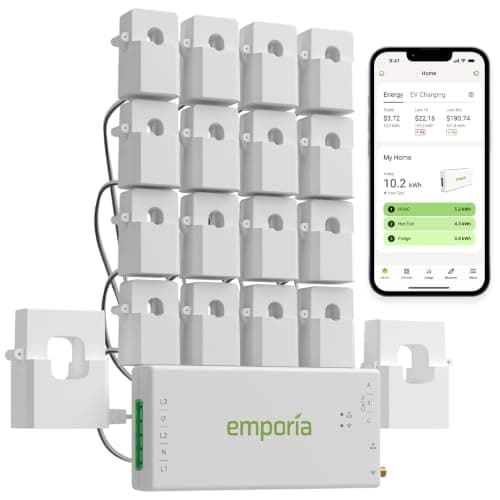
Emporia Vue 3 Home Energy Monitor
The cheapest way to replace a load calculation's assumptions with measurements. If your panel is marginal, a month of real data from this tells you whether a 48 A charger fits better than any rule of thumb will.
#ad Price as of October 28, 2026. How we make money
Most households, and anyone with a tight panel
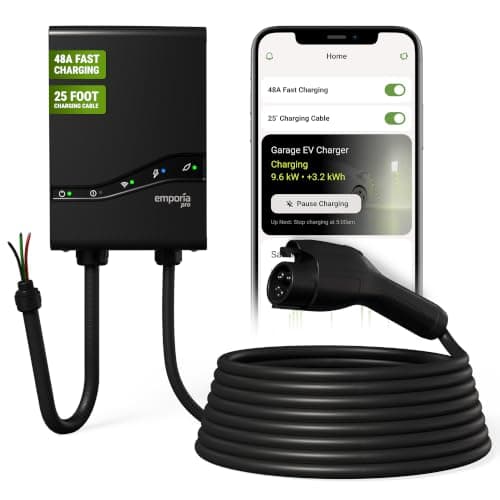
Emporia Pro Level 2 EV Charger
The best-balanced 48 A charger for a typical US house: full 11.5 kW hardwired, and the only unit at this price that ships with a whole-home energy monitor so its load management is reading your actual panel rather than guessing.
#ad Price as of October 28, 2026. How we make money
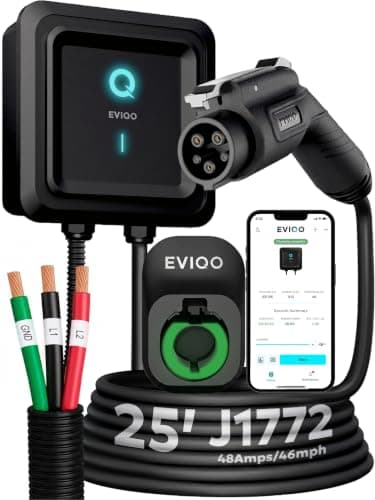
48 A on a budget
EVIQO Level 2 EV Charger (48 A, hardwired)
The cheapest way to get a genuine 11.5 kW hardwired install, with IP66/NEMA 4 weatherproofing and an internal switch for 16/32/40/48 A. The trade is a younger brand with a shorter support record.
We earn commission on qualifying purchases at no cost to you. Affiliate disclosure.
The Emporia Vue 3 measures whole-home and per-circuit draw, which turns this whole page into a measurement rather than a guess. The Emporia Pro is 48 A with load management included, and the EVIQO 48 A is the cheapest genuine 11.5 kW unit — remembering that it ships configured at 40 A. Check the load calculation before committing to 60 A, and read 40 A vs 48 A for whether the upgrade is worth it in your case.
A realistic expectation to work from
| Rate | Power | Energy in 8 hours |
|---|---|---|
| Level 1 cordset | About 1.9 kW | About 15 kWh |
| 16 A Level 2 | 3.8 kW | About 30 kWh |
| 32 A Level 2 | 7.7 kW | About 61 kWh |
| 40 A Level 2 | 9.6 kW | About 76 kWh |
| 48 A Level 2 | 11.5 kW | About 92 kWh |
That last line is the point of the whole page: a charge that feels slow is often still finishing hours before you leave. How long does it take to charge an EV at home does the arithmetic for your own mileage.