The short answer
Choose a home EV charger in this order: what your car accepts (many cars cap at 7.7 or 9.6 kW, which makes a 48 A charger pointless), what your panel allows (a load calculation, not the panel label), hardwired or plug-in, how long the cable has to be, and only then features. Most US households are correctly served by a 40 A unit on a 50 A circuit — and the single most common mistake is buying amps the car cannot use while the cable turns out three feet too short.
Question 1: what will your car actually accept?
This is the ceiling, and nothing you buy raises it. A Level 2 charger does not charge the car — it supplies AC to the charger built into the car, and that onboard unit has a fixed maximum. A Model 3 RWD tops out around 7.7 kW. Many PHEVs stop at 3.3 or 7.2 kW. Buying a 48 A charger for either is buying a feature you cannot switch on.
Our onboard charger limits by model page lists them, and each vehicle page states the exact figure with its source. Look yours up before you look at a single product.
Question 2: what will your panel allow?
EV charging is a continuous load under NEC Article 625, so the breaker must be rated at not less than 125% of the charger's output. That is the arithmetic every other decision sits on top of.
| Charger output | Power at 240 V | Breaker | Copper conductor |
|---|---|---|---|
| 48 A | 11.5 kW | 60 A 2-pole | 6 AWG |
| 40 A | 9.6 kW | 50 A 2-pole | 8 AWG |
| 32 A | 7.7 kW | 40 A 2-pole | 8 AWG |
| 24 A | 5.8 kW | 30 A 2-pole | 10 AWG |
Whether your service has room is a calculation, not a guess: EV charger load calculation walks it, can my electrical panel handle an EV charger is the short version, and best EV chargers for 100 A panels and for 200 A panels cover the two common services.
Question 3: hardwired or plug-in?
- Hardwired is required for 48 A — no residential receptacle is rated for it continuously. It is also tidier outdoors and avoids the GFCI receptacle requirement.
- Plug-in on a NEMA 14-50 costs less if the outlet exists, and the unit comes with you when you move. NEC 625.54 requires GFCI protection on any receptacle installed for EV charging, which usually means a two-pole GFCI breaker.
- If the outlet already exists, have it checked before you load it nightly. An outlet installed for a welder is not the same as a circuit sized for hours of continuous draw.
Hardwired vs plug-in has the full comparison, including resale and permit angles.
Question 4: how far does the cable have to reach?
Measure from the mounting point to the charge port along the route the cable will really take, then add three to five feet of slack. Published leads run from 18 ft to 25 ft, and that spread decides more installations than amperage does. Best EV chargers with a long cable ranks the 25 ft units; cable length and mounting height cover the measuring.
Question 5: do you need the app?
Usually not for scheduling — the car does that. The two features worth paying for are measured load management, which lets a charger coexist with a tight panel, and energy reporting if a utility program requires it. Otherwise a simple unit has fewer things to fail: see best EV chargers without an app and, for the other side, best smart Wi-Fi EV chargers.
Four chargers that answer the five questions well
One for each common answer: a 48 A unit with load management, a two-car household unit that speaks both plugs, a tough no-app unit for outdoors, and the cheapest thing worth owning.
Most households, and anyone with a tight panel
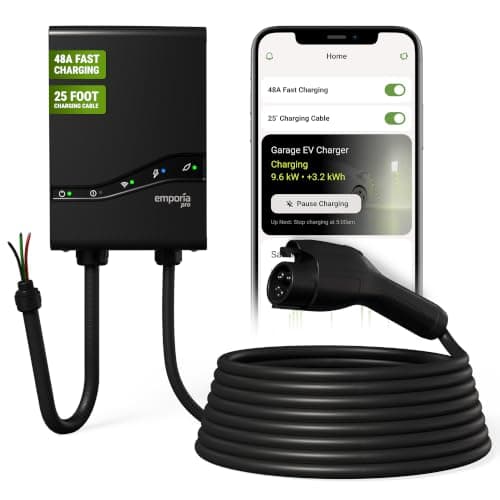
Emporia Pro Level 2 EV Charger
The best-balanced 48 A charger for a typical US house: full 11.5 kW hardwired, and the only unit at this price that ships with a whole-home energy monitor so its load management is reading your actual panel rather than guessing.
#ad Price as of October 28, 2026. How we make money
A two-car household running one Tesla and one J1772 EV
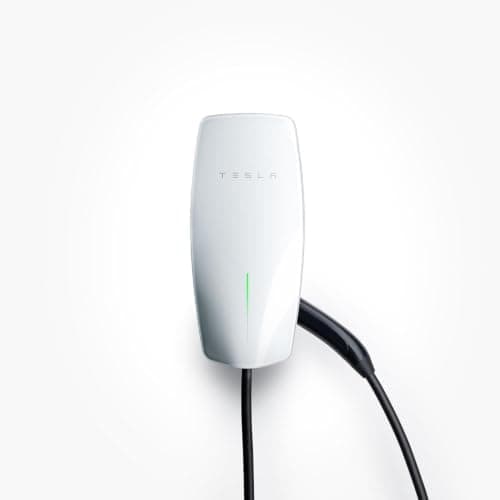
Tesla Universal Wall Connector
The only mainstream charger that handles both connectors without a loose adapter: a NACS handle with the J1772 adapter docked in the unit, which is the right answer for a mixed-fleet driveway and overkill for anything else.
#ad Price as of October 28, 2026. How we make money
An outdoor install, and anyone who distrusts apps
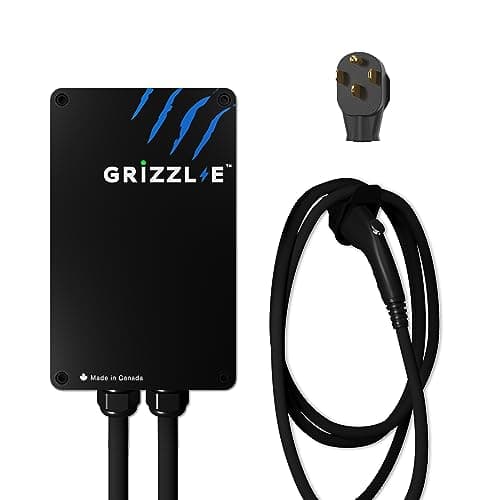
Grizzl-E Classic
A cast-aluminum 40 A charger with dip switches instead of a cloud account. Nothing about it is clever, which is exactly why it is the unit to buy for a driveway post in a cold climate.
The cheapest charger worth owning
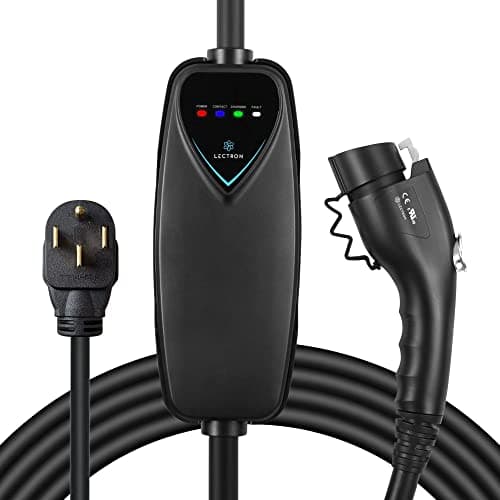
Lectron Level 2 EV Charger (40 A, NEMA 14-50)
A 40 A ETL-certified portable charger for roughly half what the smart units cost. It does one thing, it does it at 9.6 kW, and for a household charging overnight on a flat rate that is the whole job.
#ad Price as of October 28, 2026. How we make money
We earn commission on qualifying purchases at no cost to you. Affiliate disclosure.
The Emporia Pro is the default recommendation for a house that might be tight on capacity — 48 A, 25 ft cable, load management and a whole-home monitor included. The Tesla Universal Wall Connector is the answer when one Tesla and one J1772 car share a garage. The Grizzl-E Classic is the one to bolt outside, with switch-set amperage and a cast-aluminum NEMA 4 body. The Lectron 40 A cordset is the honest budget answer: 9.6 kW, ETL certified, no features at all.
The order matters more than the shortlist
- Look up your car's AC limit. It sets the maximum useful output.
- Get the load calculation. It sets the maximum permitted output.
- Take the lower of the two. That is your charger's amperage, and it is often 32 or 40 A.
- Decide hardwired or plug-in, then measure the cable run.
- Only now compare brands, enclosures, warranties and apps.
Our full Level 2 roundup is the shortlist once you know the answers, and is a Level 2 charger worth it is worth reading first if you are still deciding whether to install anything at all.