The short answer
On a 200 A service, most homes can run a 48 A charger on a 60 A breaker — and the Emporia Pro is the one to buy, because its measured load management means the charger backs off instead of tripping if the calculation was optimistic. For a Tesla-only household the Tesla Wall Connector is the same 48 A over NACS. What decides this is not the number on the panel but a NEC load calculation of everything already connected, and that calculation is cheap to have done before you buy.
Quick picks
Ranked by fit for the stated use case first, then price, then warranty and support. Tap any row to jump to the full assessment. Commission rate plays no part in the order.
| # | Product | Best for | Score | Price |
|---|---|---|---|---|
| 1 | 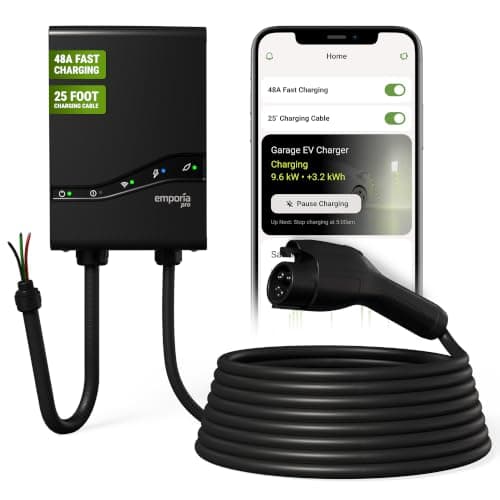 Emporia Pro Level 2 EV ChargerThe best-balanced 48 A charger for a typical US house: full 11.5 kW hardwired, and the only unit at this price that ships with a whole-home energy monitor so its load management is reading your actual panel rather than guessing. | Most households, and anyone with a tight panel | 9.0 | |
| 2 | 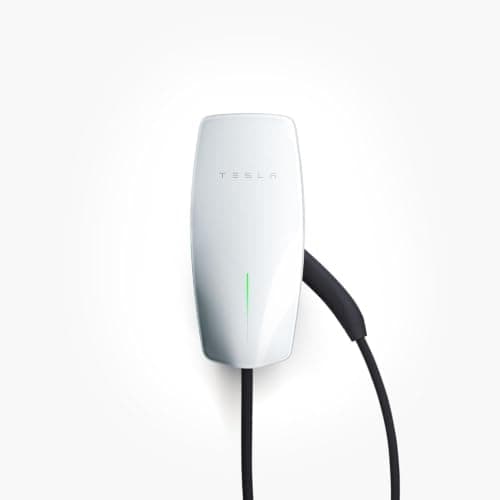 Tesla Wall Connector (Gen 3)If every car in the driveway is a Tesla, this is the cleanest answer: 48 A, a 24 ft cable, and a handle that opens the charge port for you — but it is NACS-only, so a J1772 car needs an adapter every single time. | A Tesla-only household | 8.8 | |
| 3 | 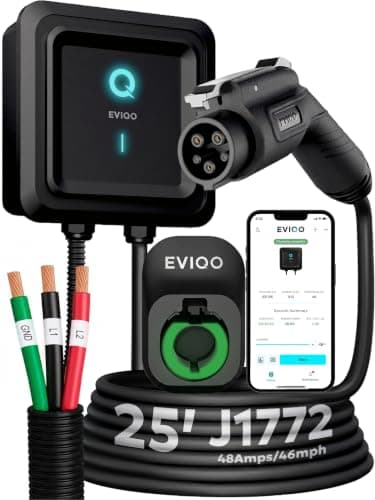 EVIQO Level 2 EV Charger (48 A, hardwired)The cheapest way to get a genuine 11.5 kW hardwired install, with IP66/NEMA 4 weatherproofing and an internal switch for 16/32/40/48 A. | 48 A on a budget | 8.4 | $449.98View on Amazon $510.00 list · 12% off |
| 4 | 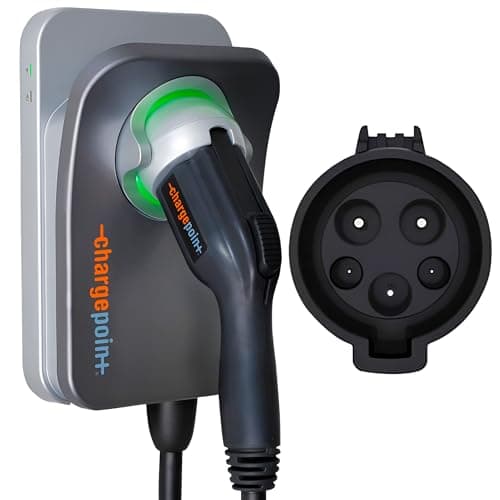 ChargePoint Home Flex (hardwired, 50 A)The most adjustable charger on this page: output steps through 16, 24, 32, 40, 48 and 50 A in the app, so one unit fits almost any panel and can be turned up later if you upgrade the service. | A house whose panel headroom is uncertain | 8.9 | |
| 5 | 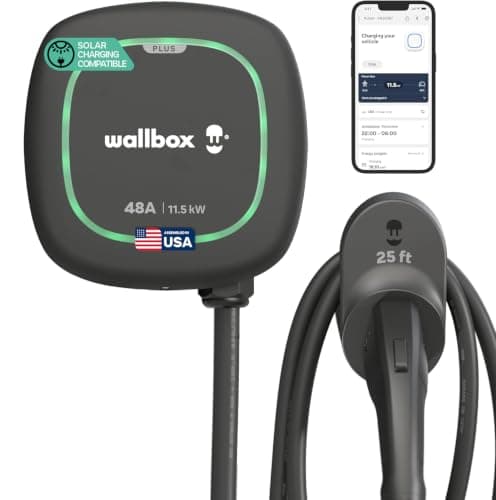 Wallbox Pulsar Plus 48 AA genuinely small 48 A charger — under 8 inches square — which is the deciding factor when the only spot left is a narrow strip of wall beside the panel. | The smallest 48 A unit on a wall | 8.5 | $699.00View on Amazon $799.99 list · 13% off |
What 200 amps does and does not tell you
A 200 A service is the common modern US residential size and it is roughly twice the 100 A service that forces every hard decision in home charging. It does not mean 200 A are available for a charger. It means the main breaker will open at 200 A, and the question is how much of that figure is already committed to heating, cooling, cooking, a dryer, a water heater and a hot tub.
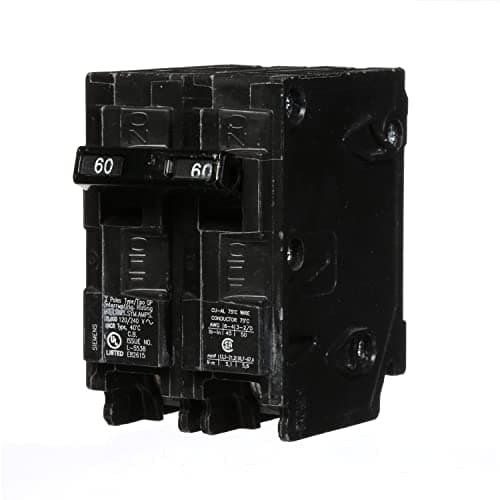
The arithmetic that matters is simple in shape: a 48 A charger is a continuous load, so NEC Article 625 makes you count it at 125% — 60 A of breaker for 48 A of charging.
48 A x 1.25 = 60 A; 60 / 200
30% of the service
NEC Article 625 classes EV charging as a continuous load and requires overcurrent protection at not less than 125% of it. Whether the remaining 140 A covers the rest of the house is what the load calculation answers.
Do the calculation before you choose the amperage
Our EV charger load calculation guide walks the standard method, and can my electrical panel handle an EV charger is the shorter version. Both exist because the honest answer to "will 200 A take a 48 A charger" is probably, and here is how to check, not yes.
| Charger output | Breaker | Copper conductor | Share of a 200 A service |
|---|---|---|---|
| 48 A / 11.5 kW | 60 A 2-pole | 6 AWG | 30% |
| 40 A / 9.6 kW | 50 A 2-pole | 8 AWG | 25% |
| 32 A / 7.7 kW | 40 A 2-pole | 8 AWG | 20% |
| 24 A / 5.8 kW | 30 A 2-pole | 10 AWG | 15% |
The picks
1. Emporia Pro — 48 A with a safety net
Most households, and anyone with a tight panel
Emporia Pro Level 2 EV Charger
48 A / 11.5 kW hardwired, 25 ft cable, NEMA 4, UL certified and ENERGY STAR, with PowerSmart load management and a whole-home monitor in the box.
#ad Price as of October 28, 2026. How we make money
The reason this leads a 200 A page rather than a 100 A one: on a 200 A service you probably do have room for 48 A, and the charger that measures total draw turns "probably" into "certainly". If the calculation was optimistic, the Pro throttles instead of opening the main breaker in the middle of a January night. The full review has the detail.
2. Tesla Wall Connector — the Tesla-only answer
A Tesla-only household
Tesla Wall Connector (Gen 3)
48 A / 11.5 kW over NACS, 12-48 A adjustable, 24 ft cable, hardwired on a 60 A two-pole breaker.
#ad Price as of October 28, 2026. How we make money
Same output, native plug, and power sharing across multiple units if you add a second car later. If a J1772 car might ever share the garage, the Universal Wall Connector is the version to buy instead — the head-to-head covers the difference.
3. EVIQO 48 A — the cheapest route to 11.5 kW
48 A on a budget
EVIQO Level 2 EV Charger (48 A, hardwired)
48 A on a 60 A breaker, IP66 / NEMA 4, 25 ft cable, ETL certified and ENERGY STAR listed.
No load management, so this one assumes the calculation came back clean. It ships configured for 40 A — the internal switch has to be set to 48 A at install.
4 and 5. The adjustable one and the small one
Two more that suit a 200 A house
The ChargePoint Home Flex is the pick if you want to commission at 40 A now and raise it later without changing hardware — 16, 24, 32, 40, 48 or 50 A, set in the app. The Wallbox Pulsar Plus is 48 A in the smallest enclosure here.
A house whose panel headroom is uncertain
ChargePoint Home Flex (hardwired, 50 A)
The most adjustable charger on this page: output steps through 16, 24, 32, 40, 48 and 50 A in the app, so one unit fits almost any panel and can be turned up later if you upgrade the service.
#ad Price as of October 28, 2026. How we make money
The smallest 48 A unit on a wall
Wallbox Pulsar Plus 48 A
A genuinely small 48 A charger — under 8 inches square — which is the deciding factor when the only spot left is a narrow strip of wall beside the panel.
We earn commission on qualifying purchases at no cost to you. Affiliate disclosure.
The Home Flex's breaker is sized to the output you choose, at 125% — so a 50 A breaker for 40 A, a 60 A breaker for 48 A. Its review explains why that adjustability is worth more than it looks on a house whose panel headroom is uncertain.
If the calculation comes back short
- Dial the charger down, not out. 32 A on a 40 A breaker is 7.7 kW — still an overnight charge for almost any commute. What amp EV charger do I need does the mileage arithmetic.
- Add load management rather than service. A measured-throttling charger is a few hundred dollars; a panel or service upgrade is thousands.
- Check breaker space separately. A full panel with no adjacent slots is a different problem from a full load calculation, and sometimes a subpanel is the cheaper fix — see does an EV charger need its own circuit.
How we picked
Every unit here is currently purchasable, carries a real UL or ETL certification to the relevant standard, and comes from a brand with an identifiable North American support path. We verified each one's published specifications against the manufacturer's own documentation on the date shown at the top of this page. We verify specifications; we do not bench-test hardware, and our methodology says so in plain terms. Ranking order is fit for the stated use case first, then price, then warranty and support — commission rate plays no part in it. The ranking here favors chargers that stay safe when the load calculation turns out to be optimistic, because that is the specific risk on a service that looks generous.